
After years of booming population growth, Utah’s growth is cooling down. But despite the slowing growth, it’s likely that the local real estate market will remain strong into the future, experts said.
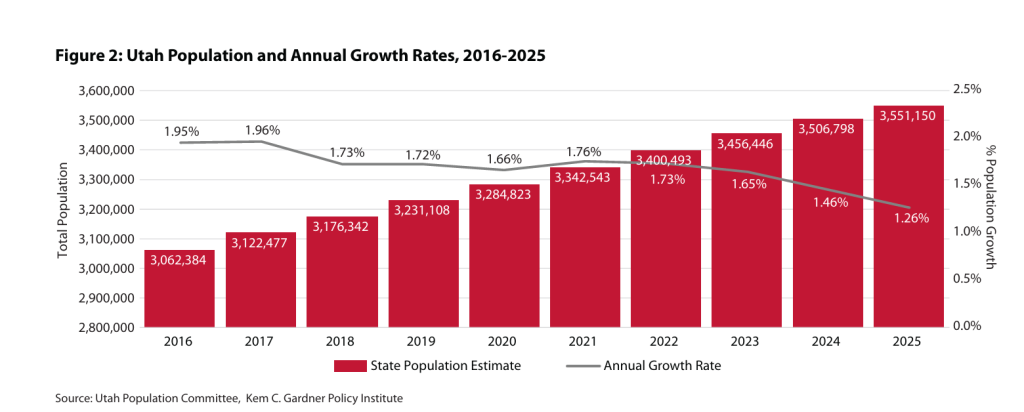
A recent report from the Kem C. Gardner Policy Institute at the University of Utah found that the Beehive State’s population growth slowed in 2025 to 1.3% compared to the 1.5% population growth in 2024. Utah’s population is now estimated to be 3,551,150 as of July 1.
The report found that natural change in population — in other words, the number of births minus the number of deaths — was the leading source of population growth in 2025, which hasn’t happened in Utah since 2021. For the past four years, Utah’s main driver of population growth was net in-migration, as people have been moving to Utah in droves since around the time of the COVID-19 pandemic.
Emily Harris, a senior demographer for the Gardner Institute, authored the report. She told Building Salt Lake it’s not a surprise that natural change is now the leading driver of growth in Utah, as that was the case prior to COVID. She said it also shouldn’t come as a surprise that Utah and Salt Lake counties saw the greatest overall population growth from 2024 to 2025. The counties added over 15,900 and 8,200 new residents respectively, according to the study.
 Harris said that despite the slowing population growth in recent years, areas like Utah County and Tooele County have continued to expand. The latter of the two was the fastest growing county in the state, and Harris said both grew in part because of the available space for new homes. Silicon Slopes and emerging jobs nearby have also spurred growth in Utah County, she said.
There could be a few reasons for net migration’s slowing rates in Utah as a whole, Harris said. Generally, she said, the economy is a big indicator for population growth in Utah and throughout the Intermountain West. Harris said that the housing market is also a contributing factor for Utah’s slowing growth rate, though she added that the state has continued to grow despite rising housing prices.
“Obviously the housing market is tight, interest rates are high,” she said. “People are not moving households because they have a lower rate, or it’s just not advantageous to move. I think that is a piece of it, but also, Utah experienced really high growth, even when the housing market was really tight.”
Despite Utah’s slowing population growth, its demand for housing likely won’t be letting up anytime soon. Dejan Eskic, a senior research fellow at the Kem C. Gardner Institute, told BSL that while the growth rate is slowing, the state will continue to see more people moving here.
“If we look at that population growth translating to housing demand, nothing’s really changed,” Eskic said of the slowing growth rate.
He pointed to the Gardner Institute’s long-term population growth projections, which estimates Utah could hit a population of 4 million by 2035, according to the institute’s latest figures. Judging from those numbers, Eskic said the state will still need about 280,000 housing units in that same stretch of time.
“It’s still, from my perspective, a pretty robust housing demand growth,” he told BSL.
That would be welcome news for Downtown Salt Lake City, which has seen rental vacancy rates rise with a rush of new supply amid the slower population growth.
Eskic added the state’s average household size is shrinking. He said for 2025, Salt Lake County’s average household size was 2.69, and it’s projected to drop to 2.47 by 2035. For Utah County, the 2025 average household size is 3.17, and by 2035 it’s projected to dip to 2.9.
“At its face value, that’s not that much, but when you think about it at a scale of Salt Lake County, that’s a significant shift moving towards smaller households,” Eskic said. “We could get away with building smaller units compared to what we’re building today, and not on apartments, but just overall housing stock.”
Salt Lake City currently has a number of recently built, vacant apartments. But despite landlords offering months of free rent and other concessions, Eskic believes Salt Lake City’s future holds more apartment buildings and infill projects, like townhomes and other types of missing middle housing.
He told BSL that the number of new permits for apartment buildings in Salt Lake City jumped 40% this year compared to 2024. He said that’s a signal that developers will likely continue to build once newer projects are absorbed into the market.
Eskic said the state’s continued growth and shrinking household sizes signal to him there’s more of a demand for smaller homes, not just in Salt Lake City, but throughout Utah.
Salt Lake City’s continued efforts to reform its zoning code has drawn developers toward building multifamily and missing-middle housing. However, other cities have focused on detached, single family homes and sometimes have openly shied away from other, more dense forms of housing.
Either way, Eskic said Utah is expected to keep growing, even if that rate may slow. Creating new, smaller housing throughout the state would be a path toward accommodating that growth and avoid falling further behind the state’s housing shortage.
“I think that comes down to local zoning,” Eskic said. “But from a developer’s perspective, they’re going to try and meet where demand is, and fight that battle at city hall. But on face value, (there’s) strong demand, with demand being for smaller households.”












0 Comments