
Utah Gov. Spencer Cox recently wondered if it was time for the state to usurp local authority over zoning, and a recent meeting over a low-density housing proposal in Riverton shows why.
The Riverton Planning Commission tabled a 15-unit, for-sale townhome proposal Thursday after roughly an hour of a meeting filled with residents who lined up to oppose the new for-sale housing.
Some commissioners openly worried whether the state government will soon prevent cities from blocking these sorts of new housing developments through restrictive zoning that exists along much of the Wasatch Front.
Located on the northeast corner of 13200 South and Redwood Road, the now-tabled proposal asks for a rezone of the land and a general plan amendment to create 15 for-sale townhomes on a 1.45-acre plot.
The land is currently zoned as RR-22, which requires each single-family home to sit on at least half an acre of land. It sits immediately next to a UTA bus stop to the west and a daycare to the east.
The rezone is asking for the land to shift to RM-14D, which would allow 14 homes per acre. The general plan amendment would seek to change the land to “high-density residential,” according to a memo from the city planning department.
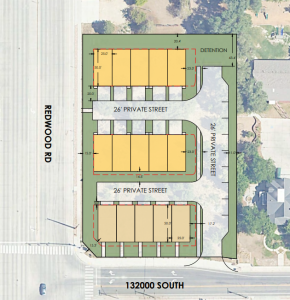
A layout of the proposed townhomes on the corner of 13200 South and Redwood Road in Riverton. Image via Taylor Moore
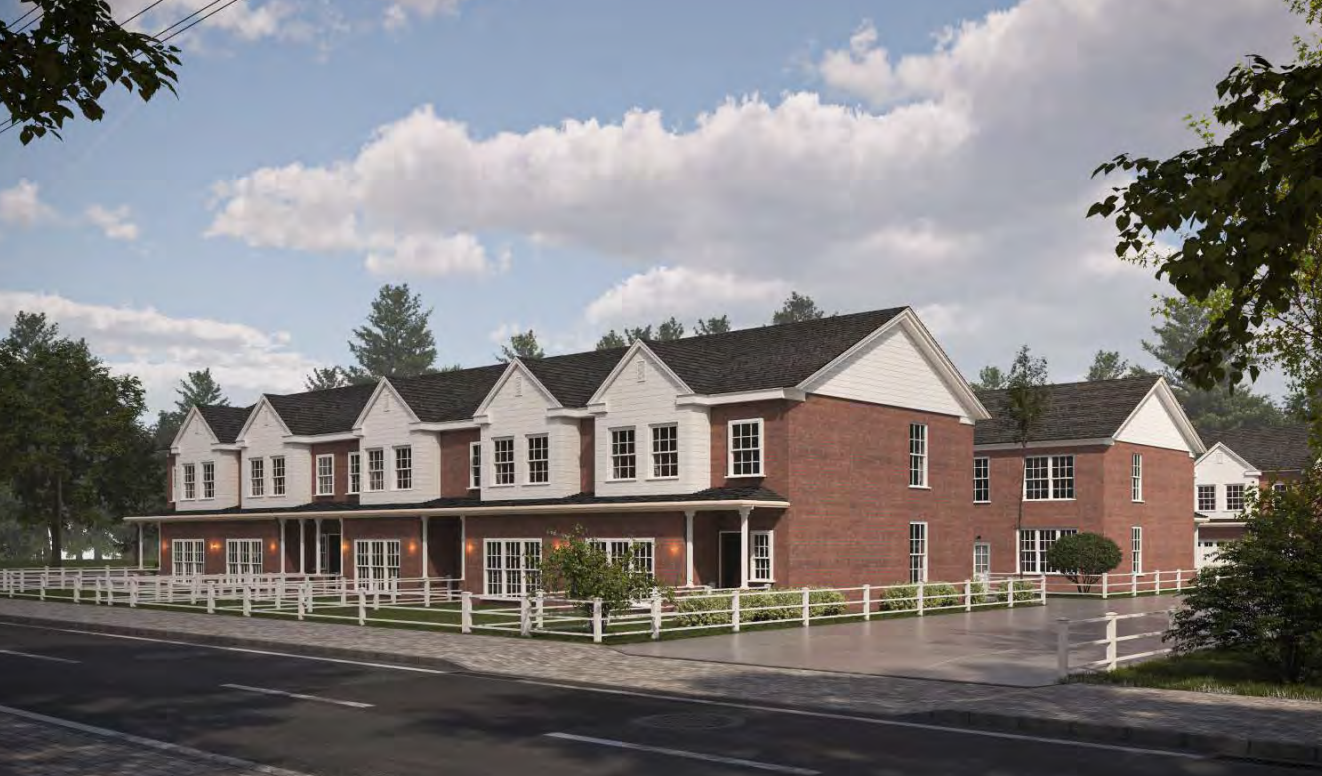
The city memo outlines how the project would turn a vacant lot into a slate of 15 townhomes, which is a much lower density than the maximum outlined in the requested zone. Plans indicate that each unit would have a two-car garage and an upscale exterior that would feature a large amount of brick, as well as picket fences. A development agreement would require “substantial conformance” to the renderings included in the city memo.
Tanner Webster, one of the developers behind the project, told Building Salt Lake he was disappointed the planning commission tabled the proposal, but he said the move does allow for him and others behind the project to talk with residents and address any concerns that may pop up.
“After the meeting we had some great conversations with the residents, and I think they understand where we’re coming from a bit better,” Webster told BSL. “Change is scary of course, (but) we’re trying to work with them as best as we can while delivering an attainable price point for first-time home buyers.”
The development’s entry/exit would be located on 13200 South instead of the six-lane Redwood Road. A bus stop for UTA Route 219 is located on the corner of the proposed slate of townhomes, and a Montessori school is next door to the east. A traffic study was also done as part of the proposal, and the study found that 13200 South would be able to accommodate the increased traffic from the development.
Numerous Riverton residents attended the Thursday meeting and spoke against the proposal. Many voiced their opposition to the idea of Riverton allowing new developments that were not single-family homes on half-acre plots, as well as increased traffic.
“Not every parcel is meant to be maximized for profit, that’s the nature of planning, and not a barrier to it,” one Riverton resident told the commission. “So I would respectfully urge the planning and zoning committee to prioritize those who raise families here and who will remain here long after developers move onto their next project.”
Following public comments, multiple commissioners acknowledged how sensitive such proposals can be for local residents, but warned that shouting down housing proposals can have unintended consequences.
Commissioner Gary Cannon, a real estate broker and developer with 40 years of experience, recalled a different proposal around four years ago where residents “came out with pitchforks and knives and torches” against a housing proposal, which was ultimately rejected by the city.
At that time, Cannon said he warned the public that the existing zoning allowed for industrial warehouse uses. The land was later developed into storage units, much to the chagrin of residents. Cannon added that the average age of first-time homebuyers keeps getting older, and proposals like this could help keep residents’ kids and grandkids in Riverton.
“This is by far the nicest product of townhome I’ve seen introduced in this generation and with this price point,” Cannon said. He said the city isn’t trying to force developments, but warned the Utah Legislature could be doing just that in the near future.
A governor’s warning
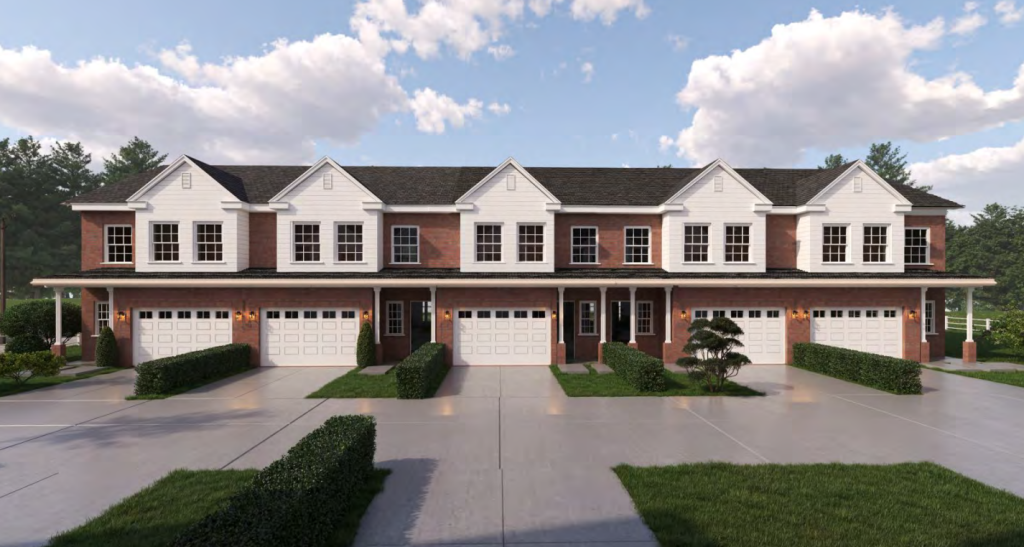
A rendering of the proposed townhomes on the corner of 13200 South and Redwood Road in Riverton. Image via Taylor Moore
Utah Gov. Spencer Cox has been vocal about his goal to create 35,000 starter homes by 2028, and he said last month the state is “a long ways away” from that goal.
He later told a scrum of reporters that state preemption of local zoning was an option he and the legislature have been considering.
“The question is preemption still on the table? And the answer is yes, it has to be,” Cox told reporters last month at the Ivory Prize Summit. “My hope is that without preemption, we’ll have enough cities that are willing to do this and understand how important it is.”
Cox said that in his home county of Sanpete, two city councils have approved controversial developments, “precisely because we’re having these discussions.”
“They decided that it was better to approve, not everything, but most of what was on the table, than end up getting preempted by the legislature,” Cox said. “I don’t want to go the preemption route, but I would be lying if I said it wasn’t on the table.”
Commissioner Darren Park described the Utah Legislature on Thursday as “hellbent” on taking away these sorts of decisions from the community, adding, “if we don’t choose to act in the very near future, I’m afraid that we will not be given the opportunity to do so.”
Park said the city has to make a decision, because if that choice is made by state lawmakers, no one is going to leave satisfied. He said the city and residents have to be realistic and make a timely decision, and if they don’t, “I think we run the real risk of something far worse, being shoved down our throats.”















Jacob, there are critical factual errors in this report regarding the “data” behind this proposal, and the narrative that residents are simply “afraid of change” ignores the legal reality.
1. There was no “Traffic Study.” You reported that “a traffic study was also done.” This is false. The developer submitted a brief memo citing generic reference manuals. No actual traffic counts were conducted at the intersection. Crucially, the developer’s own memo admitted the trip increase would exceed 5%, which specifically triggers the requirement for a full Traffic Impact Study (TIS) under Riverton City Code 18.215.080(A)—a study they failed to provide.
2. The proposal violates basic City Code. We aren’t asking the city to ban housing; we are asking them to follow their own written laws. The developer is requesting an RM-14-D zone.
– Location: This zone is explicitly restricted by city code to the “Downtown Area.” This lot is a mile away.
– Size: This zone requires a minimum of 2 acres. This lot is only 1.45 acres.
3. The “False Choice” Rhetoric. Commissioner Cannon’s warning about “storage units” is a false dichotomy. This land is zoned RR-22 (Residential), not Industrial. Storage units cannot be built there by right. The choice isn’t “approve this townhome complex or get something worse.” The choice is: “Follow the General Plan or reward speculation.”
It is disappointing to see Commissioners use the threat of “State Preemption” to justify approving a project that violates basic zoning standards. If the Governor wants cities to ignore their own General Plans to favor speculators, he should say so. Until then, Riverton should follow its own rules.
I want to make a correction to a point I made earlier regarding Commissioner Cannon’s warning that this land could become “storage units.”
I originally argued that the current RR-22 zoning prohibits storage units. That is true. But I wanted to be sure, so I looked up the specific regulations for the Commercial Gateway (C-G) and Regional Commercial (C-R) zones to see if the Commissioner had a point about future development.
I was wrong to imply this was just a zoning issue—it is actually much harder for a developer than that.
I found that under Riverton City Code (Table 18.90.010), storage units are listed as a “Conditional Use,” not a permitted right. This means that even if the City Council rezoned this land to commercial, a developer still could not build storage units by right. They would have to apply for—and the city would have to grant—a specific Conditional Use Permit (CUP).
So, for the “storage unit” threat to be real, the City would have to (1) Rezone the land AND (2) Grant a special permit.
The City holds 100% of the cards here. We don’t need to accept a bad townhome project to avoid a phantom storage unit project.