
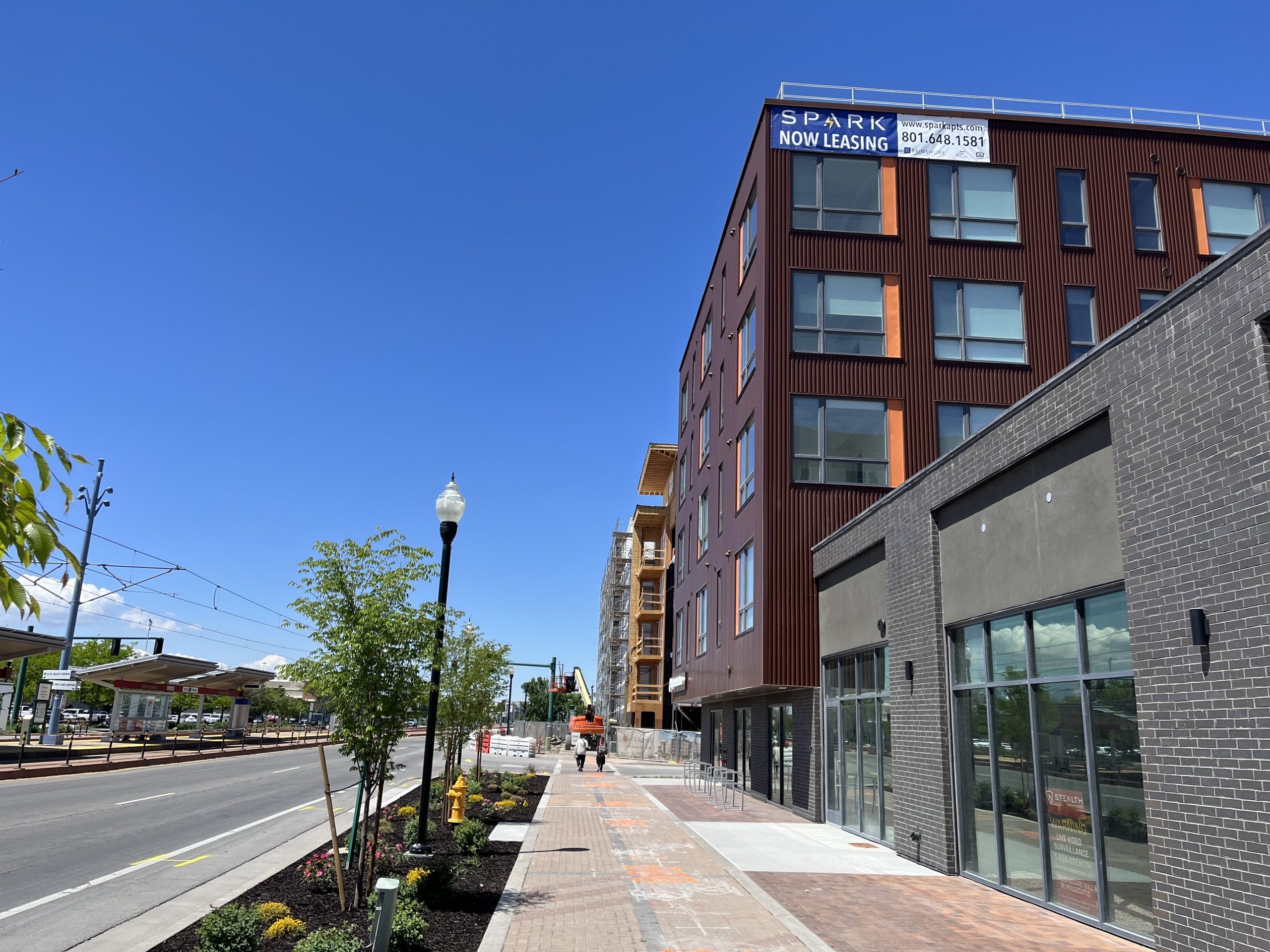
This is the second and final part of a series about the state of newly built low-income housing buildings after years of rapid building in and around Salt Lake City. To read part one, click here.
Affordable housing developers in Salt Lake City currently have an issue at hand: a large amount of recently delivered housing units are driving prices down to the point where market-rate units are now competing with affordable housing units.
That’s welcome news for renters, many of whom have seen increasing housing costs in recent years while Salt Lake City’s home prices also continue to grow. But in a state that desperately needs more housing, the glut of available units shows why concentrating units into a single city may not be the best approach.
For Bill Knowlton, an affordable housing developer and real estate attorney, this inventory of available units is concerning. He told Building Salt Lake that in the past, it only took a matter of days to lease up a new LIHTC building, but that’s no longer the case given the large amount of units that have been delivered in recent months.
However, Knowlton says there are a few reasons why all these projects are concentrated in the capital city, while projects in other cities in need of new affordable housing units aren’t getting those funds.
“You still have tremendous (affordable housing) demand outside of Downtown Salt Lake, even in Provo, even in Ogden, and not to mention outside of the Wasatch Front,” he said. “Think Moab, think Washington County, think Cedar City, think Vernal and places like that who still have a tremendous need for affordable housing. They just don’t have the infrastructure in place to where a LIHTC application will score high enough to win.”
In part one of this series, we examined the issue of excess LIHTC units that are sitting empty, and how rents in Salt Lake City are trending downward. In this part, we will examine why so many affordable units are largely concentrated within the capital city, and what the future could hold for LIHTC units during this market trend.

ZONING AND OTHER LIHTC FACTORS
If you ask Knowlton, one reason why LIHTC housing is concentrated in Salt Lake City is simply because the city has the most flexible zoning code around.
Salt Lake City has made a number of changes to its zoning code in recent years, including the recent consolidation of its mixed-use zoning code that featured upzoning in certain areas of the city including Sugar House and the Granary District. The city council is also considering a plan to change its RMF-35 and RMF-45 zones, which the city’s planning commission has already considered and approved.
The city also provided incentives that allow developers to add more density to projects if their buildings include low-income units, a change that compounds the pace at which subsidized units could be built.
Knowlton said Salt Lake City has a number of advantages that other cities don’t, like favorable parking ratios and allowable density. He praised Nick Norris, Salt Lake City’s planning director, for the city’s progressive zoning. But he added that other areas of Utah aren’t as lucky.
“There are cities in Utah County, for example, where it is illegal to build apartments,” Knowlton said. “It’s literally not in the zoning code, you can’t do it.”
He added that another big reason is how LIHTC properties are scored. Knowlton said the Utah Housing Corporation, which awards a large amount of affordable housing tax credits, is trying to adjust to market trends, but, “for the past eight years, the way that the tax credits have been allocated, it’s been weighted very heavily to projects in Downtown Salt Lake, near mass transit, right near the FrontRunner and TRAX.”
Knowlton said Salt Lake City’s concentration of housing can only help the state’s housing shortage so much, and he believes LIHTC developments need to be distributed throughout the entire state.
“In my humble opinion, the tax credit program needs to be spread more liberally throughout the entire state, and the scoring criteria needs to be modified so as to incentivize building in non-Downtown Salt Lake City projects,” he said.

LOOKING FORWARD
Both Knowlton and Peter Corroon, a longtime affordable housing developer, believe the market will likely straighten itself out by 2027. Corroon said he believes that new inventory will slow down significantly in the near future.
“2024, I think, was probably one of the biggest years for new construction projects,” Corroon said. “2025 will see the same, but slightly less, and then 2026 will see significant slowdown in new units coming online. So there will probably be equilibrium in 2027, but for now, the market’s way overbuilt, especially in the urban core.”
Corroon’s thoughts are in line with a recently published mid-year multifamily market report from Northmarq, which says new unit deliveries hit a peak in Q3 and Q4 of 2024. The report says, “because absorption is projected to outpace completions beginning in late-2025, vacancy is expected to contract toward the 93% stabilized benchmark before the next — much smaller — 2027 cohort arrives.”
Knowlton said he’s bullish on LIHTC units in Utah as a whole. But he’s less confident about the future of affordable housing developments in Salt Lake City.
He believes the question will soon become whether the revenue from decreased rental rates will be enough to pay off debt.
“That is where I think everyone is really nervous,” Knowlton said.
“Right now in downtown Salt Lake, you have developers that are currently paying debt service with their own money, meaning not with rental revenue, because there’s not enough rental revenue to pay it,” he said.
Knowlton also believes it won’t be until 2027 that Salt Lake’s market works through all of this apartment supply. Until then, rent prices are going to drop, he said, which he described as a double-edged sword.
“That’s good from the affordability standpoint, because rents going down means more affordable units,” he said. “But if you build your pro forma off of capturing a certain rent band of income, and you can’t meet that, and you cannot meet your debt service-coverage ratio with your bank, there’s going to be some blood.”












So who are we really rooting for here?! Seems like a very clear and obvious GREEDY, minded, and intentioned ENTITLED FOOLS, who are feeling some type of way, because it’s not going in THEIR favor! Huh. Surprise surprise surprise.
* Hope they don’t have claim or contribution to any HUMANITARIAN ORGANIZATIONS…….