

Around five years ago, Downtown Salt Lake City lacked a high-end, luxury apartment tower. Now, within just months of each other, three new luxury towers will open just blocks from each other.
The entire commercial real estate industry is now watching to see whether Salt Lake City has a market that’s willing to pay top dollar — over $11,000 for the penthouses — in not one but three new buildings now peppering the Downtown core.
Real estate professionals and investors around Utah are eager to see what kind of appetite Salt Lake City renters have for these types of high-end units, especially with events like the 2034 Winter Olympics on the horizon.
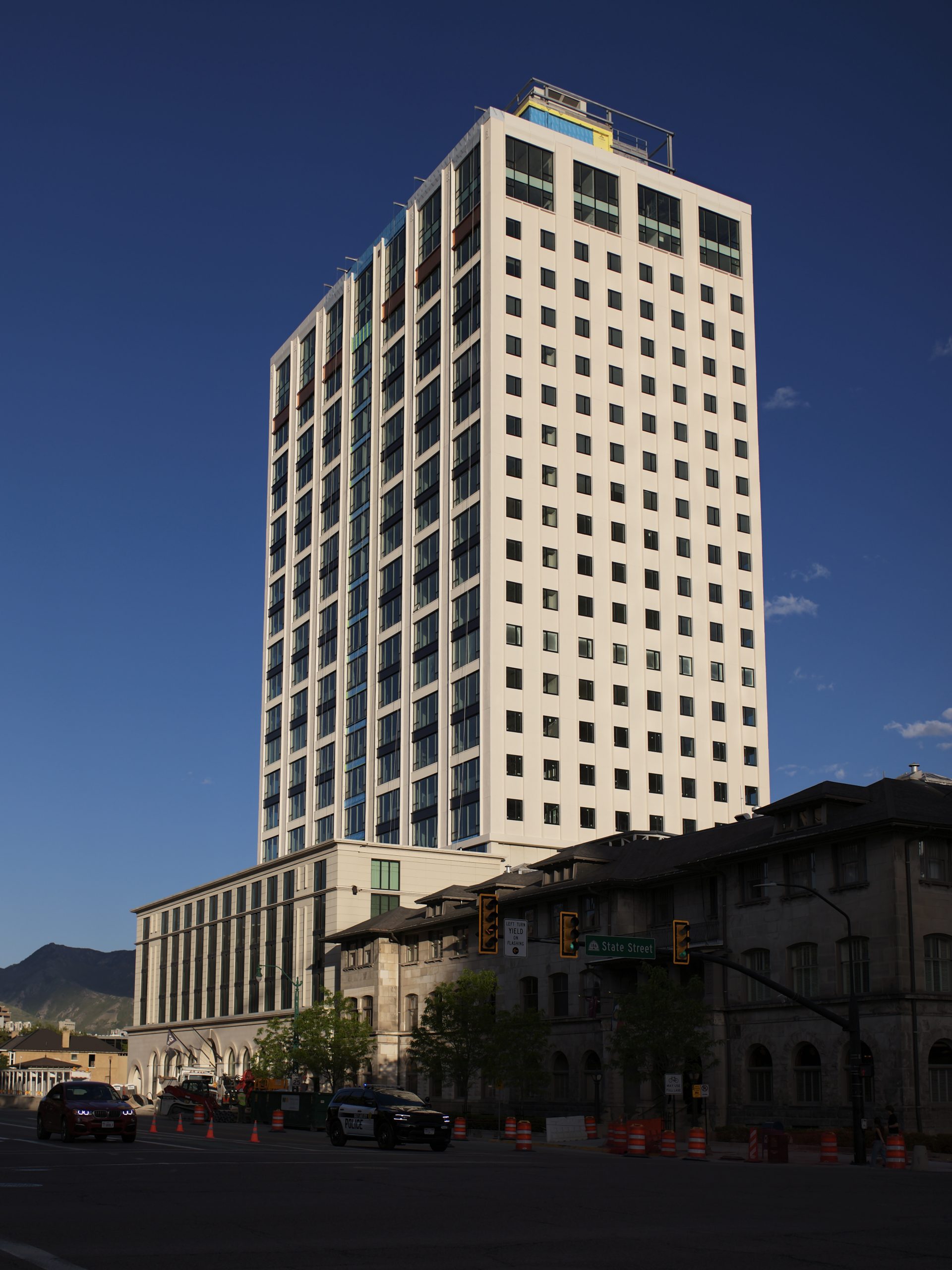
The latest addition is Seraph, a new, 25-story luxury rental tower located at 136 E. South Temple, which is slated to open in October, according to a spokesperson for Hines, the company developing the project. Seraph is the result of almost two years of construction, as the building that used to house 217,000 square feet of office space will soon become 217 apartment units.
Though units aren’t listed on the Seraph’s website, listings on Zillow show that units range from $1,758 per month for a 544 square foot studio and well into the five-figure amount for larger units.
Along with Worthington Tower and Astra Tower, Seraph is set to become the latest to test whether Utah’s capital city has enough high-income renters willing to spend over five figures for the highest end units.
“I think their biggest impact to the overall market is proving out that Salt Lake City has the incomes and the demand to support high rise luxury product in the market where rents need to be $3.75 to $4 a (square) foot to make sense of this,” said Michael King, senior director of investment sales at Cushman and Wakefield. “We had never seen that before. So big, pioneering kind of leaps and bets from those developers delivering that type of product.”
MARKET REACTIONS
King said before the three towers were built in Salt Lake City, the downtown luxury housing market was a lot of the same product. He said much of the available Downtown units had similar amenities, plus many buildings had comparable studios and one-bedroom apartments.
“It’s almost like walking into a lot of these apartment complexes, back before we had true high rise luxury (units), was almost like deja vu,” King told Building Salt Lake. “There just wasn’t any unique design, unique or differentiated unit types or product in the market.”
Mark Jensen, managing director of investment sales for Northmarq’s Salt Lake City office, agreed with that sentiment. He said for years there were few options for downtown apartments, and that’s only changed recently.
“I met my wife in 2004 and I was living at the Broadway Towers downtown, and back in 2004 and 2005, I mean, where do you live?” Jensen told BSL. “You could find an old apartment up by the University of Utah, maybe South Temple. The Brigham Apartments were around, but there weren’t really many large apartment complexes.”
Jensen said buildings like the Liberty Sky apartments changed the game in Salt Lake City. The timing on Liberty Sky couldn’t have been better, Jensen said, as it was quickly leased up amid little competition downtown. However, that project was quickly surpassed by buildings like Astra Tower and the Worthington.
“When they went up, it looked pioneering,” Jensen said. “And now you’ve got two towers that have come up, and Hines’ (project), so we’re entering uncharted territories.”
In recent years, King said the Salt Lake City market has “grown up,” and he said the increasing number of highrise luxury apartments reflects how much the market has expanded. He said the new luxury apartment towers are just one byproduct of Salt Lake City’s continuing growth.
King said developers are finally leveraging the city’s ever-present mountain views, and he believes the luxury towers are making a bigger impact on the city’s overall rental market.
Adding a third tower will certainly test the depth for demand in the luxury rental market, King said, though he added, “I don’t think any of the groups that deliver towers assumed that they were going to be competing with two others at the time of delivery.”
A rush of new market-rate apartments in the Downtown area has led to falling rents and high competition among property managers looking to fill units in new apartment buildings. The same is now true for the highest end buildings.
WORTHINGTON AND ASTRA’S PENTHOUSE OPTIONS
King said that while all three towers can be lumped together and all be considered luxury rental units, he said each building has a unique identity that renters should consider.
The Worthington, for example, has smaller units and isn’t as tall as the Astra Tower, he said. That allows Worthington to offer highrise living with excellent views at more affordable rents relative to Astra, he said. In total, Worthington has 359 units across 31 floors.
“The other thing they did differently is they provided balconies for almost all of their units, so you’ve got some private outdoor space,” King said of Worthington’s units.
Worthington’s website lists its studio units starting at $1,430, though its Zillow listings start at $1,675 for studios. In May, we reported the Worthington’s most expensive units are its penthouses located on floors 30 and 31. Those floors were fetching prices between around $8,000 for a two-bed, two-bath unit, and up to $10,995 for a southeast facing unit on the 31st floor with three bedrooms and three bathrooms and a total of 1,367 square feet.
Now, it seems those prices have softened. That same unit on the 31st floor with three bedrooms is currently listed on the Worthington site starting at $10,275 per month. It’s listed for the same price on Zillow.

Emails to Kairoi Residential, the building’s property manager, seeking comment were not returned.
For Astra Tower, now the tallest building in Utah and home to 377 housing units, King said developers opted for, “bigger units, larger interiors, and a lot more of the common areas, outdoor amenity space that’s shared, instead of doing the balconies.”
During a ribbon cutting event in May, Ed Lewis, CEO of Kensington Investment Company, which owns the Astra Tower, told BSL the cost of penthouses would be between $10,000 to $15,000 per month for the smaller units. He estimated the larger penthouse units, which would have three bedrooms, would go for, “probably $15,000 to $20,000 and higher.”
Astra’s penthouse collection outlines the units and prices available for its two-bedroom units, which start at $9,400 and tick up to $13,600 — and the latter comfortably puts the Astra at the top of the list for most expensive apartment units Downtown.
However, Astra’s website doesn’t include pricing for its larger penthouse units, nor does its website show the units as available in its site plan.
One type of penthouse unit is located on the south end of the building, with the unit type being found on the 39th and 40th floors. That type of unit includes two bedrooms and a den, plus three full bathrooms and a large deck. The total size of that unit type is 1,792 square feet.
The other type of penthouse unit is the largest offered by Astra by square footage. The site plan shows there’s one unit of this type on the 39th and 40th floors. The unit features three bedrooms, an office, 3 full bathrooms and a powder room. The units, which are both east-facing, are 1,948 and 1,941 square feet.
Though Astra Tower doesn’t list the prices for either type of penthouse unit, we’re able to take somewhat of an educated guess.
The two-bedroom units range in price and size, but the square footage for those units range between $9 and $10 per square foot. For example, the most expensive two-bedroom penthouse unit is listed on Astra’s website for $13,600 and is around 1,288 square feet — which makes the price a little over $10.50 a square foot.
Using that same figure, the larger, three-bedroom penthouses could fetch up to $20,000 per month in rent and beyond, which is in line with what Kensington CEO Ed Lewis said earlier this year.
When reached via email, two executives connected to the Astra Tower declined to comment on the tower’s penthouse prices and leasing activity.
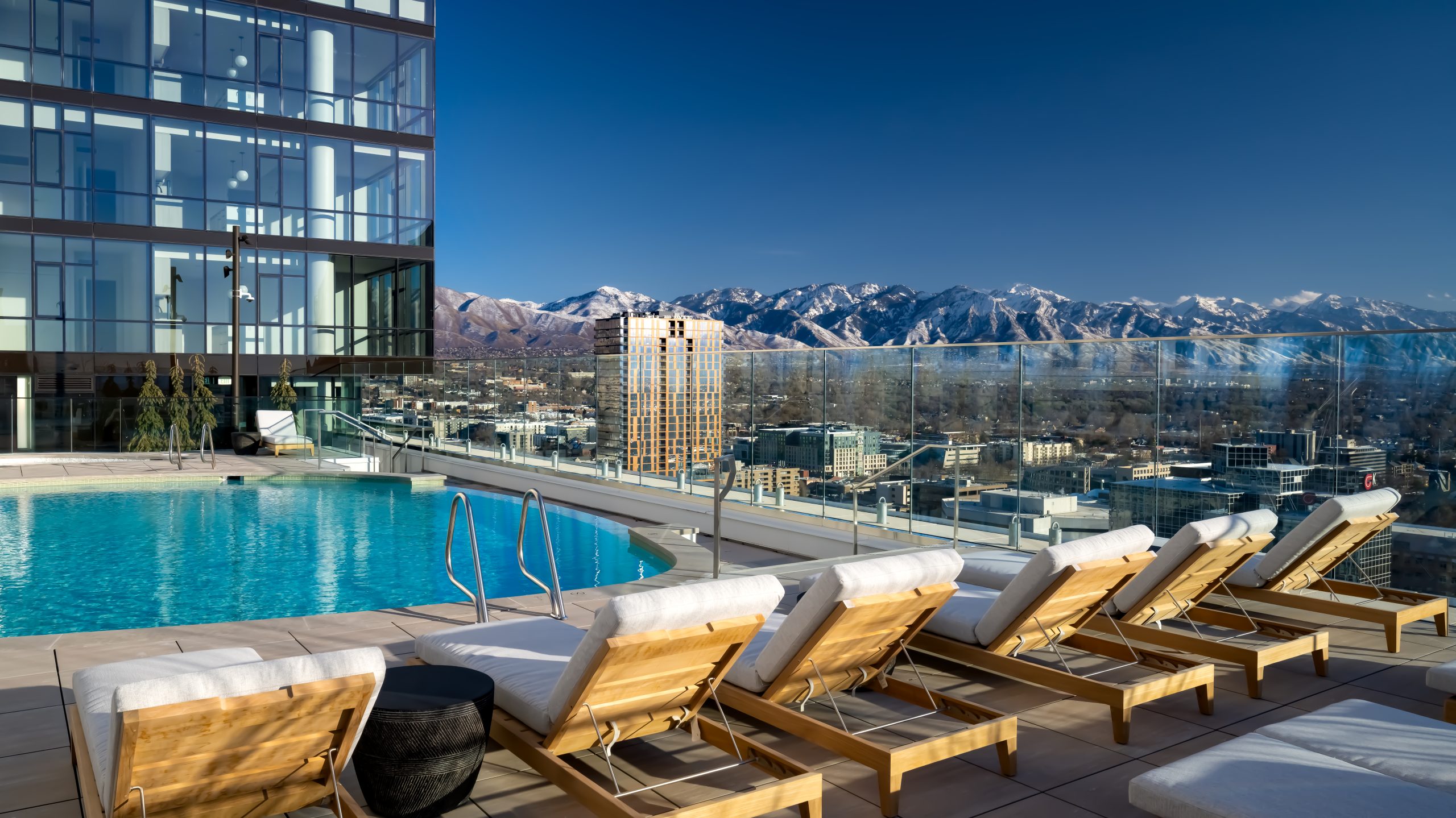
SERAPH’S PENTHOUSE OPTIONS
Jensen said he’s confident the Seraph will have a positive impact on the market, and the building’s location along South Temple gives it enough space from the other towers. Leasing activity could end up being slower than desired, but he’s bullish on the future of all three buildings.
“No one is hitting the leasing velocity that they would have desired, kind of based on where we are in the market,” Jensen said. “But I think Seraph will be extremely successful. The nice thing is, even though they look on paper like they’re relatively close, you really have three distinct neighborhoods.”
King said Seraph’s 25-floor height brings a different feel than the Worthington or Astra, and its location on South Temple is something the other towers can’t offer.
“Anyone local here knows South Temple is one of the most prestigious streets in the market,” King told BSL. “Although they are just a couple blocks away, it’s still a very different location, and I think a different renter demographic is drawn to that location than where Astra and Worthington are.”
He added that Seraph’s 217 unit count creates more of a private, cozy feel than the other towers, saying, “there is definitely an ingrained renter demographic in Salt Lake that doesn’t like to live with 350, 375 other people and fight for elevators and parking.”
“They want to live in a more boutique style apartment with less residents there, and maybe a more prestigious street or location relative to the heart of downtown,” King said.
King also noted the Seraph is a converted building, which he said makes the development all the more impressive. As a developer, he said you could argue it’s much more difficult to repurpose an existing building with the proper unit mix and design to fit with what the market demands.
“I give Hines, the developer there, a ton of credit in taking a historic, very well known and kind of iconic office building on South Temple, and keeping a lot of those, those key elements, and tying those in, and repositioning the asset to capture the demand of where the city is going,” King said.
FUTURE OUTLOOK FOR LUXURY TOWERS
Population projections continue to be bullish on Utah and Salt Lake City’s continued growth. The University of Utah’s Kem C. Gardner Policy Institute estimates Salt Lake County’s population could surpass 1.6 million people by 2060, meaning the market for luxury apartments could continue to have a solid, growing base.
Despite the continued population growth, King believes it may be a while before another luxury apartment tower could be built in downtown Salt Lake City. His best guess is it could be at least another five years before a fourth luxury apartment tower could be built, citing current inflation rates and high construction costs.
“We’re in a shaky economic environment as it relates to jobs and consumer sentiment and everyone feeling good about where incomes are and their individual situation,” King said.
He cited the quick succession of new towers as another factor that could cool development for the next few years, saying it will take some time for the market to fully absorb those new units.
“Because of the inflationary pressures on construction costs, because of equity appetite right now and the risk profile in the current environment, it’s going to be hard to get any new towers out of the ground, which I think is maybe a positive in the near term,” he said.
But as Salt Lake City prepares to host the world during the 2034 Winter Olympics, that sentiment could change, King said.
“As we get out of this near term supply glut — call it five to 10 years down the road and certainly into the Olympics — I think we are going to start to see more of that high rise product come out of the ground as we continue to prove out incomes, job growth, population growth, investment in the state, all of those things,” King said. “I do think we see a number of additional high rises, but I don’t think we see them in the next, call it four to five years.”
Jensen also says it could be a matter of years before another rental tower could be developed in Salt Lake City, but he believes another type of product could be on the horizon for downtown.
“I’ll tell you, the future is going to pivot to for-sale,” Jensen said. “That’s going to be the next round of opportunities you’ll see in Downtown living is your ability to go purchase. I think the state and developers are recognizing that there is a large need to get on the ownership ladder with sort of that sub $450,000 range, so $500,000 range, and really the best way to do that is through condos.”
Kensington Investment Company owns other parcels in the Downtown area, including the nearby Burt Bros car repair shop across from Worthington. But before it thinks about that parcel, all eyes are on Astra.









0 Comments