

Between plans going public for a tower in Sugar House and mid-rise in Central City, along with dirt moving at a key corner Downtown — some in Salt Lake City have wondered if the lull in new apartment construction and sleepy multifamily market is coming to an end.
Local experts say that’s not the case.
Though absorption of new units remains steady, the area still has a wealth of supply, and a handful of new projects on paper doesn’t translate to the multifamily market turning a corner, according to Patrick Bodnar, senior vice president of institutional properties at CBRE in Salt Lake City.
“We have a lot of supply, a lot of wood to chop, a lot of absorption to get through,” Bodnar said. “We are absorbing, it’s just taking its time. Absorption doesn’t happen overnight in our market right now, especially with the amount of supply we do have.”
According to CBRE’s 2026 multifamily market outlook report for the greater Salt Lake City area, the metro area is still one of the Intermountain West’s leaders in absorption rate, beating out areas like Phoenix, Denver and Seattle in 2025.
The same report found Salt Lake City is expected to see a decreasing pipeline of new supply based on a mix of high construction costs and high interest rates that should slow new projects.
A 2026 pipeline report from CBRE says around 9,000 multifamily units are projected to be delivered between 2026 and 2028 around the Wasatch Front — which is less than the units delivered in just 2025 alone (9,896). In 2024, the report says over 11,000 units were delivered, up from 9,020 the previous year.
The same pipeline report says that just two projects in the Salt Lake City downtown area — which includes places like the Granary District, Marmalade, and Downtown — are slated for delivery in 2026, which would total around 425 new units. Those projects are the Pickle and Hyde building and phase one of Silo Park.
Though it’s noteworthy that developers are submitting plans for new projects in Sugar House and Central City, those approvals wouldn’t automatically mean the next step is a shovel in the ground. Developments can gain approvals then sit untouched if the capital stack behind it is incomplete.
In other words, new plans made on paper won’t necessarily translate to new construction any time soon, according to Michael King, senior director of investment sales at Cushman & Wakefield in Salt Lake City.
“If you have your plans and you’re ready to go, that doesn’t necessarily mean you’re going to be able to,” King said. He told Building Salt Lake that equity markets are “really, really shallow for construction equity at the moment for multifamily.”
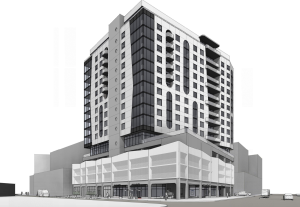
A street-level rendering of the GEM Sugar House tower project from its southeastern corner. Image via Engine 8 Architecture
King said there are exceptions, however, as neighborhoods like Sugar House can be more enticing to investors. The Residences at Sugar Alley were completed in April 2025 and leased up in less than a year, King said. With nominal concessions and rents at $3.25-$3.30 per square foot, Sugar Alley showed investors that you can build and support new construction in the neighborhood.
“Sugar House is a very different story overall than what Downtown is right now, and I think that’s an important distinction to make in the current market, that it’s very micro-market focused,” King said. “Just because we can get capital to bite on a deal in Sugar House doesn’t mean we can get capital to bite on a deal in Downtown right now, or Granary.”
King also noted that some recent movement on lingering projects can be misleading.
He said the recent work on the Domain Companies site at 370 S. West Temple is only for the hotel element of that project, not for the multifamily element of that project. Crews have also been seen moving dirt at the former Utah Theater site at 150 S. Main St., which is owned by Hines. King said that movement is to build a surface parking lot to service the nearby Kearns Building, which Hines also owns, until market forces would allow them to build their long-awaited high-rise.
For the projects being reviewed by Salt Lake City — like the mid-rise on Denver Street or the mixed-use tower on 100 South that’s currently seeking D-1 zoning before the city council — Bodnar said those developers are likely expecting to deliver units in the next two and a half to three years.

Rendering by Method Studio and Cumming Capital Management
“And then at that time, the market will have tightened up, most of the supply will be absorbed and rents will be on the move,” Bodnar told BSL. “That’s a consistent and common belief, and/or discussion topic, amongst most developers, and we have a lot of active developers looking to find sites right now to move on so that they can benefit from a strong, supply constrained market when they’re delivering units in 24-36 months.”
In the meantime, Salt Lake City renters can continue to see lower prices compared to other cities in the region. Bodnar said the Salt Lake City metro area’s average rent per square foot is around $1 less than that of Denver, and the current multifamily supply means those prices will likely stay put.
But regardless of price, Bodnar said Utah continues to be in a housing shortage, and the state is still slated for continued growth into the future.
“We need every unit that’s planned and slated to be built,” he told BSL. “We don’t particularly need them all at once, but we do have a need for housing in this market, and that’s why we had a big boom of it, no question.”













0 Comments