
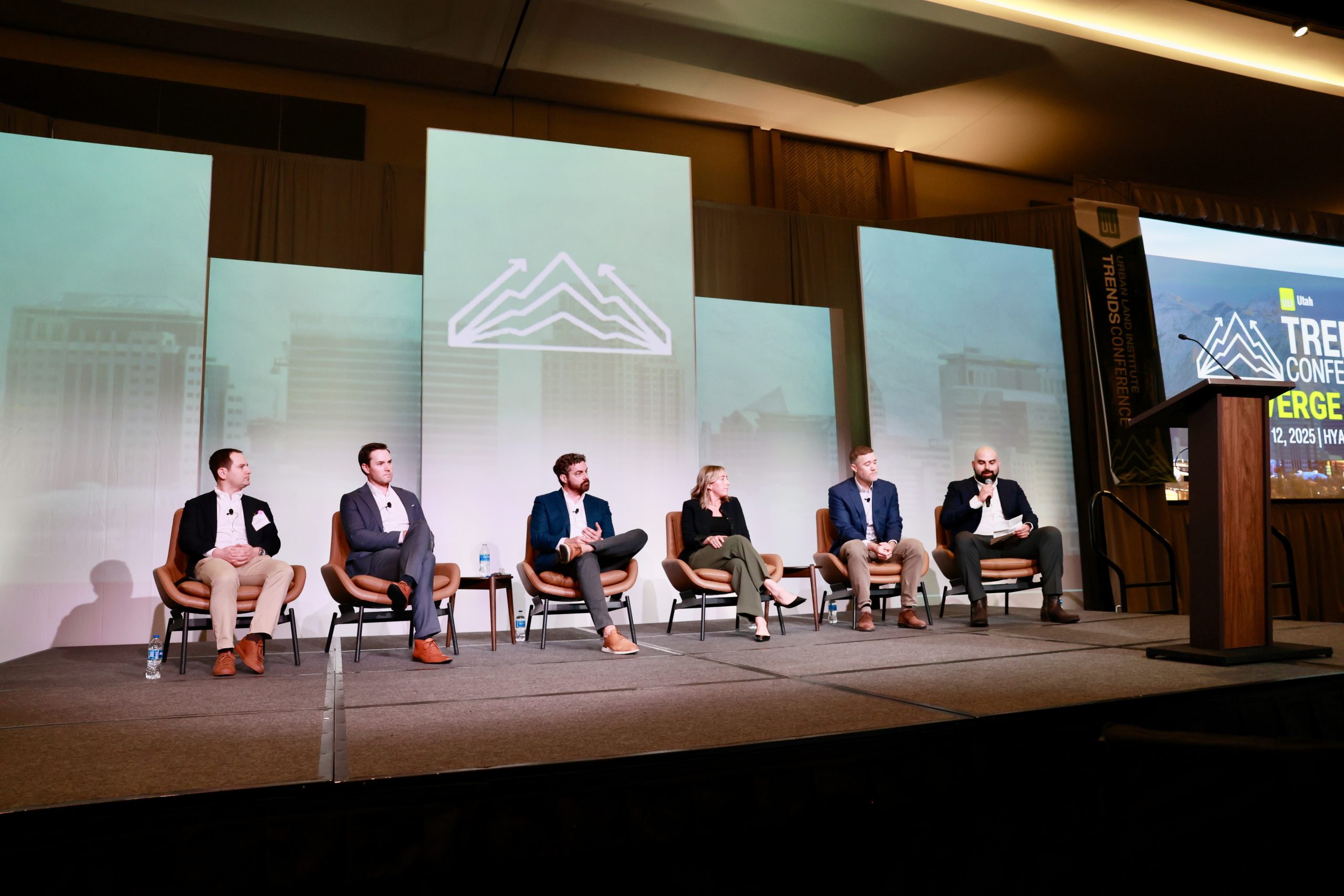
Panelists discussing capital markets during the Urban Land Institute Utah’s Annual Trends Conference. From left to right, Scott Glassberg, Phil Brierley, Keith Padien, Alexandra Schultz, Kyle Seminara, Jeff Grasso. Photo by Kelli Freshman Photography
The adage for real estate investors in recent years has been “stay alive until 2025” — though that saying needs some updating.
Utah’s private equity landscape continues to be a mixed bag, investment experts say, as the health of capital markets depends largely on the real estate sector. The industrial sector is seeing a strong market, while areas like multifamily could face significant headways for years to come.
That’s according to an expert panel Urban Land Institute Utah’s Annual Trends Conference on Wednesday in Downtown Salt Lake City. The panel consisted of market advisors from around the country, as well as in Utah.
Many of the experts agreed on one thing: the overall debt capital market continues to show signs of improvement.
A managing director for one real estate finance and investment management firm said transaction volume has grown compared to last year, and said investors’ available liquidity has been positive for the commercial real estate market.
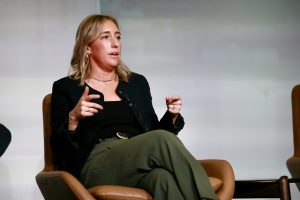
Alexandra Schultz speaks during a panel on capital markets during the Urban Land Institute Utah’s Annual Trends Conference. Photo by Kelli Freshman Photography
“The debt markets are completely on fire,” the director said during the ULI panel. “(Commercial Mortgage-Backed Securities), life insurance companies, banks, debt funds — there’s ample liquidity out there, and that, combined with the decreasing rate environment, I think it’s just spurring a lot of people to consider taking assets to market, to sell or to refi.”
The director said private equity might look to markets like San Francisco or Washington, D.C., where investors can earn a higher cap rate and the deal fundamentals are stronger. Investors aren’t jumping at the 4.6 cap deals they can typically find in Utah today, she added, when they could get over 5.5 in other major markets.
“Salt Lake, a 4.6 cap, I personally think it’s a little mispriced relative to where else we can put our money,” they said.
The director gave a nod to Mark Jensen, managing director of Northmarq, whose team led the recent $149 million sale of the Sugarmont apartments in Sugar House to the REIT Centerspace.
“But I think in order to get compelled to lean into ground-up, we really have to see a material amount of trades that make our development basis make sense,” they added. “Otherwise, I’m just going to buy 2021 or 2022 vintage product at a basis that’s below where I can build new product today.”
That means either commercial real estate prices might have to fall or rents have to climb for out-of-state investors to prioritize Salt Lake City over other markets. And earlier in the day another local expert generated perhaps the most buzz among those in the audience of hundreds of real estate professionals at the Hyatt Regency on Wednesday with a tough forecast for the next couple years.
Trouble for multifamily
In Utah, the multifamily market faces years of challenges and intense competition for tenants, according to a presentation earlier in the day from Michael King, senior director of investment sales for Cushman & Wakefield in Salt Lake City.
King said rents are continuing to fall, and concessions for new tenants are up to five times higher than previously seen.
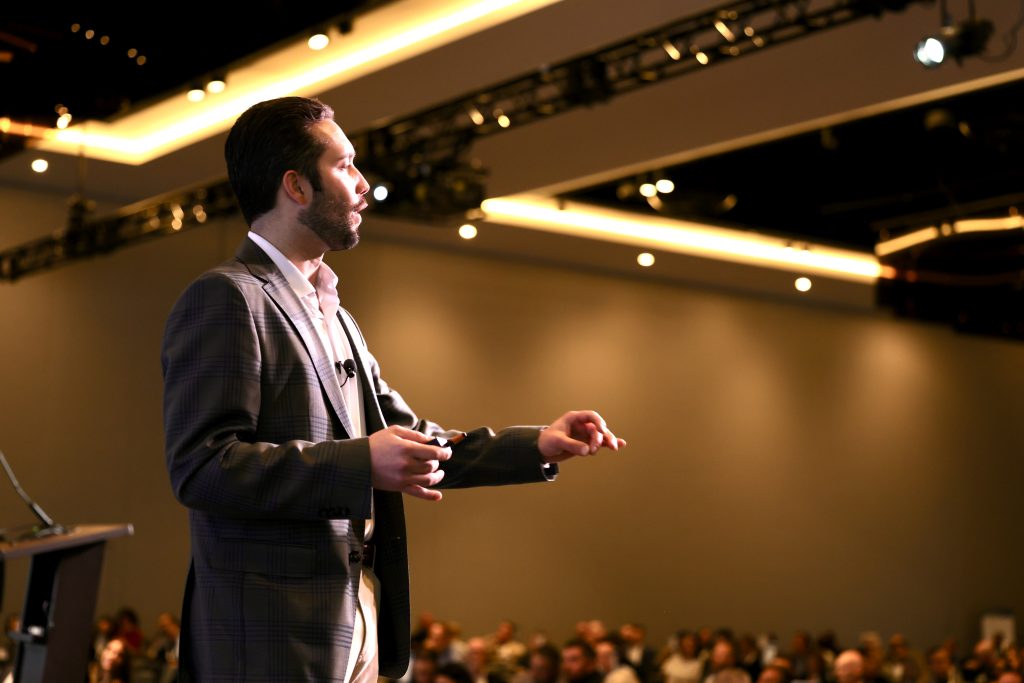
Michael King, senior director of investment sales for Cushman and Wakefield, talks during the 2025 Urban Land Institute Utah Annual Trends Conference in Salt Lake City. Photo by Kelli Freshman Photography
Back in 2022, which was the peak of the market, you could underwrite double-digit rent growth on a typical 250-apartment deal Downtown. Now, he said, “we’re seeing that effective rents down about 8.25%.”
Overall multifamily values are down 26%, King said, though he added that’s not indicative of every single project or every deal. He also said that decline came after four years of record supply and double-digit rent growth.
But now, the glut of new units coming on the market has resulted in fierce lease-up competition and heavy concessions, which King said could last through 2026 and into 2027. Some examples of concessions are up to three months of free rent and gift cards for new tenants of up to $3,000.
“We’re also hearing stories,” King said. “If renters want to go to Mexico, if you want to go on a cruise, if you want a trip somewhere — if you’re a renter in the Salt Lake City market right now, you can have whatever you ask for.”
King categorized the turbulent multifamily market issues as a part of the growing pains from all the new supply, and it will take time for all of those units to be absorbed. Though it’s certainly a renter’s market, King said current economic uncertainty can play a huge part in concessions.
“If you’re going to offer the deal today, consumers, renters, they’re going to take the deal,” King said. “But if concessions turned off right now in Salt Lake, I think the same amount of demand, the same amount of lease up velocity persists. Because we have those strong job drivers and population growth drivers, some of the best stories long term out of any state in the West.”
That optimism for Salt Lake City long term is a big reason why investors will continue to be in the local market, King said, especially with steady population growth and the 2034 Winter Olympics on the horizon. He emphasized the current multifamily market isn’t going to last forever, but he added, “we also need to recognize that it’s not going to just go away tomorrow, this is going to be a little bit more of a persistent recovery.”
“My message to investors and groups trying to get into the market right now is understand where values are from the peak,” King said. “Take advantage and get aggressive on buying opportunities, because this could be, very likely, the best buying opportunity that we’re going to see in Salt Lake for multifamily in the next decade.”
The negative current state of the multifamily market has caused the experts on the capital markets panel to avoid ground-up multifamily developments, though some believe there’s still room for investment in Salt Lake City under the right circumstances.
When it comes to investments, the director with the investment management firm said her firm wants to buy below replacement costs, and she views distressed multifamily as an investment opportunity, “where there’s distress in the capital stack, not necessarily distress at the asset level.” She’s more partial to investing in suburban Salt Lake or Utah counties instead of downtown, but added, “any kind of debt opportunity in Salt Lake is really attractive for our credit fund right now.”
Scott Glassberg, managing director of real estate for TPG Angelo Gordon, said there are two types of investment opportunities in Utah that interest him most. One is distressed multifamily, the other is industrial developments with a great location, whether that’s in acquisitions or development.











0 Comments