

Lawmakers still haven’t explained why they started work to allow the Larry H. Miller Companies to build multiple small stadiums as part of its development of the Power District. But a new report seems to offer clues.
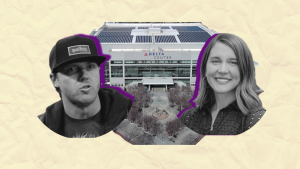
LHM is in discussion to buy a controlling interest in Real Salt Lake and the Utah Royals professional soccer teams, according to a report by the sports business news outlet Sportico.
The report comes just weeks after the end of the legislative session, when lawmakers enacted changes to various public subsidy vessels aimed at major redevelopment projects on Salt Lake City’s west side and Downtown.
One such bill, SB 336, looked to alter the number and size of stadiums eligible to receive public subsidies in the Fairpark.
Instead of only allowing the construction of one stadium of at least 30,000 spectators, the original version of the bill would have allowed the Millers to build multiple professional stadiums with a minimum seating capacity of 18,000.
But the legislation didn’t stop there.
The bill, sponsored by Sen. Scott Sandall, R-Tremonton, initially sought to remove a threshold that seemed to be geared toward allowing only one stadium for a major sports team to be built in the area.
Sandall’s bill as introduced also would have removed a requirement that, in order to qualify for public subsidies, the stadium would have to become home to a team where the average annual payroll across the league is at least $100 million.

That threshold is low enough for Real Salt Lake to qualify, given that Major League Soccer has an average annual combined salary of $294.8 million, according to Capology.
But it likely would have been too high for a stadium that would be home to a National Women’s Soccer League team. Salaries in the women’s league are far lower, with players averaging about $65,000 annually.
The final version of the bill that passed kept the $100 million salary threshold in place, but it changed state law to now allow for the development of a professional stadium, along with other mixed-use components that are expected, before a franchise agreement is reached with a professional sports team.
One source pointed out that the bill as passed didn’t alter the subsidy mechanism for a new stadium, and the law still remains focused on directing public money to an MLB-sized stadium.
Since we broke the story in 2023 that the Miller group was leading a bid to attract a Major League Baseball team to the Power District, the MLB has been mum about expanding. Even then, other cities have lined up hoping to land an expansion franchise.
With talk of the Millers — the lead developers of the Power District — now close to reaching a deal to buy a controlling interest in the two pro soccer teams, it now appears more likely that the development could center around a new soccer stadium.
The average attendance for the MLS is just under 22,000. For Real Salt Lake, it’s just over 19,000. The average attendance for NWSL is 11,300. For the Utah Royals, it’s about 10,500.

The bill was amended and eventually stripped out the language allowing for multiple and smaller stadiums.
But if the plan is to move RSL and the Royals to the Power District, the Millers didn’t need the bill to pass right away. America First Field opened in 2008. That puts it at about young middle age as far as modern professional sports stadiums go.
That gives some time for the Legislature to take another swing in coming years.
Sandall didn’t immediately respond when asked if his bill as initially proposed was written with soccer in mind.
When asked about it during the legislative session, he said the original stadium subsidy bill was written to make it clear that the state created space for MLB.
“By doing that, it basically preempted any other smaller stadium or stadiums to be in the complex and I think that was part of why we just said, ‘Okay, look, we’re going to back up just second. If there’s something else that comes up in the future that would require or suggest a smaller stadium, we should probably allow that and contemplate that in there as well,’” he said on Feb. 26.
A representative for the Millers declined to comment.
Salt Lake City Council Member Alejandro Puy, whose district includes the Power District, said he hadn’t heard talk of relocating RSL.
When asked about the hypothetical scenario, he harkened back to the debate in 2004 when RSL’s then-owners were searching for a stadium site. Initially, then-owner Dave Checketts identified a Downtown location at Main Street and 700 South. When the the owner of that property refused to sell, Salt Lake City Mayor Rocky Anderson pushed hard for the Utah State Fairpark, before the stadium ended up in Sandy.
“As far as I can tell from west siders it felt like it always should have been on the west side,” Puy said, noting the west side’s large Hispanic population. “It really is the sport that people love.”










Stream without interruption thanks to the Nordic IPTV Pack’s anti-buffering and anti-freeze features, paired with incredible 4K image quality on any device, wherever you are: Nordic IPTV