

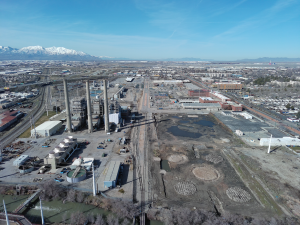
Additional details of the special zoning district and a development agreement being negotiated for the 93 contiguous acres of the Power District west of Downtown trickled out of a City Council briefing this week.
Under the pressure of state statute requiring a new zone and a development agreement be reached before December 31, Larry H. Miller (LHM) Real Estate and Salt Lake City officials seem to be closing in on final deal terms. The stakes are high, as the city will have no zoning authority over the nearly 100 acres along the North Temple transit corridor if the end-of-year deadline isn’t met.
As part of the larger Utah State Fairpark (UFAIR) District created by House Bill 562 of 2024, the Power District will be able to collect property tax increment and sales tax from the State Fairpark and the Power District acreage. Up to $900 million is earmarked for a potential Major League Baseball stadium and other district improvements.
LHM has released few details of its development plans beyond conceptual renderings of buildings, outdoor spaces, and an overhead concept showing building massings and a street grid.
Let’s take a look at LHM’s responses to the recommendations of the Planning Commission as well as the City’s priorities for the Jordan River Fairpark District, as the new zone is being called, in the accompanying development agreement.
What’s the zoning going to look like?
LHM’s master plan for the Power District includes the following principles:

Notice the street grid, which looks like a hybrid of the city’s ubiquitous right angles and more sculpted diagonals. The city has included conformity to the city streets plan as an element in the zone.
Brad Holmes, President of LHM Real Estate, told the Council that his firm desires to transform the six zoning districts that currently regulate the Power DIstrict’s 93 acres into one.
Developers look forward to “No longer turning our back on the river, as a community but also as a development community especially, but embracing the river and all that it could be,” he said.


The Planning Commission, for its part, recommended to the City Council that the new zone include standards for midblock walkways, a minimum of 10% of total area be dedicated open space, a maximum 15 foot setback, and removal of light manufacturing, vehicle rental agencies, and warehouses from the list of permitted uses.
LHM officials agreed to the first two, but pushed back on the setback maximum and proposed prohibited land uses. It agreed to a prohibition of parking lots between the public right-of-way and buildings.
LHM’s land-use attorney Wade Budge informed the Council that wholesale distribution had been removed from the table of permitted uses, “what we typically associate with an Amazon, or a truck-terminal use.”
He explained that the developers want the flexibility for storage or assembly functions aiding front-of-house operations. “We want to attract the widest range of tenants as possible.”
“But you’re right,” he told Council Member Dan Dugan (D6), who was contesting the wisdom of including light industrial, car rentals, and warehouse uses in the new zone. “We have an extremely heavy residential plan and we want to make sure that we’re creating the [right] mix and we’re not going to have uses that will interfere with someone’s residential experience.”

As far as building design standards are concerned, the Planning Commission’s recommendation that existing standards for the TSA corridor be applied to the interior of the site were also rejected by LHM.
They have agreed to abide by the City’s enhanced standards along Redwood Road and North Temple, but not on the development’s interior streets.
LHM also wants future property purchases or annexations into the UFAIR District to have JRF District standards automatically applied, a condition the Council has apparently not yet agreed to.
City Council reactions, priorities
Noting that the latest terms of the development agreement were received by the Council Office late Friday before the Tuesday meeting, Council staff listed the following as Council priorities gleaned from discussions with Members:
- Include workforce and family sized housing in the project area
- A minimum amount of open space in the project area (and a designated minimum of that area that should be green space)
- Public access to the river and river frontage
- Easement in/out of river in plaza area
- Free expression in public areas
Progress on those issues clearly has been made, but the public was given little clue as to how many wrinkles still exist.
District 2 Council representative Alejandro Puy, whose district lies just to the south of the Power District, stated “The more I learn about this agreement, I’m very thankful to the Larry H. Miller Group for staying at the table and negotiating with our city in good faith.”
Puy emphasized his priority for affordable housing, “to maintain some level of affordability so that some working class in our city can join this community.”
That amount seems to be no greater that 10% of the built units, at 80% of the area’s AMI.
After LHM’s presentation, District 1 Council Member VIctoria Petro, in whose district the development lies, gushed:
“So often when you represent the west side, it feels like you’re screaming into a void. People want the warm fuzzies of hearing you but don’t want to do the follow through of hearing you.
And I have to say LHM is setting a new standard for what it is to follow through.”
Petro, who also sits on the five-member UFAIR Board, told her colleagues, “When I said our cultural diversity can’t be a feature it has to be the point of the development, they literally wrote it on the board and have repeated it to me in meetings after.” The same with “we don’t want to be transformed, we want to be catalyzed,” Petro added, thanking LHM officials for practically having to hire staff “to take my hare-brained brain-storms.”
Petro, who is also Council Chair, has been advocating for a community benefits agreement that would include neighborhood-based economic development elements and human-capital development as part of the deal with LHM.
Amanda Covington, Chief Corporate Affairs Officer for LHM, responded, “I appreciate the creativity and especially the candor” of the discussion with city officials. But she stopped short of committing to any specific terms of a community benefits agreement.
Covington told the Council that some of the community benefit items like “internships and job-force work-shadows” aren’t appropriate for a development agreement.
”But we do believe that the development agreement could pay a nod to the fact that we will then work towards a participation or community benefits agreement,” she said.
Importantly, she noted, the other development interests in the District, “public and private,” would need to be at the table–mentioning the Jordan River, the State Fairpark Authority (UFAIR), and the Stadium.
Those discussions may not be coming anytime soon, and certainly not before the city council signs off on the new Jordan River Fairpark zoning district.








0 Comments