

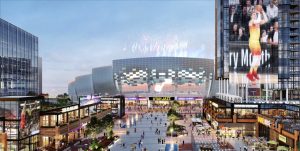
Members of the Salt Lake City Council seem poised to pass a resolution that would create a public infrastructure district to fund an overhaul to the Salt Palace, Delta Center and a new entertainment corridor connecting the two.
The PID is part of a years-long and ongoing push by state and city leaders to reconfigure the sprawling Downtown convention center and overhaul the Delta Center in an effort to keep professional sports in the city and revitalize and expand Downtown.
The effort began during the 2024 legislative session, when lawmakers approved public subsidies that would incentivize Utah Jazz owner Ryan Smith to keep the NBA squad Downtown and locate his Utah Hockey Club there.
In the latest session, lawmakers passed a bill creating a framework to pay for the reconfiguration of the Salt Palace, which currently bifurcates the west edge of Downtown and isolates the Delta Center and Gateway from the Downtown core.
The Salt Lake City Council is now carrying out its latest step in that process.
Council members could vote on the proposal next week, and it seems likely the district vote will go through despite pushback from at least two west side members.
Councilmembers Victoria Petro and Alejandro Puy implied the council has few options other than approving the resolution, and they lamented the lack of alternative options that constituents have as recourse for the district.
Puy said the district is another example of the state finding new ways of tying up future tax dollars for new projects. He said while the overall project has value, “it feels like Salt Lake City, yet again, is pitching in more.”
“Apparently the Legislature did a study that (said) the Salt Palace brings in billions of dollars of tax revenue to our state and it’s a major tourist attraction, but yet they are not willing to put any state money into it,” Puy said. “That’s frustrating to me.”
During a Tuesday afternoon work session, Petro asked deputy city attorney Allison Parks whether the city had any other avenue except following what’s laid out in a recently passed state law setting up the framework for the PID.
“Yeah, you’re totally right,” Parks said.
Petro said the Legislature created a “predetermined outcome,” and that the city was left powerless but required to give the illusion of receiving feedback from the public on the proposal.
“People are allowed to come and tell us how they feel about it, and I know it’s an unpopular thing to say, but I think we have to deal in truth with a frustrated constituency to make sure that they understand the parameters of where their influence is,” she said.
Councilmember Chris Wharton said he heard from several constituents who hoped public input would be able to shape the city’s path forward, but that’s not the case with this resolution.
“Residents could be forgiven for thinking that because we’re having a hearing, that means that the decision is gonna be based, at least in part, on the comments we hear at the hearing,” Wharton said. “In this one situation, that’s not the case because of state law.”
He continued: “This is a process, and this is a partnership that we’re entering into, or have entered into already, with the county and the state and with (Smith Entertainment Group), and there could be lots of iterations to that and lots of phases to that, and I hope that people will still stay engaged with us as we move forward through this next phase.”
More about the PID
The resolution is part of a process outlined by Senate Bill 26, which created a new type of public infrastructure district, or PID, specifically for a convention center reinvestment zone. This zone would be known as the Capital City Revitalization Zone, which includes the Delta Center and Salt Palace.
Parks explained to the council this PID is different than others. Normally, a PID is created by local governments and private developers to only fund improvements only to infrastructure.
“The purpose of this new PID is to be a financing mechanism for Smith Entertainment Group’s redevelopment of the Delta Center, their entertainment district, and also the reconfiguration and redevelopment of the county-owned Salt Palace and improvements that directly serve the Salt Palace,” Parks said.
She added the district would be a government entity, and any district debts are not liabilities of the city. Because the Salt Palace is owned by Salt Lake County, the county mayor must review and approve any proposed use of funds before money can be dispensed.
The PID would also have a board made up of five people — single representatives from Salt Lake City and Salt Lake County, as well as three board members representing Jazz Arena Investors LLC — a subsidiary of the Smith Entertainment Group.
The PID would collect funds in two ways: through the .5% sales and use tax increase, and through funds from the convention center revitalization zone, which was created in SB26. The first source of money will be used to service bonds for projects under the agreement, Parks said. The latter chunk of funds comes from a number of sources, Parks said, including 50% of the state sales and use tax increment and 100% of any local sales and use tax increment within the PID.
The PID would consist of only the 10 acres that make up the Delta Center, but the Capital City Revitalization Zone includes the Salt Palace. This means the larger area would benefit from tax increment from the Delta Center.
If the resolution passes, the City Council would allow a massive redevelopment of the Delta Center and Salt Palace to move forward, and would begin to enable tax revenue to flow toward an overhaul of some of the city’s biggest attractions.












0 Comments