

The Ballpark neighborhood is slated to see a large amount of changes in the coming years, as the now-vacated Smith’s Ballpark is slated to undergo major redevelopment. That means land in the surrounding area is also likely to see construction soon, making the open seat in Salt Lake City Council District 5 all the more interesting.
It’s the only open seat among the four races, as incumbent Council Member Darin Mano previously announced he wouldn’t seek a second full term. With Mano stepping aside, three candidates — Erika Carlsen, Amy J. Hawkins and Vance Hansen — are hoping to succeed him.
Building Salt Lake interviewed the majority of candidates to get their takes on the upcoming Ballpark NEXT redevelopment, density in the district and other aspects relevant to the district. BSL did not interview Vance Hansen.
ERIKA CARLSEN
Among the first candidates to officially enter any council race was Erika Carlsen, a 38-year-old resident of Ballpark. Outside of the race Carlsen works in the nonprofit sector, as she currently works for the Trust-Based Philanthropy Project.
Carlsen said she’s been in favor of the council’s recent changes to the mixed-use zoning code, adding that she generally supports simplifying city zoning code in order, “to make it easier for us to build homes, easier for small businesses to open up and to create mixed-use neighborhoods and to create mixed-income neighborhoods.”
Missing middle housing is what’s most needed in the Ballpark neighborhood, she said, adding that building types like duplexes and triplexes can improve local housing supply without changing the character of the existing neighborhood.
For the Ballpark NEXT plan, Carlsen said she helped lead the community meetings that set the stage for the city’s adaptive reuse approach for Smith’s Ballpark, adding she was happy to see others express their desire to preserve part of the stadium.
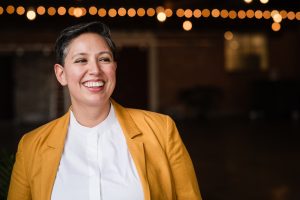
Erika Carlsen. Courtesy photo
One thing the community made clear in those meetings was the need for more owner-occupied housing, which Carlsen said she wholeheartedly agrees with.
“We have an opportunity to do something really creative on that land, because it’s city-owned land,” she said. “We can do something similar to Perpetual Housing Fund, Community Land Trust, rent-to-own models, etc.”
The plan to create year-round activation for the ballpark, plus daylighting the nearby city creeks were also aspects of the plan she praised. But on the flip side, she said the plan to build a hotel on the ballpark site was disheartening and left her confused.
“Part of why I don’t understand (including a hotel) is it never came up in our community conversations as something that could be included,” Carlsen said. “So it’s something I’d like to learn a little bit more about.”
Instead, Carlsen said she’d prefer swapping a hotel with a community recreation center, which she said would pair well with the nearby open space where the baseball field currently stands.
“We could even have a grocery store and a post office — we lost our post office,” Carlsen said. “I would love to see those types of things in the plan.”
The cost of housing is a big reason why families aren’t sticking around Salt Lake City, Carlsen said, but many of them are still commuting into town for work. She said the city needs to prioritize building family-sized housing in neighborhoods that can reasonably absorb multifamily housing, like Ballpark.
“We’ve built a lot of studios, a lot of one bedrooms, but I know that if we build three bedroom units, and we do it in a gentle density approach, we can create and deliver more housing so that people can live where they work,” she said.
She added that approaches to density like ADUs can encourage multigenerational families to remain in the same space. She praised the city’s Backyard Keys program, which provides loans for west side residents who want to build an ADU on their property.
“I think (ADUs) build a stronger neighborhood, stronger community,” she said. “It helps with childcare, it helps with social isolation that many of our seniors might be feeling and experiencing. So I am very supportive of ADUs, I would like to see more of them built. Though I recognize there are real challenges to getting them built.”
Another aspect of Carlsen’s campaign is offering greater support to small businesses. One way to do that is to streamline the permitting process. Another way the city can better support small businesses, she said, is to allow businesses to use money from the city’s economic loan development fund to refinance existing debt, adding that way, “they can get ahead rather than feeling totally weighed down by it and leading to their closure.”
AMY J. HAWKINS
Another candidate seeking to represent District 5 is Amy J. Hawkins, a 43-year-old Ballpark resident. Hawkins moved to the neighborhood almost 12 years ago and teaches at the University of Utah School of Medicine.
She said she’s running for council again because, put simply, “I want the job.”
Hawkins has been a Ballpark and community advocate for a decade and has been chair of the Ballpark Community Council since 2018. She said her scientific background is an aspect that few others in city government have.
“We need people who have that kind of training involved (in government),” Hawkins said. “We need voices of scientists, and folks need to see that people who got into scientific research do it for the same reasons that people get into other kinds of public service.”
Hawkins has made clear she believes the city’s current Ballpark NEXT plan has shortcomings, particularly regarding its lack of green space. It’s not just the Ballpark NEXT plan — Hawkins said the city’s plans for 300 West also feature a lack of green space. She said the neighborhood is among the hottest in the city due to the lack of parks and high amount of roads, and replacing what green space Ballpark has is a mistake.
“I’m really disappointed about the conversation about green space in that (Ballpark NEXT) discussion,” Hawkins said. “We hear a lot of conversations about equity. I think our council is educated enough to acknowledge the change in climate. Where are we going with that? I don’t hear a lot of requirements, even for things like green roofs or something like that. There could be even more innovative ways that we could get at some of this.”
She’s also concerned with packing multiple uses in the same site, saying, “some of the uses proposed on site aren’t necessarily compatible with each other, like there’s a public playground on the site and it’s not clear how that would fit in with the alcohol licenses that were also proposed for the site.”

Amy J. Hawkins. Photo by Justin Hackworth
What she doesn’t want to see is the redeveloped ballpark turn into Library Square, which has vacant storefronts and open space that’s paved over.
She said one potential route for the ballpark is to press pause on redevelopment and use the existing stadium as a site for the 2034 Olympics, adding, “they’re not that many 14,000 seat venues in the Salt Lake area.”
In the meantime, she said the city could put up temporary pickleball courts and use the existing stadium lighting for those trying to play after dark.
“That would be my great wish,” she said. “Just put a pause button, because what I heard from folks in the neighborhood over and over again, is that they’re just going to turn it all into apartments, and we don’t really have strong evidence yet that that’s not what’s going to happen.”
Another area of emphasis for Hawkins is expanding for-sale housing options. The Ballpark neighborhood is frequently a site of new development, but the majority of those new housing options are rentals. As someone who bought a townhome in 2014, Hawkins said she likely wouldn’t be able to purchase a similar home in Salt Lake City and would likely have to move to the suburbs.
“In Salt Lake, you can either rent an apartment or a home, or buy a single family home, and there’s almost nothing in between,” she said. “That’s really unacceptable, and it’s going to drive out the middle class.”
She believes too much attention is paid to affordable housing units, which are still rentals that typically don’t offer equity to tenants or an opportunity to purchase the unit. Addressing home ownership is best done on a regional level, Hawkins said, which is an approach she’s taken with other issues as well.
“This shouldn’t be something that each municipality reinvents by themselves, because we recognize it is a regional conversation, and, if anything, it’s a national conversation,” she said. “We’ve seen home ownership decline nationally and in Utah both, that’s a dark future.”
Despite the Salt Lake Bees moving south, Hawkins said the neighborhood’s moniker shouldn’t go away anytime soon. She knows the neighborhood will be changing quickly, and she hopes the future of the neighborhood continues to be a place where young people can establish a community for themselves.
“I’m hoping that we will successfully incentivize denser for-sale housing, and that we can become the neighborhood where individuals and families choose to get a foothold in the community and get to build equity for the first time,” Hawkins said. “I think that would be the best possible future for this neighborhood.”
Hawkins said taking a regional approach can also be applied to other neighborhood issues, like homelessness and public safety. She’s seen plenty of neighbors leave due to Ballpark’s crime issues, saying, “it wasn’t because of lack of amenities, it was because of the public safety conditions in the neighborhood.”














0 Comments