

Developers are in the process of building hundreds of low-income housing units near the North Temple corridor, adding to the area’s rapid changes after installing transit and upzoning the land.
As of January, over 2,000 federal low-income housing tax credit (LIHTC) units are currently in the works along North Temple and nearby streets, according to a review by Building Salt Lake. A good amount of those units are currently in the construction phase, but the majority of these new units have not pulled construction permits. Developers are also in the process of obtaining public subsidies to help them build affordable units for people earning less than the median wage at a rate that would quickly transform the area.
These types of units are labeled as “affordable housing” because in order to live there, you cannot have a yearly income above an amount agreed to by the developer in exchange for taxpayer support to build the project.
Much of these planned units are available for people who make at or below 60% of Salt Lake City’s area median income (AMI). According to city records based on US Census data, the city’s area median income is $80,900 for a single person. Spending no more than 30% of their income on rent, someone earning median income could afford a one-bedroom apartment of $2,166 per month.
At 60 percent AMI, a single person could afford a one-bedroom unit that costs up to $1,299 per month, according to federal HUD guidelines, which set the threshold of a person normally spending nearly one-third of their income on housing.
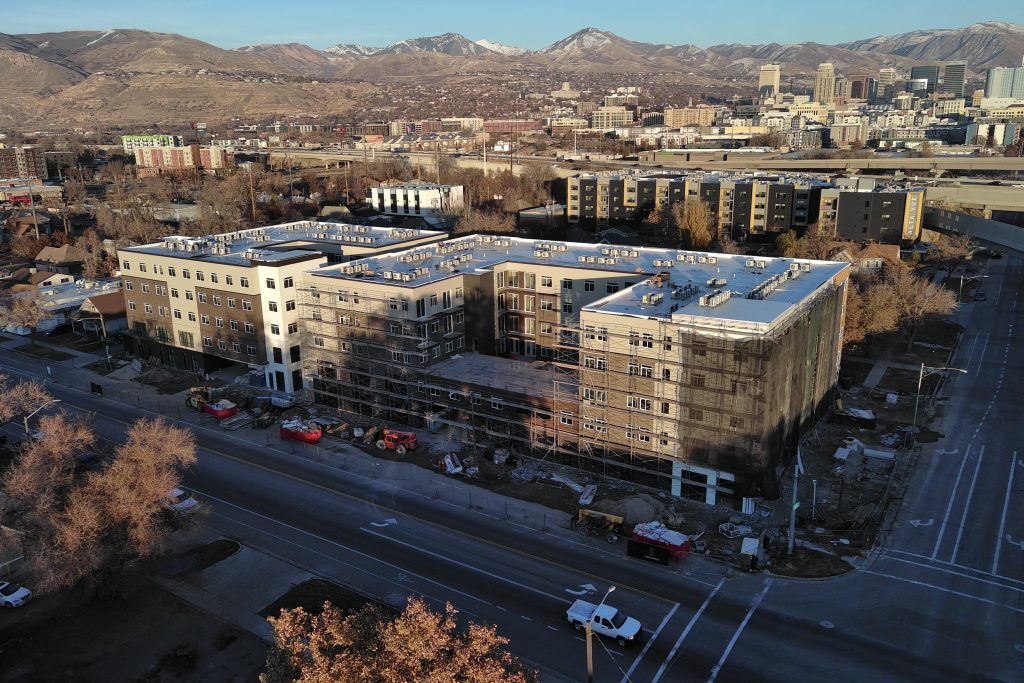
Affordable projects planned and under construction
There’s never a guarantee that planned projects will be completed, especially when costs for labor and financing remain significant headwinds for development. But the influx of low-income housing planned for the North Temple corridor shows that developers are targeting the area for an affordable housing boom.
We last gave an update on this corridor of housing in July. While a number of those projects haven’t started construction, others have, and there are others that have been proposed since.
Here are existing North Temple projects that are in some stage of the construction pipeline.
9Ten West
- 910 W. North Temple
- 180 units, 100% affordable
- 60% AMI or lower
- 54.39% aggregate AMI
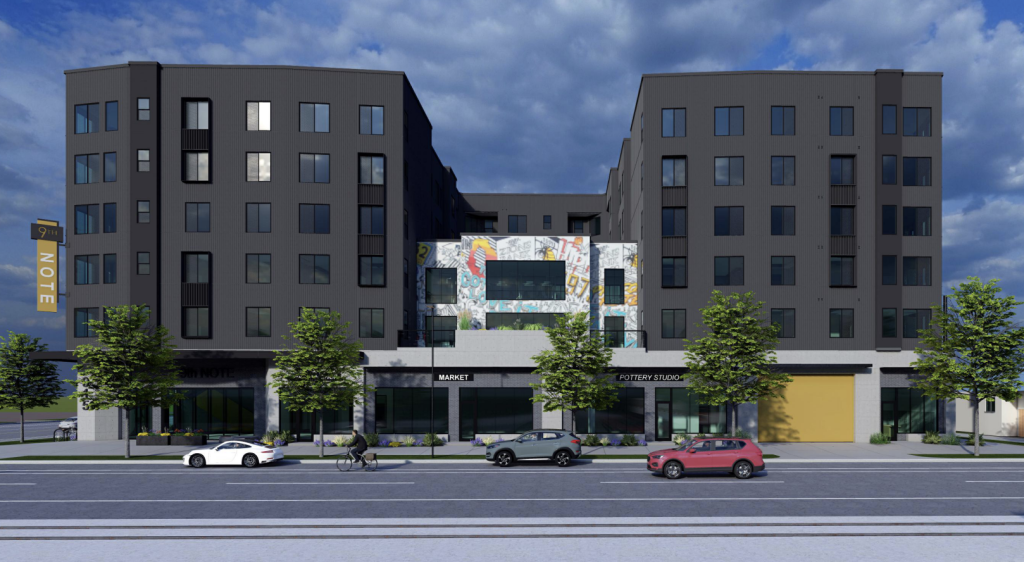
9th Note
- 915 W. North Temple
- 110 units, 100% affordable
- 60% AMI or lower
Alta North
- 1865 W. North Temple
- 283 units, 100% affordable
- 60% AMI or lower
Alta Fairpark
- 140 N. 1000 West
- 147 units, 100% affordable
- 60% AMI or lower
Alta Vue
- 820 W. 200 South
- 306 units, 100% affordable
- 60% AMI or lower
2nd South Apartments
- 934 W. 200 South
- 105 units, 100% affordable
- 60% AMI or lower
MODA Griffin
- 915 W. North Temple
- 110 units, 100% affordable
- 60% AMI or lower
Folsom Apartments
- 947 W. South Temple
- 108 units, 100% affordable
- 60% AMI or lower
Village at North Station
- 1925 W. North Temple
- 769 units, 100% affordable
- 60% AMI or lower
The Utah Department of Workforce Services’ Division of Housing and Community Development is responsible for issuing state bonds to developers, and those bonds fund development for affordable housing.
During a meeting earlier this month, the Private Activity Bond Authority Review Board, which issues the bonds, discussed three more applications for affordable housing along the North Temple corridor. The projects aren’t necessarily new, but the requests for public subsidies from the state are new.
Those projects are:
The Cooperative 1881 (formerly The Catherine)
- 1881 W. North Temple
- 198 units, 100% affordable
- 60% AMI or lower
- 56.39% aggregate AMI
The Flats at Folsom
- 16 S. 800 West
- 188 units, 100% affordable
- 40%, 60% and 70% AMI units
- 60% aggregate AMI
Emeril Avenue
- 37 W. 800 West
- 93 units, 100% affordable
- 60% AMI or lower
- 53.57% aggregate AMI
Affordable units also have limits on the rent that can be charged, which correspond to 30% of a person’s income at the set percentage AMI. Here’s a breakdown of Salt Lake City’s rent limits by AMI level, according to Salt Lake City’s guide to affordable housing incentives:
| Bedrooms | 30% AMI | 50% AMI | 60% AMI | 80% AMI | 100% AMI |
| Studio | 606 | 1,011 | 1,213 | 1,618 | 2,022 |
| 1 Bedroom | 649 | 1,083 | 1,299 | 1,733 | 2,166 |
| 2 Bedrooms | 780 | 1,300 | 1,560 | 2,080 | 2,600 |
| 3 Bedrooms | 901 | 1,501 | 1,802 | 2,403 | 3,003 |
| 4 Bedrooms | 1,005 | 1,675 | 2,010 | 2,680 | 3,350 |
| 5 Bedrooms | 1,109 | 1,848 | 2,218 | 2,958 | 3,697 |
These figures also don’t factor in the unknown number of affordable units that will be proposed as part of the Power District — the 93-acre project that will include a large amount of housing, in addition to a potential stadium for a MLB team. Much of the district’s land is on the south side of North Temple between the Jordan River and Redwood Road.
They also don’t include the expected number of market-rate units coming to the corridor, which has already been transformed by newly built apartments and townhomes.
According to the development agreement between Salt Lake City and Larry H. Miller Real Estate, a minimum of 10% of all dwelling units in the district must be designated as workforce housing. Households hoping to qualify for those units can only make up to 80% of the area median income, or about $73,920 for a couple. A minimum of 20% of the Power District housing units will be family-sized, which are a minimum of two bedrooms per unit.
In addition to the Power District, there are even more apartments in this area that are in the works, like the Crossing @ 9th, located at 880 West 200 South, and the Altitude Apartments being built just to the east of Red Iguana 2.
A budding low-income cluster to worry about?
Community leaders said they weren’t concerned about such a fast concentration of low-income housing in such a small area, given the need for affordable housing throughout the city.
Bill Tibbitts, deputy executive director for the Crossroads Urban Center, told Building Salt Lake he’s happy to see this large amount of affordable housing units in the works. Though Tibbitts said the city needs deeply affordable housing, which is 30% AMI, having more affordable units is still a huge plus. Any amount of cheaper housing helps, he said.
“If somebody’s paying $2,000 a month for rent and they find a place that’s $1,600 instead, that means they need our services less,” Tibbitts said.
Tibbitts said this kind of affordable housing would still be out of reach for people trying to escape homelessness. He said given Salt Lake City’s area median income, many of those who would qualify for the 60% AMI benchmark would likely be young professionals, as it would still take a job well above minimum wage to afford these kinds of apartments. He doesn’t believe this type of housing would lead to increased crime or a strain on resources.
Tibbitts said people shouldn’t be fearful of affordable housing or deeply affordable housing, adding that mixed income housing still has the potential to raise property values.
“The people who move into units that are affordable at 60% of the area median income are people you want for neighbors,” he said. “They’re not scary.”
Salt Lake City Councilmember Alejandro Puy, who represents areas of Poplar Grove, Fairpark and much of the West Side, told Building Salt Lake he personally believes concentrating affordable housing isn’t a problem.
What concerns him more, he said, is clustering shelters and temporary housing while adding affordable units close to those same resources. He said adding those elements together, while offering few options for family housing or home ownership, is a recipe for disaster.
“This is when we create neighborhoods that are maybe destined to fail,” Puy said. “No one wants that.”
Puy added the North Temple area needs a strong economic strategy and a safer neighborhood to succeed. He added the city needs to make sure families aren’t being displaced, but one thing is for sure — the more housing, the better.
“We need more affordable housing everywhere in our city,” Puy said in the email. “It does make sense that areas around North Temple see this concentration because the value of land, the tax incentives and the zoning encourages it. Those forces are powerful.”









0 Comments