
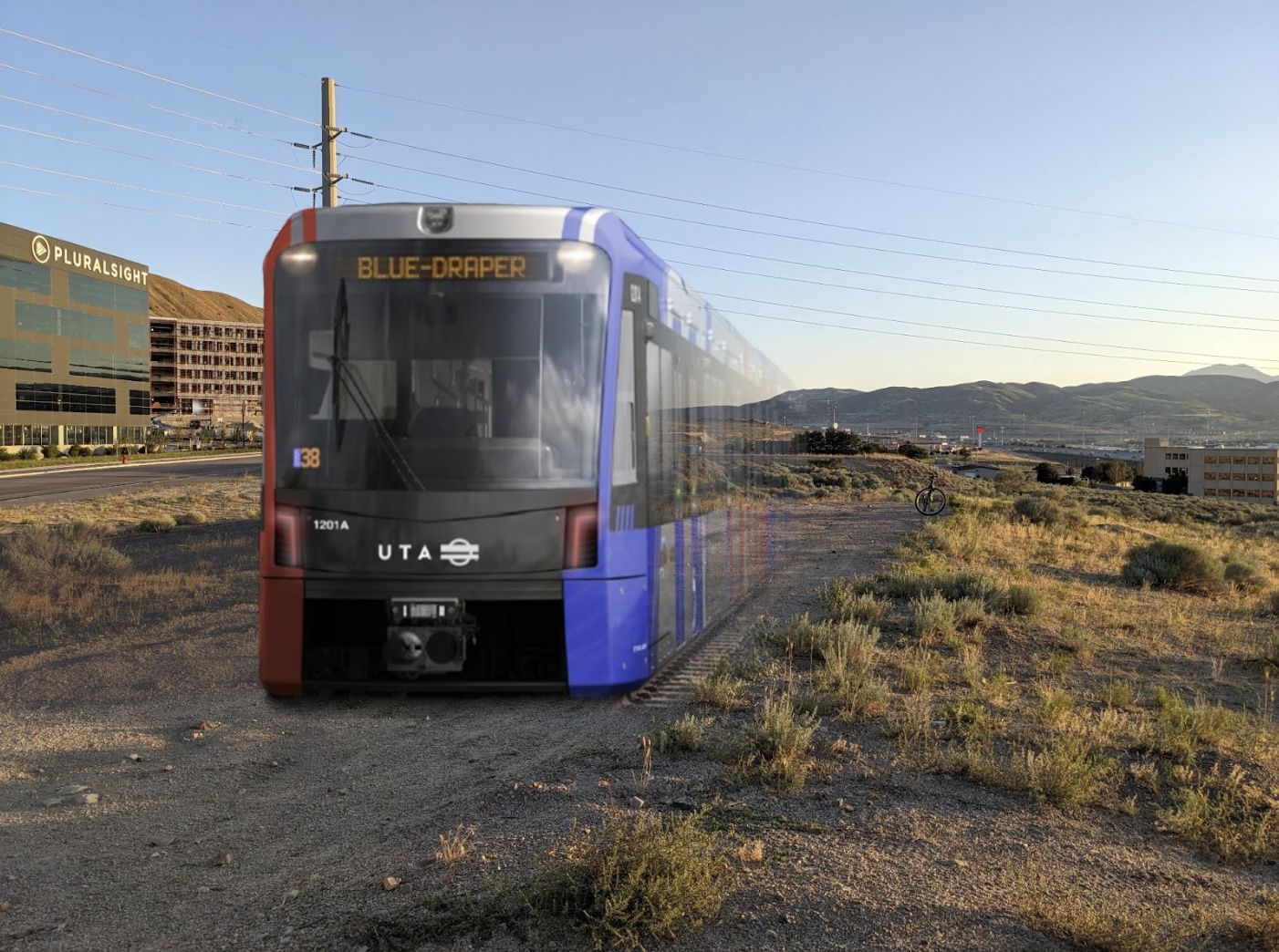
Looking south along the proposed corridor for the Point transit project. New UTA light rail vehicles might one day move up and down along the corridor. (Rendering)
In a tense exchange during an Oct. 9 Mountainland Association of Governments (MAG) meeting, Utah Department of Transportation (UDOT) officials and Lehi City leaders found themselves at odds over the future of light rail service through northern Utah County.
The debate centered on the Point of the Mountain Transit Project, a long-studied proposal intended to connect Draper and Lehi with high-capacity transit. In the meantime, the Point development, on the site of the former Utah State Prison in Bluffdale, has gained significant momentum on Utah’s Capitol Hill, and is reshaping public policy for future transit connections between Salt Lake and Utah County.
The topographical squeeze is at Point of the Mountain, where a growing conflict is currently flaring over whether the next passenger line should follow the long-promised TRAX Blue Line extension or a new route designed by state planners to serve the Point development project.
Broken promises of a Blue Line TRAX extension to Silicon Slopes?
When Adobe announced its plans to build a major corporate campus in Lehi in the late 2000s, state leaders assured the company that light rail would follow.
Then-Gov. Gary Herbert reiterated that commitment at the ribbon-cutting ceremony, saying that TRAX would one day loop around the Point of the Mountain to serve Adobe’s site and neighboring greenfield developments.
That promise became a key component of what Lehi and regional planners called a “tech corridor” vision – one where rail transit would link the Silicon Slopes technology cluster with Salt Lake City to the north and the fast-growing communities of Utah County to the south.
Sixteen years later, however, that vision remains unrealized. The state has focused all of its efforts into a new development at the former state prison site, and Lehi Mayor Mark Johnson fears that this could put any prospect of Utah county light rail in jeopardy.
The Mayor started raising concerns in early July when he released a video to the city’s facebook page expressing his disagreement with UDOT’s current alignment for the point transit line. It did not connect to the TRAX Blue line, but instead, follows a more costly route that crosses over I-15 and terminates at the Draper FrontRunner station.
Then, on Sept. 19, UDOT released the Finding of No Significant Impact (FONSI) on the Environmental Assessment (EA) for the project. A letter at the end of the FONSI from the Mayor to the Federal Transit Administration (FTA) describes reasons that the city does not support the current western alignment of the project.

Mayor Mike Johnson of Lehi
In the letter, Johnson reiterated that Lehi fully supports expanding transit into Utah County but argued that the current design “provides limited regional value” and breaks earlier state promises made to Adobe when it chose to build its 200,000-square-foot campus in Lehi with assurances of future TRAX service.
The Lehi Mayor also noted that the city has already entitled roughly 3,600 high-density housing units along the previously planned Blue Line corridor—land use decisions made, Johnson wrote, “in good faith” that the rail extension would one day reach Lehi.
He concludes by urging state and federal partners to ensure that the Draper Blue Line extension is built around the Point of the Mountain and deeper into Utah County, shaping transit “for generations to come.”
UDOT in the hot seat
Things finally came to a head during the Oct. 9 Mountainland Association of Governments board meeting. On the agenda was UDOT’s Jim Golden, the agency’s transit division director, giving a summary to the board about the project’s FONSI status. Following this presentation, the schedule called for Mayor Johnson to speak on the same.
Golden emphasized in his presentation that full implementation with light rail would be decades away and would begin with dedicated shuttles or “Innovative Mobility Zones” until ridership and development justify a rail line.
A new map was shown during the presentation that gave a nod to a potential blue line extension, but the planners are moving forward with an alignment to the west.
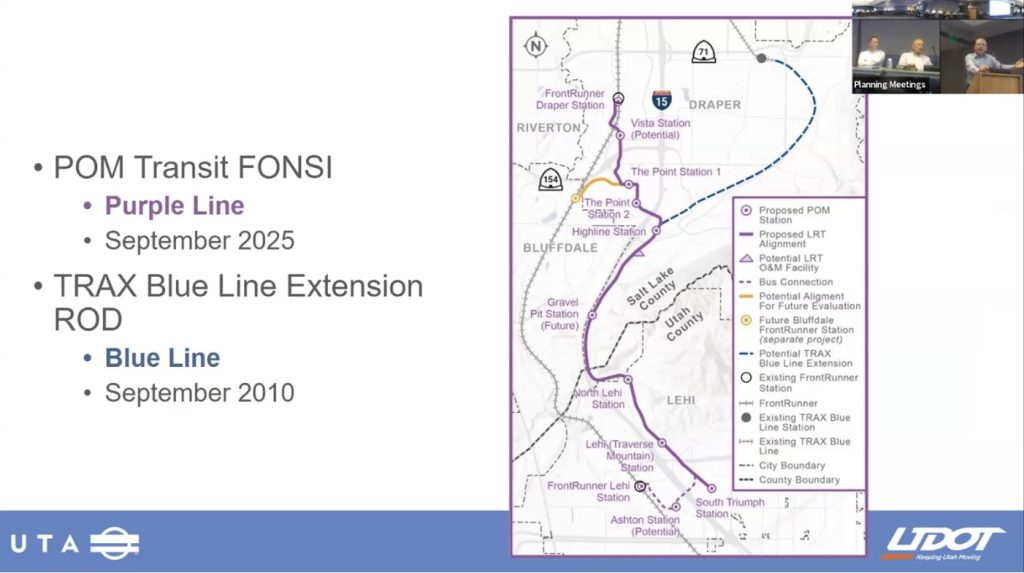
UDOT showing an updated alignment map which includes a potential TRAX Blue line extension.
That western alignment set the stage for the evening’s debate.
‘We don’t know how this happened’
When it came time for Johnson to speak, he didn’t mince words.
Starting off with a signed letter from prominent Silicon Slopes businesses “Podium, Weave, Entrata, Sunrun, DigiCert, Vivint, Kiln, and multiple growth stage technology firms in Lehi. These employers are competing nationally for talent that increasingly expects rail connectivity as part of their modern work environment.”
He also pointed to the five transit-oriented developments (TODs) at different stages of planning within Lehi, some already under construction, totaling more than 3,600 new housing units. Many are adjacent to the corridor reserved for the Point transit/Blue line extension.
“These are TOD units,” Johnson quipped, “and as a reminder, the ‘T’ in TOD stands for ‘transit’. Without transit, we’re just calling them our ‘odd developments.’”
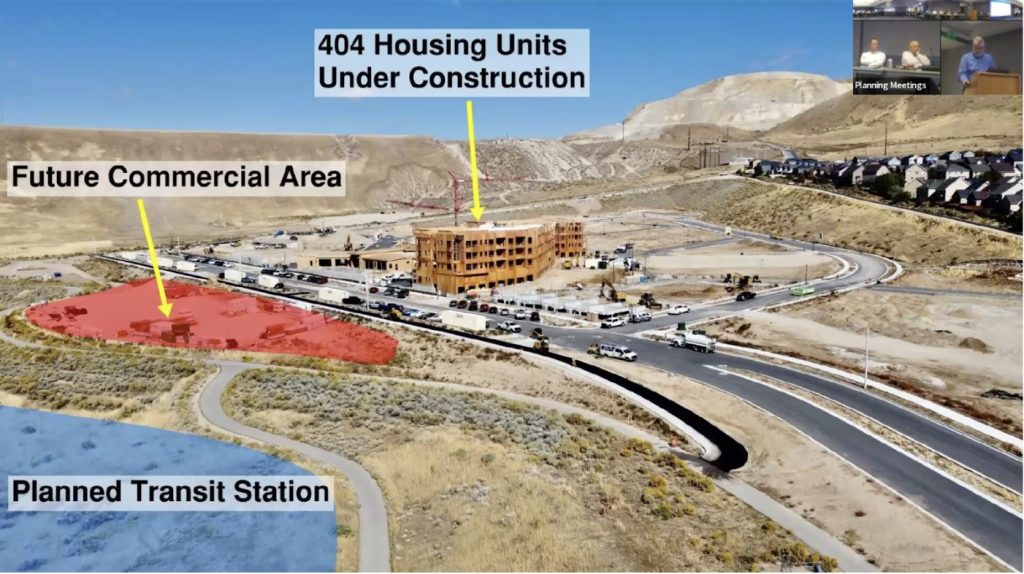
One of the TODs known as “North Lehi Station,” currently under construction.
“We have been in communication with the governor’s office. And in our meeting with Steve Waldrip, he apologized to us about the change in alignment and said, ‘We do not know how this decision happened,'” Johnson added.
Citing the current nebulous state of the Point development, Johnson added “The Point project still has shifting priorities. That concerns us. Silicon Slopes is in place, and it needs transit.”
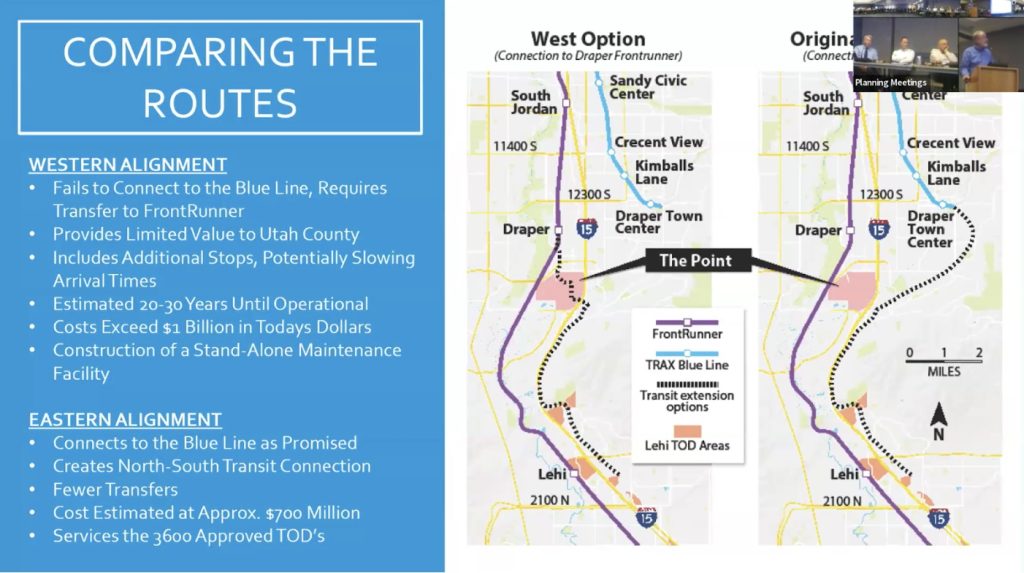
A slide shown during Mayor Mark Johnson’s presentation
The Mayor ended his presentation by asking if a motion could be made that would see MAG requesting that the state agencies involved with the point transit project go back to the drawing board and reconsider the Blue line extension.
UDOT’s response
After Johnson’s presentation, the discussion shifted to a more pointed back-and-forth among city and state leaders.
MAG’s chair invited Jim Golden back to the microphone to respond. Golden clarified that UDOT’s process was constrained by federal procedure.
Golden explained that once the Blue line extension is in the plan, the next step would be securing federal funds through the FTA grants program – a highly competitive process dependent on documented ridership demand.
He noted that while some of the data Lehi cited could help, “Ridership is one of the main things they ask for […] We try to be as aggressive as we can to say, ‘We think this is going to be like this.’ And they will hammer us down and say, ‘What is it actually going to be? What is there that’s actually there?’”
Johnson, visibly frustrated but diplomatic, responded, “Jim, you understand the process more than I do. I understand my problem, which there are two different things. And that’s all we’re asking for is an opportunity to say, ‘we don’t know that you can trust the ridership numbers when there’s no opportunity for ridership in that area.’”
UDOT Executive Director Carlos Braceras, who was in attendance, stepped into the discussion.
“In order to get federal money, you have to follow the federal process,” Braceras said. “We use the land use that you all have set as city mayors, as county commissioners, you have determined what that land use is. That’s what we use when we try to determine what the ridership is. And the numbers are so low, we will never get federal money for light rail in this area.”
Braceras went further, arguing that it’s too early to have light rail in the area under either alignment.
“Until we stop mining gravel at the Point of the Mountain and that’s built into homes and businesses, and we have the density,” he said. “Light rail is not the right solution, and could never be justified with the Federal Highway Administration.”
Mayor Johnson responded that Lehi would continue working “parallel” to UDOT to ensure the Blue line alignment remains a part of the conversation.
“I hate to be in conflict with the state on this issue, and it’s one that’s kind of cropped up and caught us a little bit off guard.” he said. “I’m comfortable with your efforts. I just ask that you’re comfortable with ours, that we can make this motion, and we can start communicating a little better than we have in the past.”
Braceras added that the project was so far out into the future, that a re-evaluation of the environmental assessment would need to be performed anyway, which is when alternative alignments could be revisited.
The room eventually found consensus. After several clarifying questions from MAG board members, Vineyard Mayor Julie Fullmer offered a motion stating that when the Point of the Mountain Transit environmental assessment is re-evaluated, stakeholders must also revisit the Blue line extension.
MAG’s board unanimously approved the motion.













0 Comments