
The cost of non-residential construction in Salt Lake City is up 7.87 percent from a year ago, the steepest increase among the eight metropolitan markets tracked by Mortenson, the national general contractor whose quarterly cost index is one of the few public measures of regional construction pricing.
The national figure over the same period was 5.60 percent. Denver, at 6.84 percent, was the next highest. Portland and Seattle, at 3.19 percent and 3.48 percent, were less than half Salt Lake’s rate.
The data covers the 12 months ending in the second quarter of this year, and there are signs that the price hikes have slowed. But the report shows that one of the most persistent and significant headwinds to construction around Salt Lake City will continue to plague developers.
Salt Lake’s 1.47 percent quarterly increase ranked fourth of eight and came in just under the national 1.58 percent, though Mortenson’s past reports show the market began far outpacing the nation in the first quarter, when costs ran nearly 10 percent above a year earlier.
Two things are pushing the local number, according to the Mortenson executives responsible for the report. The first is structural steel.
“The biggest newer topic in the last couple of quarters is structural steel,” said Matt Hackman, Mortenson’s estimating manager in Salt Lake City, who oversees the firm’s budgets and bids in Utah.
Hackman said the pressure is coming from procurement rather than raw material scarcity, with fabricators quoting longer lead times. That’s a different problem from the pandemic-era steel disruptions. As supply dwindles and demand rises, he said, costs follow.
That has not finished working through the market. Steel price increases move into coil, rolling and pipe on a delay of a couple of months, Hackman said, meaning mechanical and fire protection contractors are likely to see increases still to come.
President Donald Trump renewed and expanded a 25 percent tariff on steel imports in February 2025. That was doubled to 50 percent in June 2025.
A second major driver of cost increases is electrical, partially because of a rise in copper prices.
“Beyond structural steel, it seems electrical is just always one,” Hackman said, pointing to switchgear, generators and the copper content in complex equipment.
Data centers are a significant part of that. Asked whether the AI buildout explains the spikes in copper wire and related components, Hackman said data centers are “a large contribution,” because the buildings tie up so much steel and copper. Tariffs and commodity import and export swings account for some of the rest.
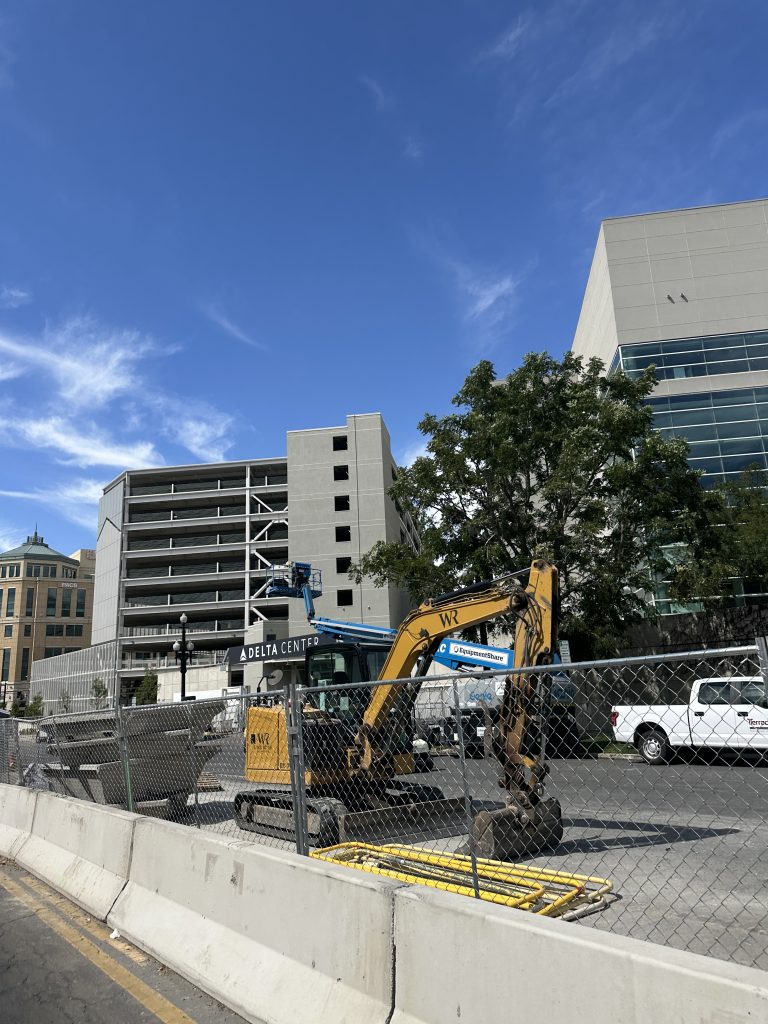
Construction outside the Delta Center in September 2026.
A regional pull
Chase Farnsworth, who became Mortenson’s director of project development for Utah this summer after 13 years in the firm’s Arizona business, said Salt Lake’s costs are being influenced by the advanced manufacturing and data center boom in Arizona.
“Though our markets are 600 some odd miles apart, economically, they’re really not that distinguished,” he said, citing TSMC and Amcor in Arizona and stadium work in Las Vegas alongside Utah’s own mega-projects.
Farnsworth also said Utah has substantial work in procurement that has not broken ground and is invisible from the street. He described a confidential semiconductor manufacturer in the market that continues to grow, and health care projects totaling close to a billion dollars in Utah that have not started construction.
“There are some things that are being procured in the background that you will see cranes and yellow iron around soon that will make you say, ‘Oh, that makes sense now,’” he said.
Intermountain Health is in the final stages of entitlement for its plan to build a new regional hospital at the Sears Block near 800 S. State. Smith Entertainment Group is also underway with a years-long renovation of the Delta Center that included the addition of a new eight-story parking garage.
Over in Summit County, developers are underway with a major expansion of Deer Valley Resort.
That dynamic is itself a cost driver. With lead times stretching, Farnsworth said owners who are not buying now will not have material for a year, so they are committing cash well before groundbreaking.
Hackman said the response is selective early procurement — locking prices on steel and electrical equipment while avoiding buying out an entire project a year ahead of completion.
Employment dip
Construction employment in the Salt Lake metro averaged 12,500 workers in the first half of 2026, a 1 percent drop from the same period in 2025, in the building-construction category Mortenson cites.
Hackman said he did not have a firm explanation but pointed to segments moving the opposite direction from the mega-projects: multifamily and portions of industrial, where development economics and interest rates have slowed activity. Mega-project demand, in other words, is not the whole market.
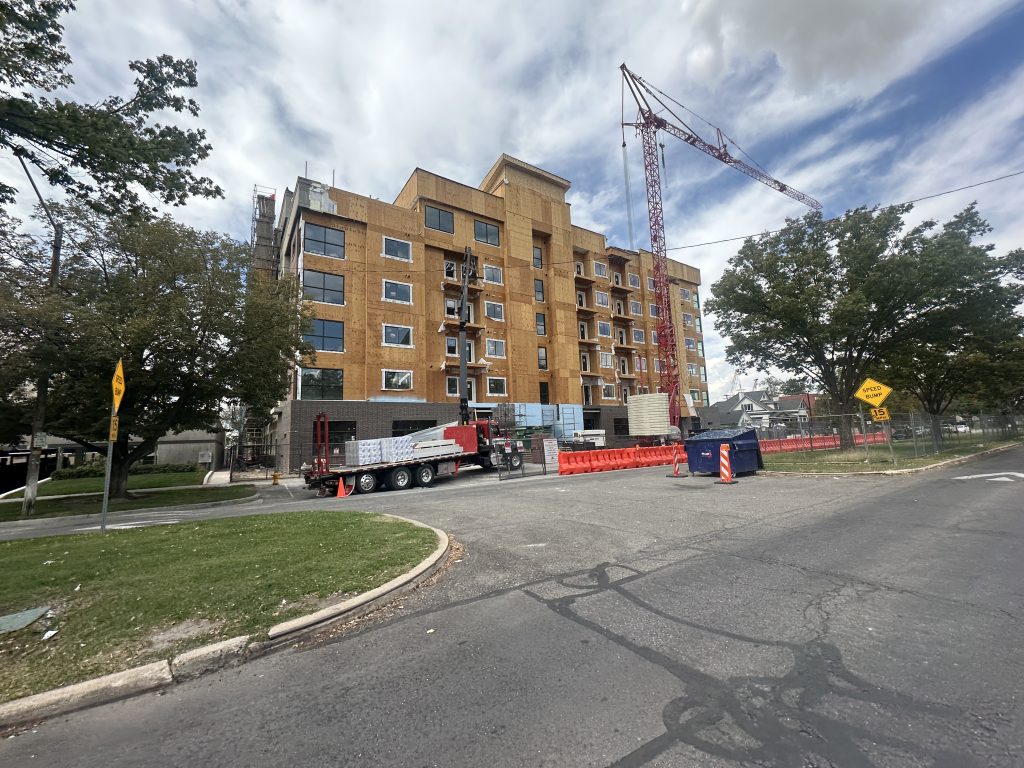
Construction in Salt Lake City’s Marmalade neighborhood.
He had no local labor cost figures, but said mega-projects are offering premium rates to secure crews and keep them on site.
A second national data set points the same direction on material costs.
Associated Builders and Contractors, analyzing federal producer price index data, reported construction input prices rose 1.2 percent in August and stood 8.9 percent above a year ago, with non-residential inputs up 8.8 percent. In July, ABC measured a 0.1 percent monthly move and a 7.4 percent annual figure — meaning national input costs accelerated sharply between the two months.
A recent spike in diesel prices could keep upward pressure on construction costs. Hackman, who tracks fuel for estimating, noted that prices recently hit an all-time high at over $6 a gallon, and said the effect reaches nearly every material.
“It affects paint, it affects concrete, across the board,” Hackman said.
Mortenson began tracking Salt Lake City roughly two years ago, and Farnsworth said the index is built on input from local trade partners rather than in-house estimates. The feedback is drawn from Utah, though the firm’s regional footprint extends into Idaho and Montana.
Hackman cautioned against reading the report’s “stable” outlook as a plateau. “Construction costs are steady, and steady doesn’t mean flat,” he said.
Across roughly the last 50 years, he said, fewer than a handful have shown a true year-over-year decrease.












0 Comments