
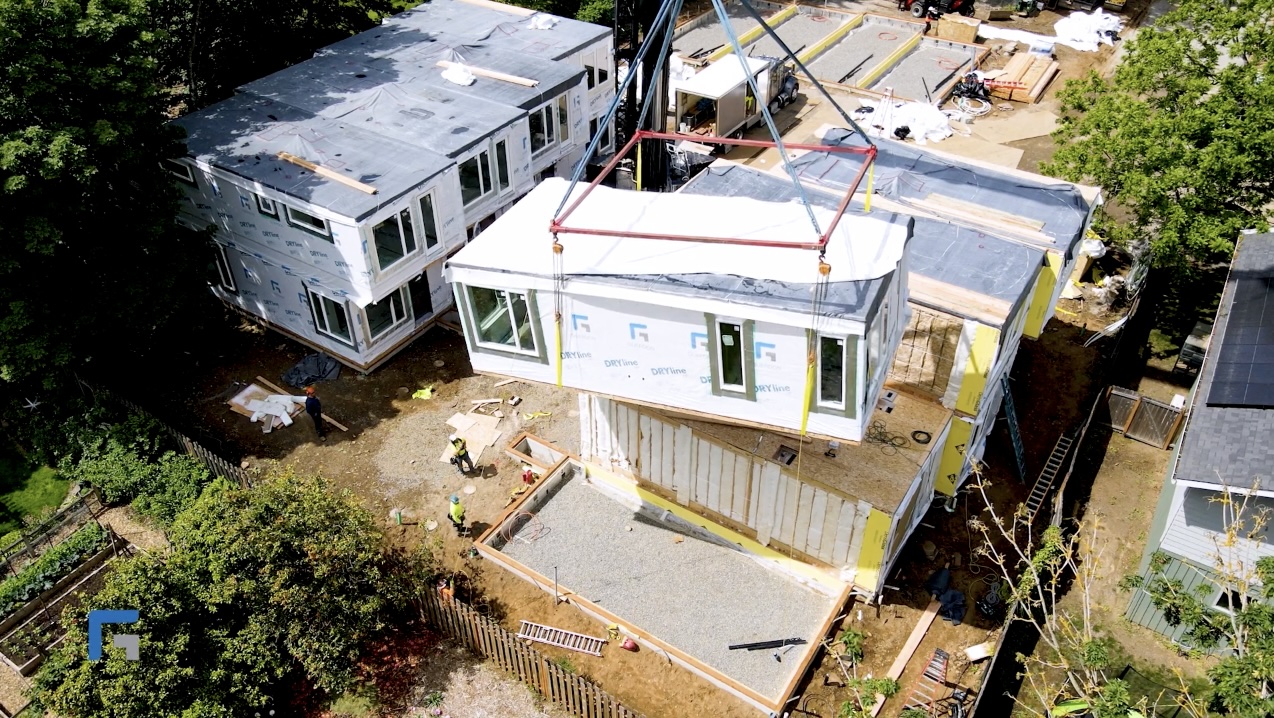
As state officials continue to search for ways to bring the cost of housing down, Utah’s governor recently floated one potential path for builders.
During a forum in late October, Utah Gov. Spencer Cox discussed modular building techniques as a potential route, saying the state should be enabling mass-produced, factory built housing to reduce construction costs and churn out new homes more quickly.
“We should be doing more on the modular side, because if you can standardize the way that we build, then you get some benefits of economies of scale and speed and manufacturing that you see in other areas,” Cox said during a session of the Ivory Prize Summit.
The Ivory Prize Summit is a yearly event put on by Ivory Innovations, a nonprofit wing of Ivory Homes that’s based at the University of Utah’s David Eccles School of Business. The yearly event recognizes organizations from around the country who offer up new, pioneering ways to make housing more affordable.
One such Ivory Prize winner this year was Reframe Systems, a Massachusetts-based company that uses “robotics and volumetric models to build the fastest AI-powered microfactory network, producing net-zero, modular housing,” according to the Ivory Prize website. In other words, Reframe uses robotic manufacturing to fabricate homes that are designed in house, and up to 85% of their build process is done in factories.
Clark Ivory, CEO of Ivory Homes, told Building Salt Lake he believes Utah needs this type of homebuilder. Though he hoped to convince Reframe Systems to open up shop nearby, he said the Massachusetts company plans to go farther west.
“I’ve been pushing the guys from Reframe Systems to come to Utah,” Ivory said. “They’re going to California next, but (they say) Utah will definitely be on the top of their list.”
Vista Station
Though he noted Utah does not currently have “a really serious factory built option,” Ivory said one of the company’s upcoming multifamily projects will utilize modular building.
Ivory Innovation’s Vista Station project in Draper will consist of roughly 200 units on a 5.24-acre plot that include one-, two- and three-bedroom units. A unit count has yet to be finalized, but around 64% of the units will be one-bedrooms, while the two-bedroom and three-bedroom units will comprise 32% and 4% of the unit count, respectively.
Ivory said the project will use Guerdon, an Idaho-based modular builder.
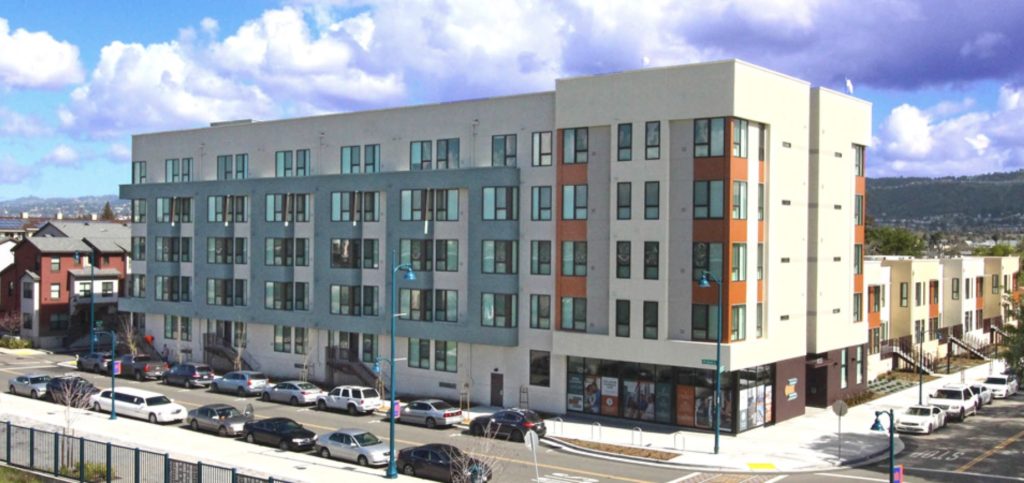
A modular project by Guerdon at the Coliseum BART station in Oakland, CA, completed in 2018.
Abby Ivory, president of Ivory Innovations, told Building Salt Lake that there was a steep learning curve when it came to embracing modular building, as it took around six months of work with Guerdon to figure out the most efficient build for the Vista Station project.
The project will be located at 13376 Vista Station Blvd, which is near the former eBay office and a short walk from Draper’s FrontRunner station. Due to its proximity to transit, the Ivory project is a part of one of Draper’s master area plans, which show that up to 2,553 residential units could be built nearby in the coming years.
An Ivory Innovations representative told Building Salt Lake the development is still in its early stages and has yet to finalize a site plan or exterior design. Work on the development is slated to begin in the summer of 2026 and will go vertical in early 2027.
Even with transportation costs to and from Idaho, Abby Ivory said the building cost for modular projects is around or just below stick built. She said she hopes that insight can help future developments be built with an even greater reduced cost.
Some Utah projects have already utilized modular homebuilding methods, like The Other Side Village in Poplar Grove or at the Box 500 Apartments in the Granary District, which used shipping containers in its construction.
Future modular projects
During his forum last month, Cox said builders in Utah have had no issue taking advantage of LIHTC to build affordable housing, but he wants to put more of a focus on building more attainable, for-sale units. He said missing middle housing is a real issue, as much of the housing units built over the past 20 years have been either large homes or apartment complexes.
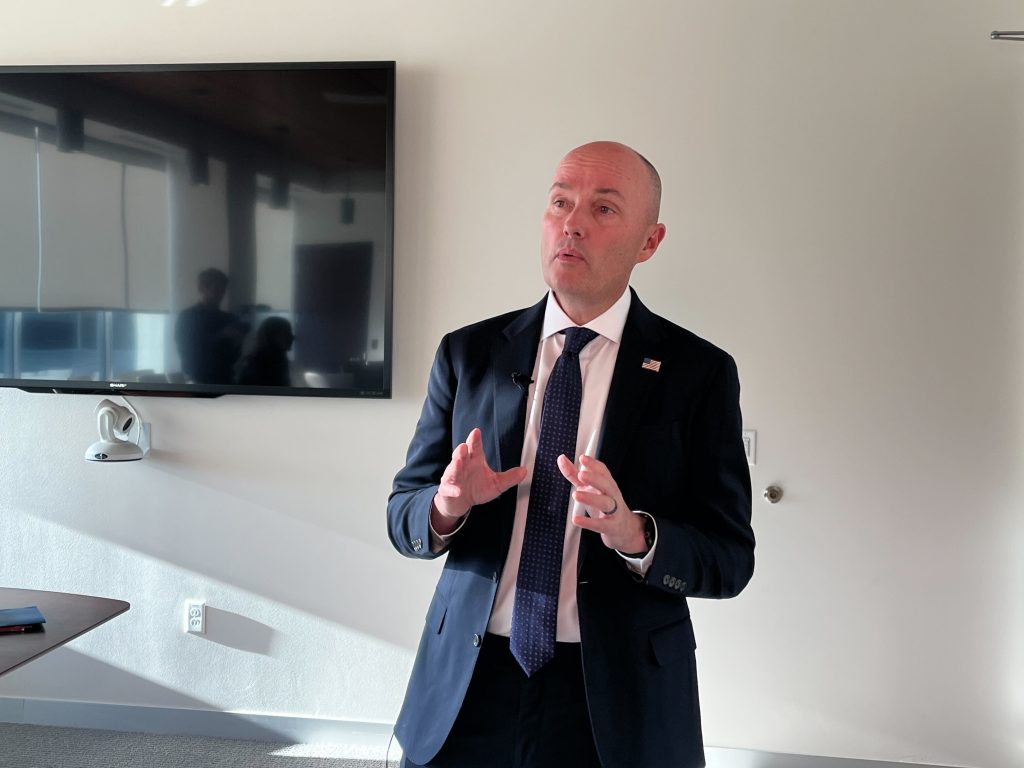
Utah Gov. Spencer Cox talks to the media at the Ivory Prize Summit in October 2025. Photo by Jacob Scholl | Building Salt Lake.
He said the state is “a long ways away,” from hitting his goal of building 35,000 new starter homes by 2028, but setting those sorts of ambitious goals are a challenge he’s hoping the state can rise to meet.
“It’s why we’re thinking outside the box with some really interesting, I think, and kind of radical new ideas and policies,” Cox said.
Last year, the Utah Legislature passed Senate Bill 168, adopting a statewide building code for modular units. That bill included standards set by the International Code Council and the Modular Building Institute. But despite that bill, Cox said varying city codes can still make it difficult to win approvals for that type of building.
“So standardizing that — we’re doing that at the state level, where we can do a state level code and a state level inspection for modular to make it easier,” Cox said. “Those are some areas where I think we could make some gains moving forward.”
Abby Ivory said a large modular building factory in Utah would do wonders to reduce building costs and speed up construction timelines. Clark agrees, saying that creating a large, modular building factory somewhere along the Wasatch Front could be a key piece in creating high-quality, attainable housing. He hopes the Vista Point development can serve as an example for other builders who want to utilize modular homebuilding methods.
“That project I think will be a nice one for everyone to watch and point to,” he said. “There’s been various things done with (shipping) containers and other things Downtown, but the truth is, real, high quality factory built housing is what we need. I’ve looked at a lot of the other concepts, and if we’re going to invest, we want to invest in something that’s proven, that’s really going to be quality.”













0 Comments