
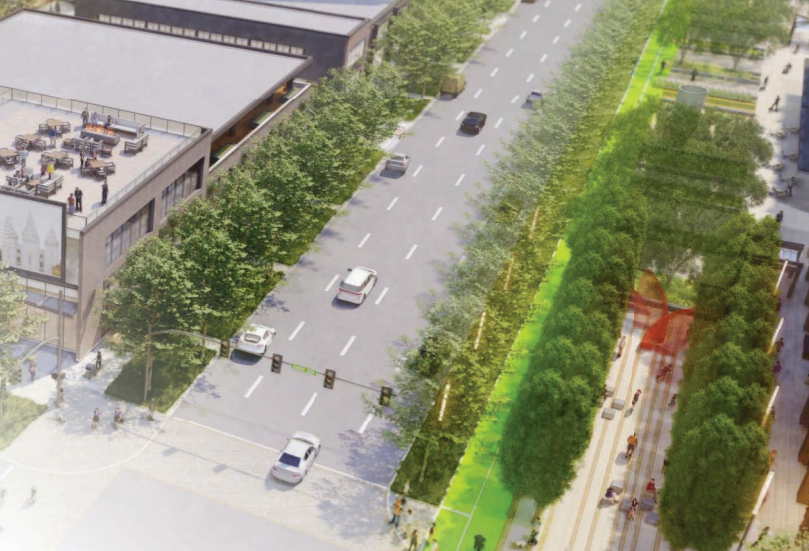
Two of Salt Lake City’s most car-dense, one-way streets could see an overhaul in the hopes of making the streets more pedestrian- and business-friendly.
In a presentation to the City Council on Tuesday, staff members from the council and Transportation Division presented the Grand Boulevards Concept Development Project — a long-simmering concept to change 500 South and 600 South between Interstate 15 and 700 East.
The goal of the project is to try and walk the fine line between keeping up the current vehicle flow and also increasing pedestrian, biking and other modal options for the streets.
Keegan Galloro, a transportation planner for Salt Lake City, acknowledged that any changes to 500 and 600 South would have to run through the Utah Department of Transportation, which is a byproduct of Senate Bill 195.
UDOT already owns the sections of 500 South and 600 South between State Street and I-15. SB 195 also stripped Salt Lake City of its ability to plan the portions of many streets around Downtown and beyond, including 500 South and 600 South east of State.
“As we all know, redevelopment is reshaping the landscape around this area and around these corridors,” Galloro said. “It’s moving from more of an auto-centric, business and warehouse kind of district, to apartments, restaurants, offices — places that people like to live, work and play.”
The Tuesday update was the latest in a long-simmering concept of making two key entrances and exits to and from Downtown Salt Lake City better looking and more welcoming for people who aren’t in cars.
There was no discussion about previous or ongoing efforts to reconfigure the rows of large billboards that line both 500 South and 600 South, indicating recent efforts to tame the billboards’ visual impact along the corridors is on the shelf for now.
A mixed council reaction
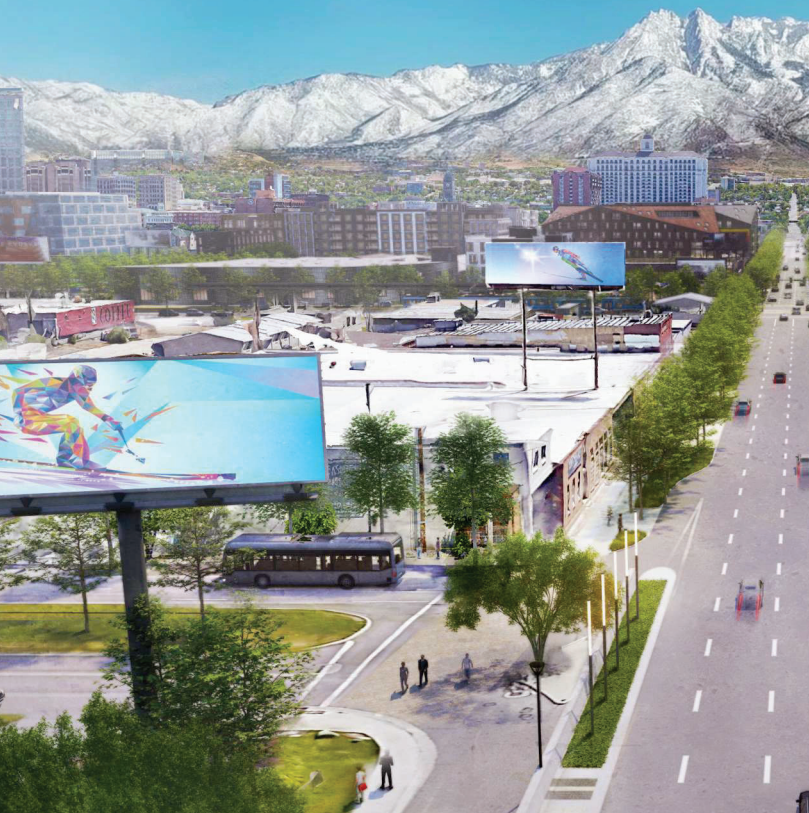
Reaction from the council was varied. Some members acknowledged the need for enabling different modes of transportation, but said cars need to get in and out of Salt Lake City.
Councilmember Dan Dugan said he likes the idea of Grand Boulevards going in and out of the city, but worried that activating the streets would be difficult as long as each are one-way.
“I’ve always thought about the idea of making those streets, at some point, two ways instead of one way,” Dugan said. “So you just slow down some different things, you can activate the street, and you can actually make it more livable as a walkable street.”
Galloro said making the streets two-ways is, “something that’s definitely on the table, and it’s something that we’re looking at.”
A number of Downtown businesses oppose any plans to slow down traffic or change how roads are currently used, said Councilmember Eva López Chávez. She asked city transportation staff how they could find balance in the project.
“We really do need to make sure that we’re addressing the needs of all users, and that does include people who drive,” said Jon Larsen, Salt Lake City’s Transportation Division Director. “As a city continues to grow and evolve, and our transportation system becomes more and more multimodal, I do think it’s important that we do that in a way that still leaves driving as a convenient option for many people who come to Salt Lake City.”
For Councilmember Victoria Petro, who represents Rose Park and parts of Fairpark, driving across town has become more of a challenge. She said more and more streets that run from East to West are either clogged with construction, have been narrowed down to one or two lanes or are too congested to use regularly.
“I just want to know, is there one time where we’re not going to penalize people who have been conditioned into actually needing a car, by virtue of family size, by virtue of not earning enough to have disposable hours in their day?” Petro asked.
She told city staff she regularly has to drive through Salt Lake City during peak hours to drop off or pick up her kids from school, and she often takes 500 and 600 South because those are the quickest options.
“You take our west side kids and send them to East High School, you send them to Highland (High School),” Petro said. “We have to cross the city in record time to not only pick them up when they’re sick, but to get to parent teacher conferences, to get to band concerts. There has to be at some point a consideration for what we’ve inherited through the legacy of the car, and not harming the people who are still dependent on it.”
Larsen said he’s heard from other west side residents with the same concern. He said understands using transit might not be the best option for everybody, adding, “The last thing you want is for people to feel like they’re being punished for driving when they’re just trying to go about their day.”
“The Grand Boulevard project, I think, is going to be a project about balance, and I really do believe that there’s enough space in the right of way to be able to meet our multimodal needs, our design needs, and create more highly functional, beautiful streets, while still keeping cars flowing,” Larsen said. “Might be a little bit slower, but we’ll still be moving the same number of cars.”
Nick Tarbet, the council’s deputy director of policy, said it’s still very early in the process of creating a plan for the two streets, and the council’s feedback will be considered in future concepts.
Galloro said the longest phase of the planning project will be for public engagement, which will start in the coming weeks. He said a plan for the area could be finalized before the end of the year, but it could be longer, as the city has had to shift its timeline in response to SB 195.

EDITOR’S NOTE: This story was updated to correct the credit for the draft renderings.















0 Comments