

The Salt Lake office market’s headline numbers still look bleak. Phil Brierley says they’re the wrong numbers to look at.
“If you look at those numbers, they tell you pretty much nothing about the Salt Lake office market,” Brierley, who leads CBRE’s capital markets team for office and industrial sales in Utah, told a crowd at the Urban Land Institute’s Trends conference at the Hyatt Regency on Tuesday morning. “The truth is that the Salt Lake office market isn’t really about the averages.”
The average is a market-wide vacancy rate of 21.8 percent, according to CBRE’s third-quarter report for the Salt Lake City-Provo market.
But Brierley said more than half of the area’s office buildings are at least 90 percent leased, and most of the empty space sits in roughly 30 percent of buildings. Vacancy in prime buildings near Downtown is just 6.5 percent.
That split, he argued, has pushed the market past the “flight to quality” that has defined office since the pandemic. It’s not that tenants stopped wanting the best buildings, he said. “It’s that the best buildings are full.”
The problem for Salt Lake City: the cost of developing new office space is far higher than current market rents can pay for. That delta is the largest single largest headwind toward seeing more new development break ground.
CBRE’s replacement-cost math shows new office needs rents of about $60 per square foot NNN, or roughly $72 all-in, to pencil. Top rents today are around $35 NNN.
Brierley pitched the room to push rents higher in top buildings, buy and upgrade the next tier, and start lining up land for the next round of office construction.
“From my vantage point, looking back at my career, this is probably the best opportunity we’ve ever seen,” he said.
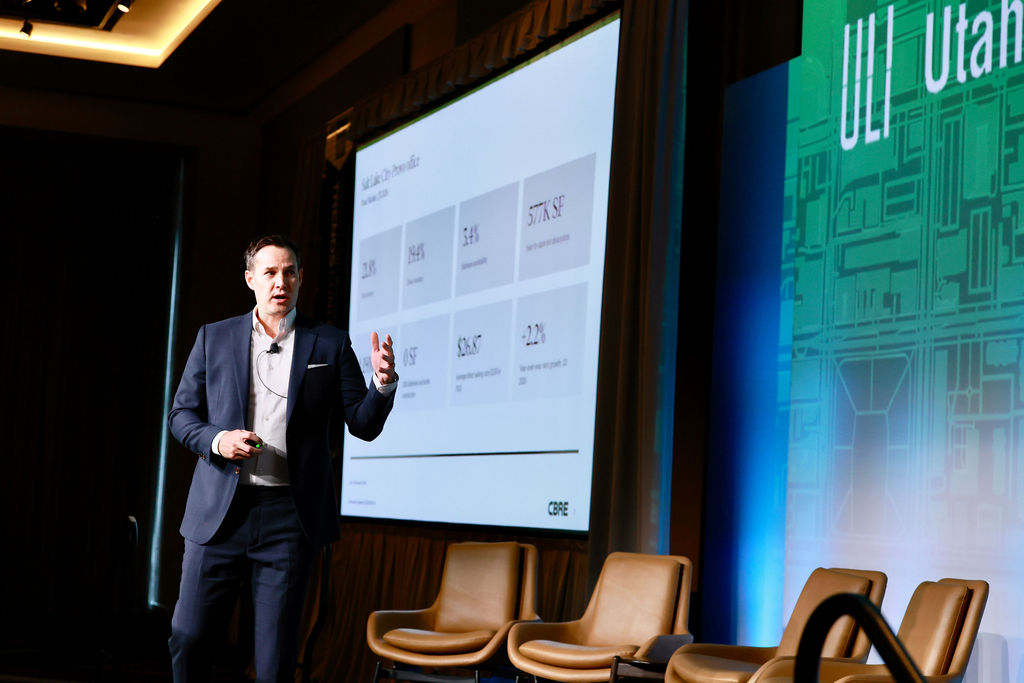
Phil Brierley, vice president with CBRE, speaks about the Salt Lake metro’s office market during ULI Utah’s annual Trends conference in Salt Lake City on Oct. 20, 2026. Photos by Kelli Freshman Photography.
Two years of shrinking vacancy
CBRE’s Q3 numbers back up the slow-but-steady recovery.
The Salt Lake City-Provo market, which covers Salt Lake and Utah counties, absorbed 161,000 square feet of office space in the quarter. That’s the eighth straight quarter of positive absorption and brings the 2026 total to 577,000 square feet, already more than the 488,000 square feet absorbed in all of 2025.
Overall vacancy fell 80 basis points from the second quarter to 21.8 percent, and is down 140 basis points from a year ago.
It’s the eighth consecutive quarterly drop. Total availability, which includes space coming open in the next six months, fell to 23.1 percent, its lowest level since early 2023.
Demand is moving down the quality ladder.
Class B buildings accounted for more than 95 percent of the quarter’s net absorption, gaining 155,000 square feet of occupancy, according to CBRE.
Class A added 36,000 square feet, while Class C lost 29,000 square feet.
Class B vacancy is still the market’s weak spot at 27.3 percent, but it’s down 260 basis points from a year ago, indicating that investors are already capitalizing on the opportunity for value-add in the space.
Q3 leasing was also strong. Tenants signed 1.52 million square feet of deals in Q3, 29 percent above the five-year quarterly average, though the number of deals hit a five-year low.
Class A buildings captured 74 percent of that volume. The largest deals included a confidential 218,000-square-foot renewal in the CBD periphery, Pattern’s 141,000-square-foot renewal and expansion in Lehi, and 1-800 Contacts’ 125,000-square-foot renewal in Draper.
At the top of the market, rents are climbing. Average asking rent for Class A space in the CBD hit a record $40.08 per square foot, full-service gross, up 10.9 percent from a year ago.
Asking rents at a few best-in-class buildings topped $50 per square foot for the first time, according to CBRE. Across the whole market, asking rent rose just 2.2 percent year-over-year, to $26.87.
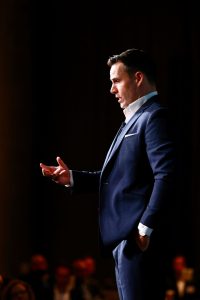
Phil Brierley, vice president with CBRE, speaks about the Salt Lake metro’s office market during ULI Utah’s annual Trends conference in Salt Lake City on Oct. 20, 2026. Photos by Kelli Freshman Photography.
Nothing new is coming to compete. For the third straight quarter, CBRE counted no office projects under construction in the market, down from nearly 2.9 million square feet across 16 projects at the 2020 peak.
‘Where the puck is going’
Brierley said 62.7 percent of all office absorption over the past 24 months has gone into ‘next-tier assets,’ buildings just below best-in-class.
“I’m going to say here at five to 9:00 on a Tuesday morning that we’re done with flight to quality, which I think is a pretty controversial thing to say,” he said.
He predicted 2026 will likely be the best year for Class A leasing the market has ever had.
At the same time, the supply of office space is shrinking. Brierley said Utah has lost 4.4 percent of its office stock, or about 2.4 million square feet, over the last two years to conversions and to owner-users buying buildings. That’s more than the state built from 2022 through 2026 combined, he said.
CBRE’s report shows the same trend at the metro level: about 1.2 million square feet left the competitive inventory over the past 12 months, compared with 120,000 square feet of new deliveries. In Q3 alone, the State of Utah bought the 312,234-square-foot former FranklinCovey headquarters, and Intermountain Health bought the 235,000-square-foot Fairbourne Station Tower to convert into a medical campus.
Why no one is building
On rents, Brierley pointed to a mismatch. Salt Lake has the highest employment growth of the 40 markets CBRE tracks, he said, but the second-lowest office rent growth. If rents caught up to job growth, “we should have double-digit rent growth in Salt Lake City.”
On cap rates, he said investors spent 2023 unable to price office at all. Office trades nationally fell by two-thirds, and Salt Lake didn’t see a single office sale over $20 million in 2022 or 2023.
Now buyers are agreeing on core office pricing again, in a 6.5% to 8.5% cap rate range, with primary and secondary markets converging. Salt Lake sits “right bang in the middle,” he said.
Brierley cited a recent local core trade of 60 Park Ave in Sugar House at a 7.3 cap rate and said more should land in the mid-7% to low-8% range. He doesn’t expect much compression unless interest rates fall. That sale set the new record for highest price per square foot for an office building in Salt Lake, Brierley said, at $408 per square foot.
What’s next
CBRE expects vacancy to keep falling. With no new buildings coming and more properties under contract to owner-users, tenants will increasingly be limited to renewing in place or taking existing vacant space, the report said.
Large contiguous blocks are already scarce in top buildings, and CBRE expects demand to keep shifting to the next tier of buildings and to other submarkets. That shift, the report said, is “gradually strengthening the fundamentals needed to support future Class A development.”
“That’s not to say that everything is perfect,” Brierley said Tuesday. “That’s not to say that everything is amazing and that the world has changed in office.”
But he told developers in the room the rents needed to justify new towers are “coming faster than we think.”









0 Comments