

Demand is catching up to supply in the Salt Lake County Industrial real estate market. And data centers are taking off.
The last time we reported, developers had added significant supply to the market, causing bloated inventory to suppress rents while absorption lagged.
Today, numbers from the second quarter of 2026 tell a story of vacancy gradually falling, absorption rates multiplying, and leasing solidifying. The Industrial sector, which includes Warehouse/Distribution, Manufacturing, and Flex/R&D spaces, isn’t monolithic, and sub-market differences stand out while reviewing reports from major brokerages in the Salt Lake County region.
Take a look at the Q2 2026 Industrial sector numbers with us, reports supplied by CBRE, Colliers, and Cushman & Wakefield.
Vacancy
Q2 2026 shows a marked improvement over vacancy (for all sub-markets) in Q4 2025, which stood at 8.9%, according to CBRE. The current numbers vary from different sources–with Colliers reporting Q2 2026 vacancy at the low end (5.67%) and Cushman & Wakefield on the high side (7.8%). CBRE pegs current vacancy at 7.2%, with 1% of that coming from subleases.
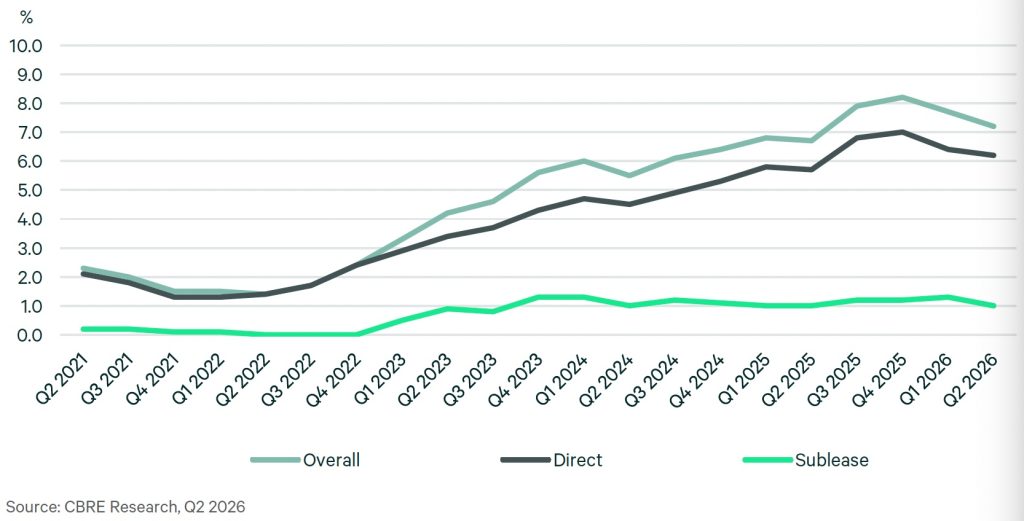
Vacancy across all Industrial types, as reported Q226. Credit: CBRE
Submarket variations are notable. According to Cushman & Wakefield, the bloat in vacancy (10.5%) is concentrated in warehouse/distribution facilities over 100,000 sf–whereas buildings between 10,000 and 100,000 sf are experiencing a low 3.3% vacancy rate.
This highlights “the ongoing disconnect between elevated big-box availability and strong demand for small- and mid-sized industrial properties,” according to Cushman authors Rebecca Lloyd and Jenna Bowen.
Absorption
Measured as space newly occupied minus vacations, there’s good news on the absorption front. Colliers saw a 39% increase from this time last year, measuring 530,000 sf of positive net absorption in Q2, and a year-to-date positive total of 2.3 million sf.
CBRE reports that absorption more than doubled from the previous quarter and was five times higher year-over-year. The reversal is remarkable from Q3 and Q4 2025, which saw negative absorption numbers of 416,000 sf and 372,000 sf, respectively.
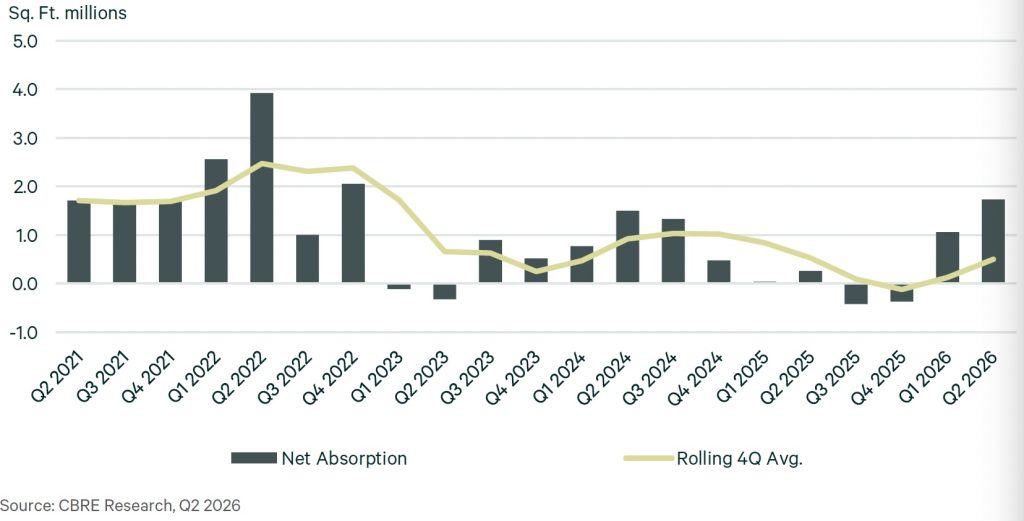
Net absorption trend as reported Q226. Credit: CBRE
Leasing activity
Leasing numbers, which track new leases signed, are mixed if not contradictory.
Cushman & Wakefield reports robust net increases both quarter-over-quarter and year-over-year. New leases, excluding renewals, surpassed 2 million sf, a notable increase from the 1.4 million sf from Q1 and an impressive year-over-year gain from the 647,000 sf leased in Q2 2025.
Yet CBRE reports a net slowdown over the quarter, declining 10.3% from Q1, amassing a leasing total of 2.8 million sf (a total higher than Cushman’s). Yet CBRE sees a silver lining in those numbers: “A smaller proportion of renewals and greater share of new lease transactions point to continued tenant expansion and market entry activity, a positive signal that demand is being driven by new occupiers rather than solely by existing tenants renewing in place,” write authors Blake Richter and Sierra Hoffer.
Again, geographical sub-market differences are an important part of the picture.
All sources point to the Airport-Northwest-California Avenue district as Salt Lake County’s most dynamic Industrial area. It contains not only 72% of Salt Lake County’s total Industrial inventory, but also accounted for 94% of total leasing activity (1.9 million sf) in Q2, according to Cushman.
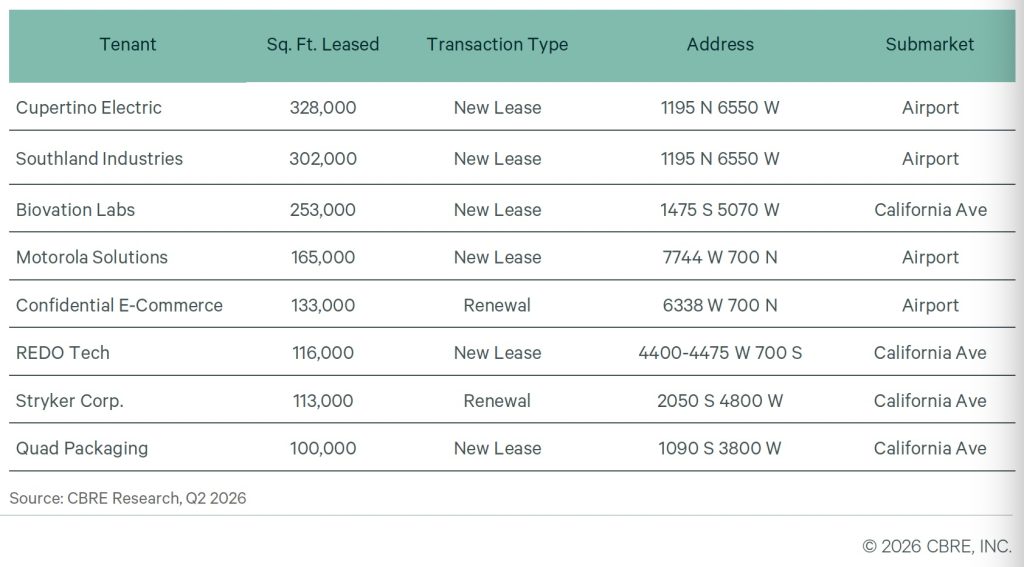
Industrial Q226 key leases. Credit: CBRE
Large Q2 leases in the area include Cupertino Electric’s 328,000 signing at The Quadrant III and Southland Industries’ 300,000 sf at The Quadrant II, with occupation for both scheduled for Q4 2026.
Rent
More good news in an over-supplied market: rents have stabilized.
Across all three property types–Warehouse/Distribution, Manufacturing, and Flex/R&D–asking rate rents pushed up quarterly from $.82 to $.87 per sf (NNN), according to Colliers. CBRE has that number at $.82, while also reporting modest increases quarter-over-quarter and year-over-year. Cushman concurs, seeing current rents at $.86.
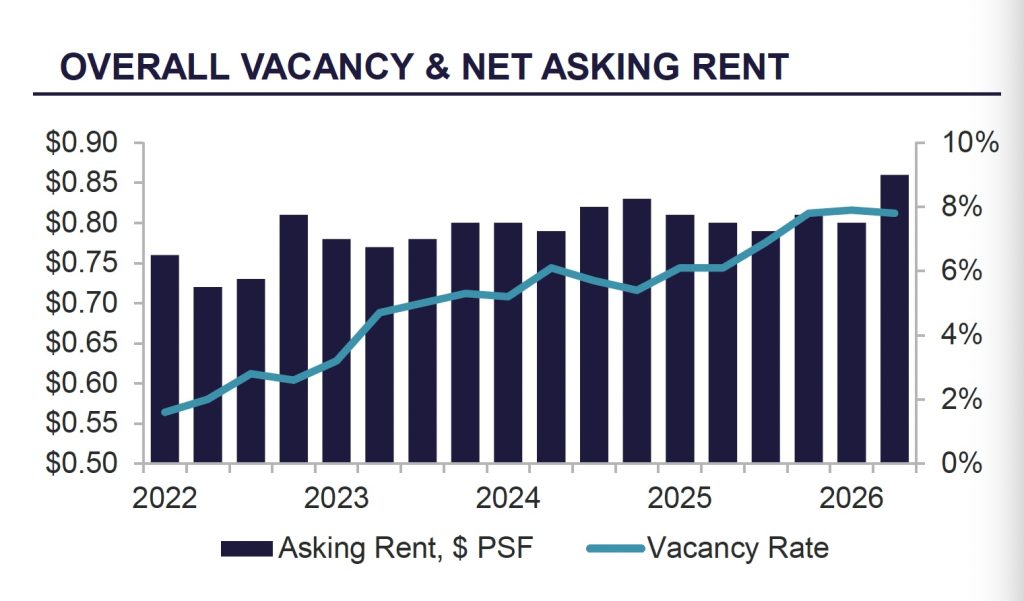
Industrial vacancy and rent rates as reported Q226. Credit: Colliers
Overall, the rent growth outlook remains “neutral” for the near-term.
However, property-type submarket differences are notable. Flex/R&D space, which includes improvements like offices, is renting at $1.13 sf (NNN), reflecting that “tenant demand remains focused on high-quality industrial space,” according to Colliers’ authors Megan Donnell and Jeanette Bennett.
Construction
As vacancy starts to dip, ground-up investors aren’t shying away from the construction market.
CBRE reports a 45% increase in square footage under construction from a year ago, totaling 2.6 million sf over 21 projects. Colliers points to nearly the same aggregate (2.8 million sf), while noting, with CBRE, that the grand majority of increased space is being created in Salt Lake City’s Northwest-Airport-California Ave zone.
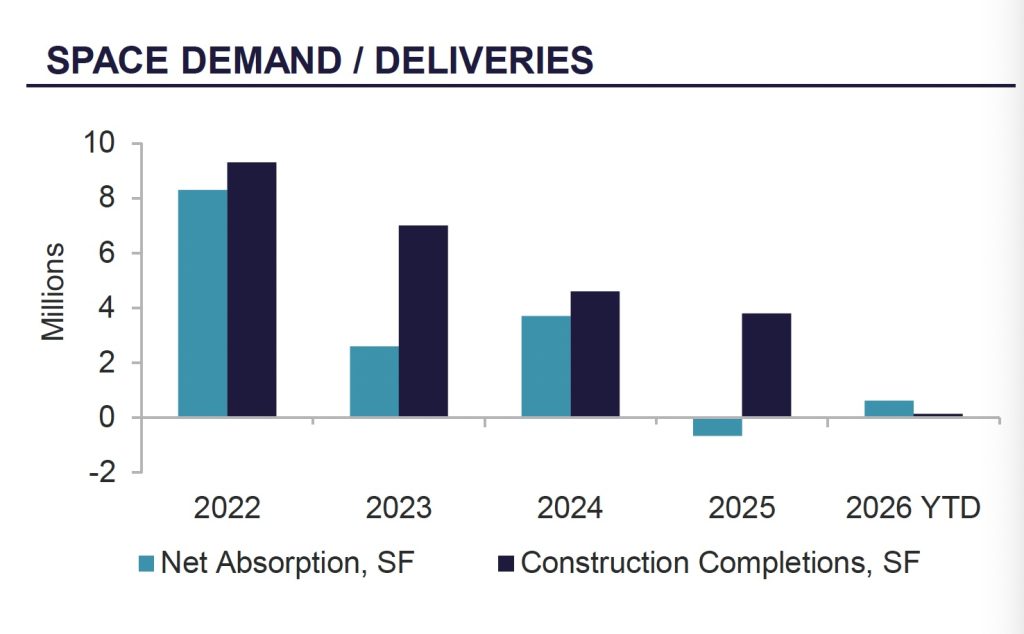
Industrial construction deliveries and absorption, as reported Q226. Credit: Colliers
Diversification of Salt Lake County’s Industrial stock is also happening. Colliers says that “the largest projects currently underway” are two large data centers in West Jordan, each enclosing 318,000 sf of space.
That trend, and acknowledging a new data center new product type, may become the lead for stories covering quarters to come.













0 Comments