

The private equity managers of the Industry SLC office building and incomplete 1,000-stall parking garage in the Granary District have defaulted on a $97.3 million loan, and the buildings are now in receivership and facing foreclosure, according to recent court filings.
The Industry office building is credited as being a catalyst in the neighborhood after it opened and quickly leased up in 2020, and the garage is expected to play a pivotal role in managing parking demand for a wave of nearby housing and mixed-use projects that have already been built or are in some stage of development.
Construction on the garage has been stalled, and a recent case opened by Acore Capital Mortgage in Utah Business and Chancery Court shows why: the buildings’ owners are in default, and new ownership may be coming.
Following a series of loan amendments and a September default, the existing deeds of trust allow the lender, Acore, to sell the properties, according to the complaint.
The complaint says that Catalyst Opportunity Funds, as the borrower on the properties, owes $103.7 million for the loan and other costs associated with the properties, plus attorneys’ fees.
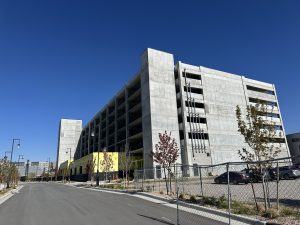
The Industry parking garage in October.
Catalyst is a Utah-based private equity firm that specializes in development in opportunity zones across the country. The company played a key role in backing projects around the Granary, as well as the Silos to the north. It is the largest single investor in the Granary District.
Catalyst took over both buildings in the wake of the collapse of Makers Line and its interwoven network of subcontracting companies owned by H. Jason and Ellen P. Winkler. Catalyst took control of the office in March 2023 and the garage in January 2024, according to the complaint. A judge in a separate court case wrote that Winkler “was fired.”
The developers had previously agreed to make principal and interest payments until Sept. 10, 2025, at which point they were required to pay in full.
Acore wrote that as of July 10 it had the right to collect all rent from the office building, but alleged that Catalyst hadn’t given it to Acore, according to the complaint.
According to a leasehold deed of trust between Catalyst and Acore in April 2025, Acore can move forward with non-judicial foreclosure in the event of a default by Catalyst.
Court documents show Acore issued a notice of default directly to Catalyst three months later. It notified the Salt Lake County Recorder of the default on Oct. 21, waited the required 10 days and moved toward foreclosure on the buildings on Halloween.
The garage, at 647 S. Granary Way, is owned by AAM Investments, LTD., which is registered to Bruce Markosian.
Neither Catalyst nor Acore respond to requests for comment.
A pattern of Industry defaults
The pending foreclosure follows what has become a pattern of trouble for Industry developments.
The Winklers moved to Salt Lake City after their development group Q Factor developed Industry office spaces in Denver’s RiNo district, a revitalizing area similar to the Granary. The projects were known as Industry Denver and Industry RiNo Station.
They soon created a similar development in a similar neighborhood in Salt Lake City with the 150,000-square-foot Industry SLC office building.
But after apparent financial turmoil leading up to and following the collapse of a web of subcontracting companies the couple launched in Utah, Q Factor lost its management role in the buildings. The recent default lines up with what has happened with the Industry buildings in Denver.

H. Jason Winkler | Q Factor
Those projects have similarly gone through defaults and ownership and management changes following the collapse of Makers Line.
Industry Denver, which opened in 2014, defaulted on $29 million loans in late 2023. Conscience Bay Company bought the building in 2024 for $19 million and rebranded the space to Fabrica RiNo. Industry RiNo Station at 3827 Lafayette St. in Denver was placed in receivership earlier this year after defaulting on $60 million in loans that were secured on the property.
Industry RiNo Station remains in receivership, and late last month the receiver disclosed that the building is less than half leased, Business Denver reported. Winkler has told that news outlet that he owns about half of the building with another, undisclosed, family.
Winkler has told Business Denver that the ownership group had “months of interest payments sitting in reserve accounts with the lenders, but those dollars cannot be used for paying interest,” Winkler told the outlet in March. “We are currently working with the lender to resolve this crux and hope to be back on track soon.”
Winkler didn’t immediately respond to a request for responses in writing on Tuesday.
The defaults in both cities followed a quick rise in valuations across commercial real estate and record-low borrowing costs throughout the COVID pandemic. Inflation spiked and the Federal Reserve began raising interest rates at the same time that office valuations were falling following the rise in vacancies and demand for newer office spaces.
That made it more difficult to both refinance out of loans and sell properties at a profit, two traditional paths for office landlords.

Post District in October 2024
Delays to the garage’s construction caused by the Makers Line collapse may have contributed to the perfect storm that has led the properties toward foreclosure.
What does this mean?
It’s too soon to say what the downstream effects of a foreclosure and eventual sale could be for the trajectory of the Granary District.
Catalyst is a partner with other major players in the neighborhood. Specifically, the group said that it has invested $600 million in the broader Granary area, along with Blaser Ventures and Lowe Property Group.
Blaser and Lowe recently recapitalized the Post District immediately north of the Granary in a $170 million deal.
Blaser is likely the largest single landholder in the area, with plans to develop holdings from Kilby Court west to Granary Live and more. Blaser didn’t respond to a request for comment.
The future of the garage is key not only because of its role as a shared space among multiple users, but also because the building’s ground floor is slated to include 12,000 square feet of commercial space, creating a mid-block retail node and broadening out retail offerings in the Granary.












0 Comments