
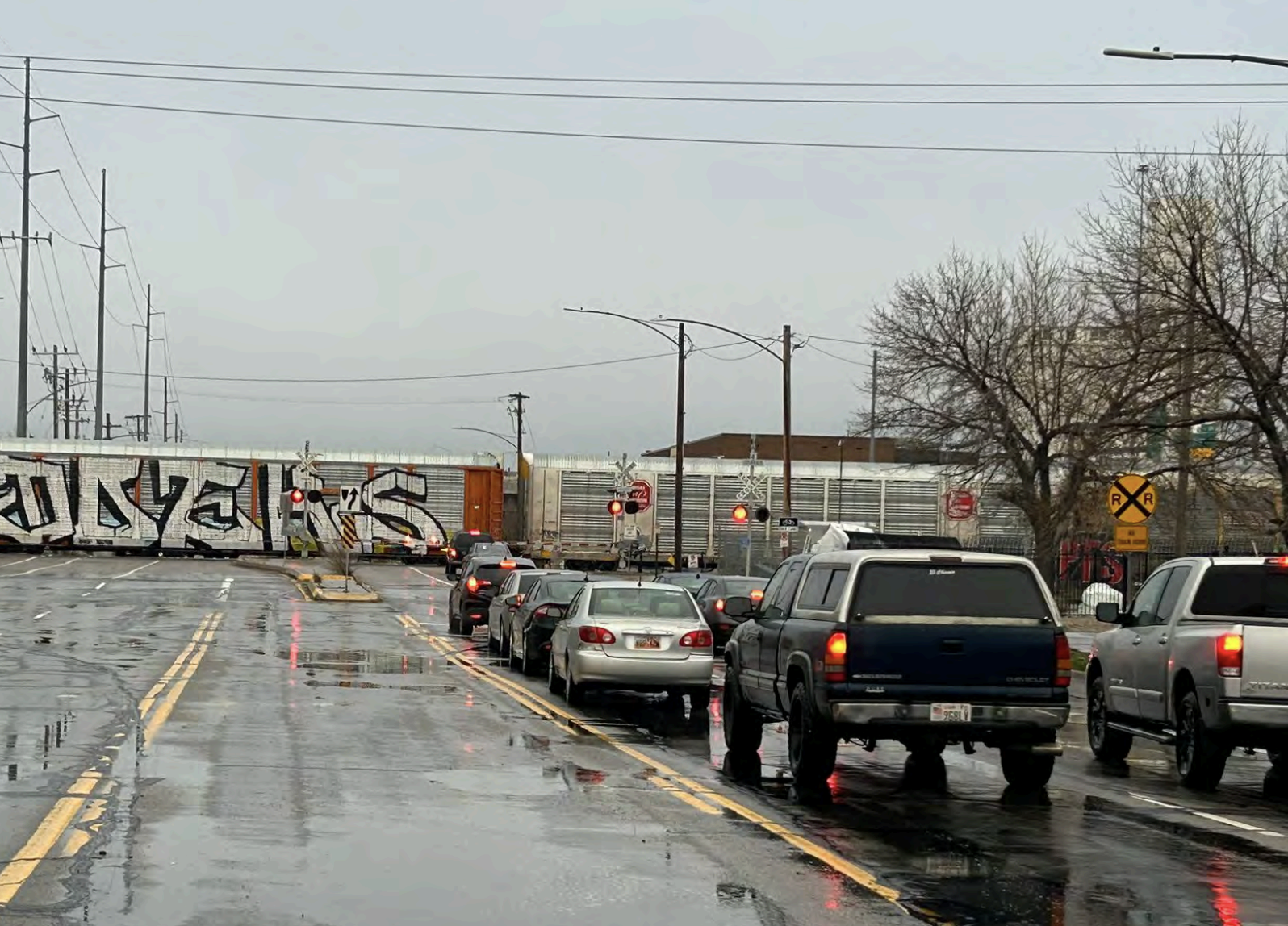
West side residents routinely have to head east to access basic daily needs, like going to work, getting groceries or accessing healthcare — all while experiencing frequent delays at train crossings that can last from a few minutes to several hours.
For those who live on the west side, that delay isn’t much of a surprise.
But it’s one of the newly released findings from a Salt Lake City survey taken earlier this year as part of the city’s West-East Connections Study, an effort to improve transportation between the two sides of the city. The survey and the overall study was discussed Tuesday by members of the Salt Lake City Council during a work session.
Joe Taylor, a project manager for Salt Lake City’s transportation department who is overseeing the study, said the notion of west siders frequently having to leave their neighborhoods for services isn’t new.
“What we heard will be pretty unsurprising,” Taylor told the council. “It’s real clear there’s a really robust mobility challenge in the city, and that’s at the top of people’s minds when you try to get from one half of the city to the other.”
Over 1,000 west siders responded to the survey, which found that 81% of respondents cross the West-East divide on a daily basis, according to a staff report on the study. In addition to crossing that divide, 71% of respondents said their travel is delayed by train stoppages on either a daily or weekly basis. Around half of respondents said they use overpasses to avoid potential delays at train crossings.
The staff report noted that the maximum wait time observed during the study ranged from 23 minutes to a whopping 14 hours. The latter figure made Council Member Alejandro Puy, who represents the Poplar Grove and Glendale neighborhoods, do a double take.
“Is that a typo there, or is it 14 hours?” Puy asked city staff. Taylor said yes, it was correct. The city’s administrative transmittal indicated a 14-hour wait time took place at the 600 West train crossing.
Puy said it is “astonishing” how bad some of the train crossings are, adding that he knows of businesses on the west side that consistently have issues with train blockages that cause employees to be late.
“The effects of this issue are huge on the west side, and I’m excited that we are finally sort of coming to that realization,” Puy said.
When it comes to mode of transportation, 92% of respondents said they use a car to get around the city — by far the preferred transportation method — while around 55% said they use public transit. The survey also found that 39% of respondents use their bike to get around and 36% said they walk.
Despite the solid survey turnout, the staff report acknowledges that the results may be skewed based on the survey pool. For example, Latinos are underrepresented in the survey, as only 11% of survey respondents identified themselves as Hispanic or Latino while U.S. Census data indicates the west side’s population is around 48% Latino.
Homeowners also make up an outsized portion of survey respondents. Around 72% of respondents said they were homeowners, while only around 54% of west side residents own their homes, the staff report says.
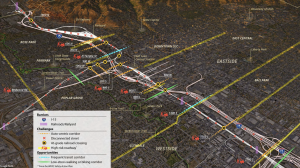
A map of the East-West transportation corridors in Salt Lake City. Image via Salt Lake City
Council Member Victoria Petro, who represents the Fairpark and Rose Park neighborhoods on the west side, said it’s important to note that lower-income residents were also underrepresented in the survey, and she hoped that future surveys or analysis is more in line with the area’s demographics. Petro said another important transportation aspect is analyzing travel from north to south, not just from west to east.
“If you are north of the rail lines and there is something blocking 600 West, 800 West, 900 West, and permanently blocked 1000 West, your option is to go over the viaduct into Downtown via North Temple and circle around, or go all the way down to Redwood Road, both of which are already congested corridors,” Petro said during the meeting.
Petro later told Building Salt Lake it was validating to have the experiences of west siders quantified into a study. Still, she wants to see the demographic gaps addressed in future analysis of the problem. She said the findings didn’t surprise her, but it did outline an issue that’s larger than Salt Lake City.
“For me, it’s more the greater futility of how disparate things are in the state, with public transit being funded at a different level, and the lack of control and culture war concerns about the ability to get people on the same page to make the necessary investments,” Petro told BSL.
In the future, Petro’s hope is for the study to paint a comprehensive picture of the area’s transportation issues that connect all pockets of the city, not just the issues of traveling from the west to east sides.
“I hope that we have a strategy that arises that is well justified,” Petro told BSL. She said she hopes for, “something that is actually responsive to future stressors, to where the development is, where jobs are going.”
Taylor said the survey discussed Tuesday was the first phase of the study, and the second phase would consist of more robust community outreach. A slide deck presented to the council showed the second phase is expected to last from December to August 2026. An action plan based on the study could be created some time in early 2027.



















0 Comments