
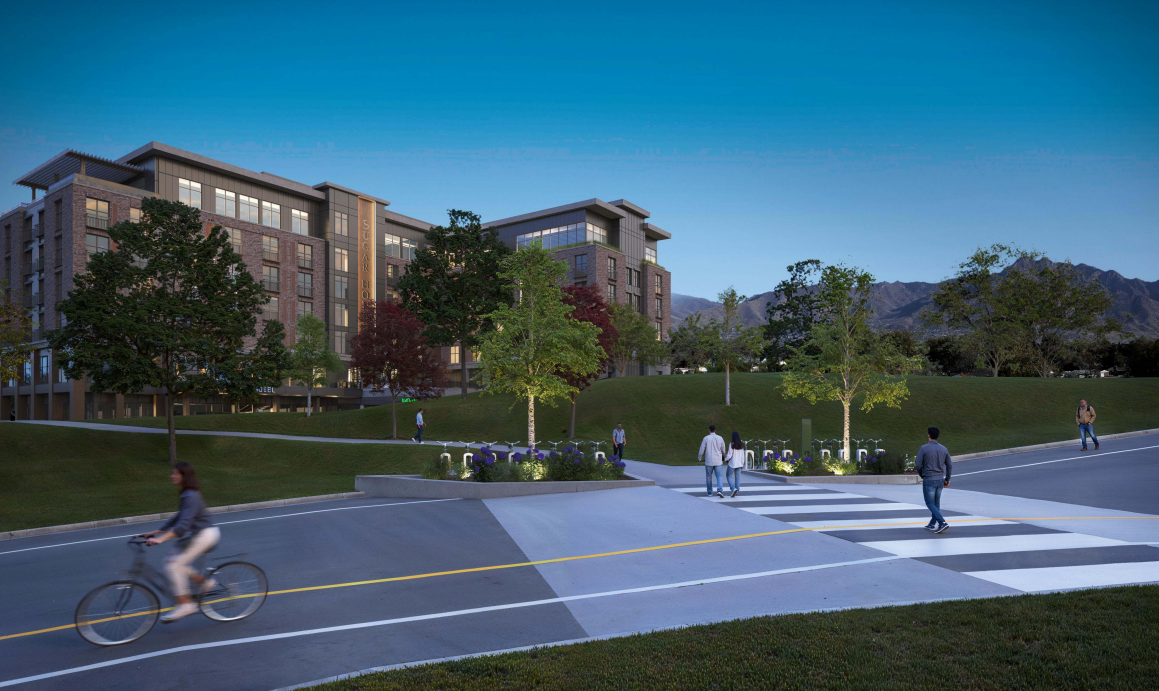
Over a year after plans for a hotel near Sugar House Park became public, the proposal is likely dead following a surprise vote by the Salt Lake City Council, leaving the future of the parcel in question with few clear answers for what might come next.
It was the third separate attempt to develop the former Sizzler site, as proposals to build multifamily housing and a gas station were also unsuccessful under pushback from residents. The Salt Lake City Council’s seven members voted in unison Tuesday to reject the hotel proposal, likely ensuring the 0.82-acre parcel will remain vacant for the foreseeable future.
The vote threw into question whether the neighborhood and City Council would accept any proposal for the site, whether another developer would step in to attempt something new, and even the value of the property itself after six years of a political quagmire.
John Potter, founder and CEO at Magnus Hotel Management, told Building Salt Lake the vote was disappointing but not entirely surprising, given the neighborhood’s strong resistance to the project. He believes the hotel would’ve added a number of jobs and economic benefits to the area, as well as community benefits and amenities for locals like the rooftop restaurant and retail spaces.
“We think the hotel project would have, in the long run especially, been great for the neighborhood,” Potter said Wednesday.
Potter said next steps on the project are still being evaluated, but he said, “We’re not in an encouraging mode, given the uniqueness of the site and the feedback regarding why our application was rejected.”
Given its proximity to the park, high land value, low-density MU-3 zoning and an existing ground lease agreement still in place, the future of the parcel at 2111 S. 1300 East is uncertain. Whatever the solution may be, potential paths forward will likely be costly.

WHAT ELSE COULD BE BUILT?
Industry experts told Building Salt Lake there’s a number of issues that complicate any future solution for the parcel and could lead to it sitting vacant for over a decade.
Kip Paul, vice chairman of investment sales at Cushman & Wakefield’s Salt Lake City office, represented the land’s current and longtime owner in the deal with Kum & Go. He explained that Maverik, which bought Kum & Go in 2023, still holds the remaining 15 years on a ground lease for the site. The company owes $250,000 each year to the property owner, Paula Romney Farr, who doesn’t plan on selling.
“Maverik is going to just keep paying, the fee simple owner isn’t going to sell the land, and so we just sit until (the City Council) approves something,” Paul told BSL. “If Maverik tells us ‘we’re not going to do anything with it, just stop and we’ll just sit on it and make the payments,’ you’re going to have that corner in its current condition for 15 years.”
If someone came along and wanted to build something else in line with the existing MU-3 zone — something like a restaurant, cafe or beer garden — “they’re clearly not going to be able to pay $250,000 a year in rent, that’s pretty lofty,” Paul added. Maverik could potentially pay part of that difference in a sublease if they want, but that added expense could complicate a deal for a potential tenant.
Paul said it’s also tough to secure financing for a ground lease, adding that the existing 15-year term “is very short for a land lease, so it just kind of sticks the whole project into a quandary where it’s just challenging from all angles.”
In years past, he explored the possibility of the city’s Public Lands Department buying the land or swapping it for a different parcel, but the funds weren’t available on the city’s end. (Salt Lake City paid $7.5 million to buy Allen Park after it was poised to be developed into housing in 2020.)
“If somebody wants it to be part of the park, then they need to come up with money to make that happen,” Paul said. “I mean, it’s privately owned property, and you can’t fault the fee simple owner for wanting maximum value out of it.”
Council Member Sarah Young said in an interview that she voted against the measure because she believed expanding the neighborhood’s business district east of 1300 East sets a worrisome precedent.
She said the city worked hard with the community to establish more density in Sugar House’s urban core, which is one of the new places in the city that allows heights up to 150 feet in mixed-use zones.
“To now say that the business district actually extends beyond the traditional boundaries that are outlined in a community plan, it just felt, for me, like the real sticking point that I couldn’t get past related to the proposal,” Young told BSL on Wednesday.
ECONOMIC DIFFICULTIES
Andra Ghent, the Ivory-Boyer Chair in Real Estate at the University of Utah and a former member of the city’s Planning Commission, said the land’s MU-3 zoning — which caps building heights to 35 feet by right and 40 feet through a design review — would make things difficult for any developer to build something that’s economically viable.
Currently, the taxable land value for the site is just over $2.56 million. Ghent said ground floor retail space would be ideal for not only the neighborhood, but park users as well.
However, given the landscape of Salt Lake City’s multifamily market and the glut of new units that have come online in recent years, it would be difficult to build housing in a way that would be economically viable without upzoning the parcel.
“What I think would be a good trade for the city would be something with first-floor retail, but higher height,” Ghent told BSL. “Retail sometimes doesn’t pencil in mixed-use buildings, but if they could go, ‘hey, you can go to five stories, maybe not 90 (feet), but five stories if you put ground floor retail,’ maybe that would pencil.”
Parking throws another wrench into the possibility of developing the site, as any retail or residential uses would likely draw in more traffic than a hotel would. Ghent said a hotel would’ve been a fairly ideal use, given that it would typically draw less car traffic than retail or residential uses would. She added that building a hotel would’ve been a tax boon for the city, as the development would’ve not only drawn in property tax gains, but also funds from the transient room tax, which in Salt Lake County is 4.75%.
Either way, the financials on developing the property would be tricky — especially given the existing ground lease and existing low-density zoning.

An application filed Jan. 14, 2022, would replace a vacant restaurant overlooking Sugar House Park with a gas station at 2111 S. 1300 E. in Salt Lake City. Photo courtesy of Google Maps.
“I don’t know if something like what standardly goes in the MU-3 zone would actually pencil, given that Maverik has that ground lease on it,” Ghent said.
Peter Corroon, president of Sentry Financial’s real estate division and a longtime developer around Salt Lake City, said a hotel seemed like a good option for the site, though he added the height was, “probably too big for that site location.”
He said a smaller boutique hotel could be an option for the site, but having a hotel of any size would require a rezone. According to Salt Lake City’s zoning code, hotels and motels are permitted uses starting at the MU-5 zone, but not in the MU-3 zone.
Height and potentially obstructing views were some of the numerous issues that Sugar House residents had with the hotel plans, though city staff previously noted in reports that a 40-foot structure built in accordance with the MU-3 zone would be enough to block mountain views.
FUTURE DEVELOPMENTS
Young said her fellow council members also had issues with the proposal, including concerns over having parking as a proposed community benefit and potential traffic impacts to the surrounding roadways.
Young added that the Sugar House Park Authority has ideas of what to do with the parcel, but said those plans aren’t yet public.
“From my position as a council member, the best folks to figure out what makes sense there are going to be the neighbors who represent the (Sugar House) Park Authority, in partnership with the Sugar House Community Council,” Young said. “They care about the neighborhood, they care about the park, and they care about the business district. So putting all of those interests together to come up with a solution is going to be our best way to find a way forward.”
If Young had her way — she said the parcel would be developed into a beloved Utah staple that’s gone but never forgotten.
“When I was running for this position for the first time in an elected capacity, they asked us what should be on that corner, and I stand by my answers still today, which is we need to bring back Training Table,” Young said with a laugh. “Whenever somebody asks, ‘what would you put there?’ it literally is my answer, and I feel like it’s my best way to manifest it into reality.”












0 Comments