
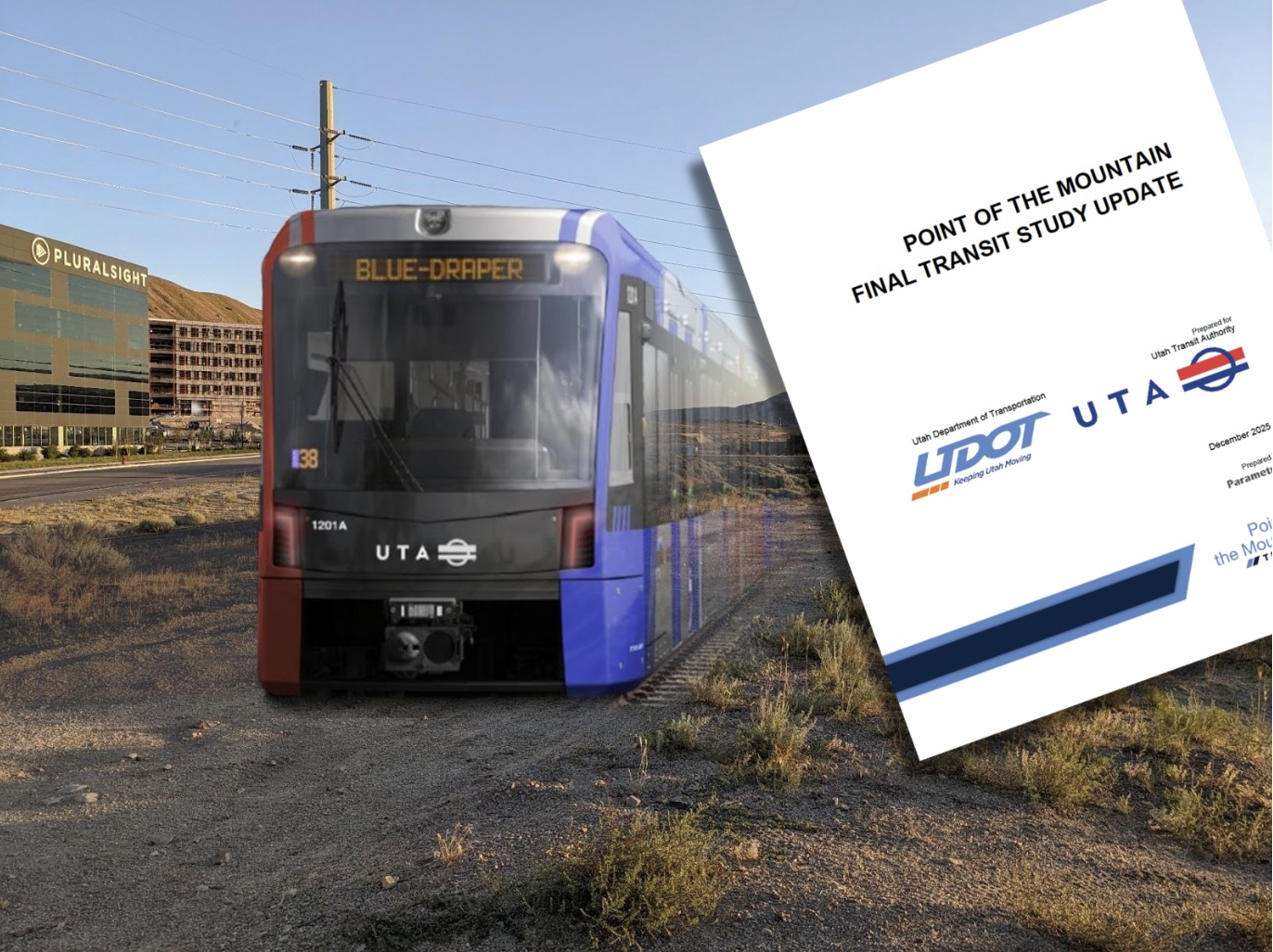
The Utah Department of Transportation (UDOT) has released the final study update on the Point of the Mountain transit project. It marks the end of a seven-year effort to determine better transit connectivity between the Draper and Lehi geographic chokepoint, known locally as “The Point of the Mountain.”
In reality, this project was more an exercise built around accommodating and legitimizing a state redevelopment vision for the former prison site known as “The Point.”
The conclusion reached by this final update leaves doubts that the project will start anytime soon. It states that the $1+ billion dollar project will need to be put on hold indefinitely until funding can be determined. And that funding source would have to be entirely local, as the preferred alternative’s chosen mode of light rail was found to not meet ridership requirements imposed by federal grant programs.
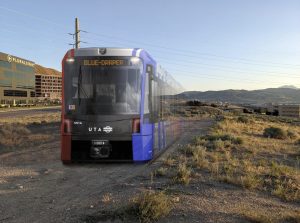
All of this is disappointing for transit planners in Utah county who have long sought for a TRAX extension farther south. With that goal explicitly reflected in the metro area’s TransPlan50 Regional Transportation Plan, which identifies future light rail expansion into Utah County. The most direct and practical way to advance that objective would be to extend the Blue Line beyond its current terminus at the Draper Town Center station, using infrastructure and rights of way which have been ready to accept rails for over a decade. But the Point development is now holding that plan hostage.
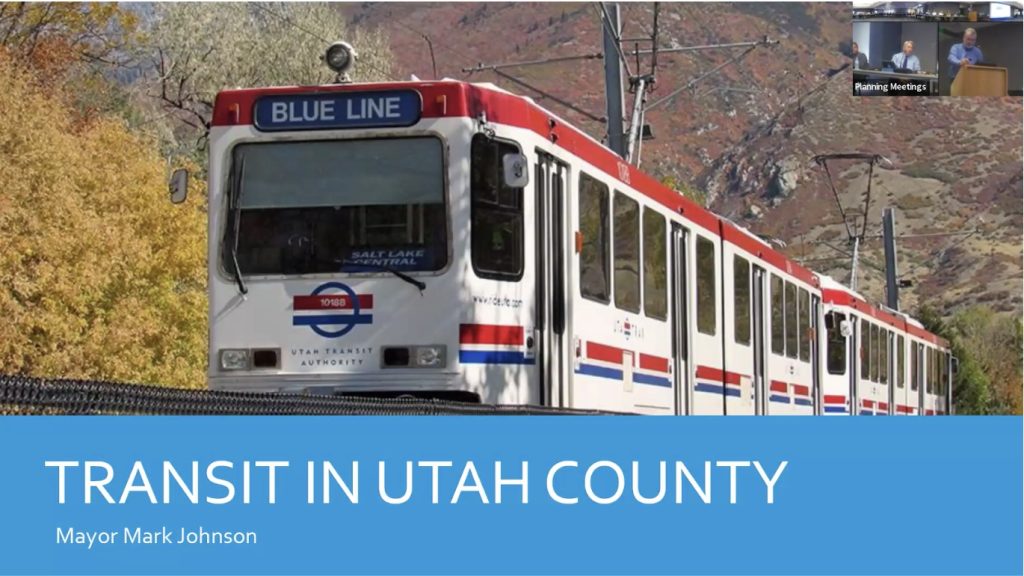
Presentation given by Lehi City Mayor Mark Johnson in October 9, 2025 petitioning UDOT that a higher priority be placed on the Blue Line extension.
The study documents themselves show that a Blue Line extension makes more sense overall. Although a bit of digging is required to get to this conclusion, as a Blue Line extension was not part of the final study. However, a ridership and cost model for this alternative can be inferred by looking closer at some of the details in the various documents released.
Numbers that speak for themselves
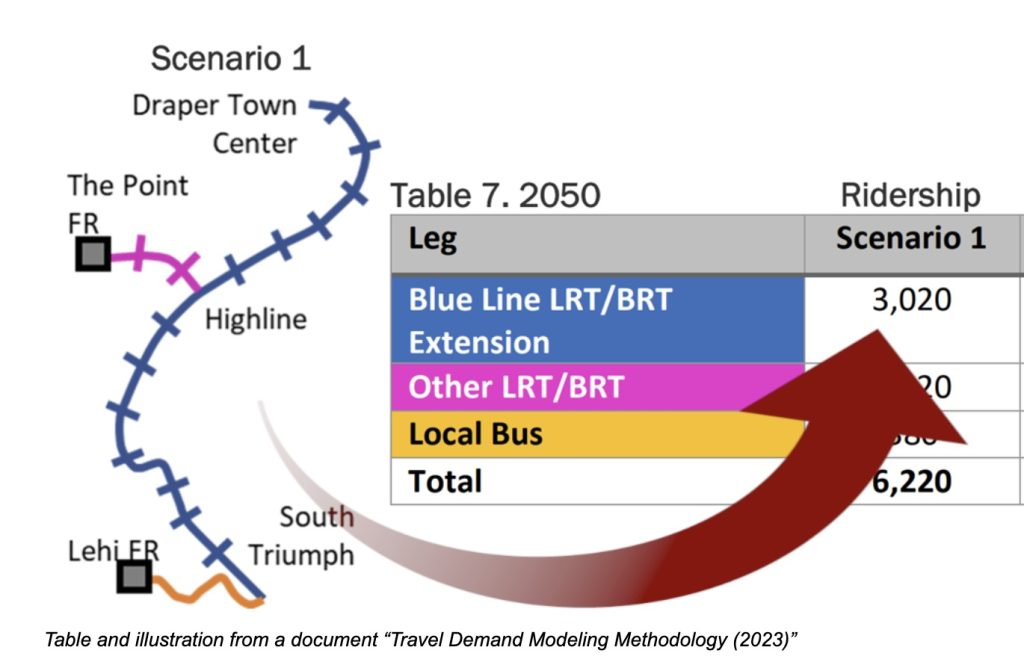
Let’s start with ridership. The current design that serves the Point development is projected to reach up to 4,370 daily riders by year 2050. For the Blue Line extension ridership projection, we need to look at a study appendix document labeled, “Travel Demand Modeling Methodology”. Table 7 of this document shows a total of 3,020 daily riders for the year 2050 between Draper Town Center and South Triumph stations.
Next, we’ll get the cost estimates for both of these alternatives. UDOT reports a total cost of the current design to be $944 million (2022). Inflation brings the cost to $1.3 billion, but we’ll leave that out to keep things simple.
The Blue Line alternative is a bit trickier to nail down. The study does provide a cost spreadsheet separated by project segment, but this does not include the segment between Draper Town Center and 146th south. Building Salt Lake was able to obtain through a GRAMA request the cost of this missing segment. This new information estimates the cost at $169 million. Adding in the segment from 146th south to the terminus in Lehi, we come out to a rough total of $593 million. This includes vehicles and all categorical contingencies needed in order to make a fair comparison.
We can now see that while a Blue Line extension underperforms by about 30% in daily ridership, it outperforms with a respectable 37% reduction in cost. Overall making the Blue Line extension a 8% more cost-efficient design over the state’s current plans.
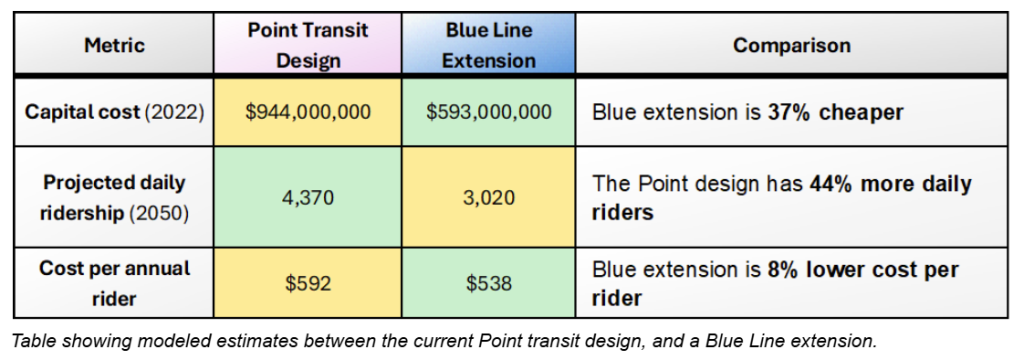
For many projects, the cost per annual rider metric is just as important, if not more important, than pure ridership counts. Though, the UDOT study seems to place a higher emphasis on ridership. Other successful light rail projects fall into the realm of $300 per annual rider. At $538, the Blue Line extension nudges closer to meeting that over UDOT’s design ($592).
A Viable Future for the Project
At less than two-thirds the cost, this seems like a slam dunk for the Blue Line extension, but there is one last thing to mention – funding. As stated in the study, the project’s poor ridership would not qualify for a Federal Transit Administration’s (FTA) grant. And that fact is going to hold true even with the new numbers we have.
Not only that, but the current federal administration is looking to fund fewer transit projects, causing many states to either delay projects, or fund them locally. For a Blue Line extension, $593 million is well within the realm of projects that UDOT routinely completes without federal assistance. For comparison, the recently completed West Davis highway had a cost of $750 million. If UDOT wants to get serious with their new transit division, they need to build rail. And they need to take every opportunity they can to do so.
The fact is, given current zoning, this area may never densify enough for light rail to make sense on its own. However, this corridor should be viewed in the greater context of the regional transit network. It is a vital extra link between Salt Lake County, and Utah County. And importantly, it quickly gets riders around the point of the mountain with very limited stops along the way.
It should also be noted that none of this is an argument against the success of the Point development itself. On the contrary, the redevelopment of the former prison site is one of the most significant land-use opportunities the state has undertaken in decades, and it deserves to thrive. The Point is already receiving substantial direct investment to support that goal, including roughly $200 million for a new FrontRunner station and associated infrastructure designed specifically to serve the site. That level of rail access should not be discounted.
However, the numbers don’t support the state’s priorities for the Point Transit Project. As demonstrated, a Blue Line extension is superior by almost every metric, can realistically be funded locally, provides a transportation alternative, and allows Utah County to start fulfilling their transit goals much sooner.
















0 Comments