

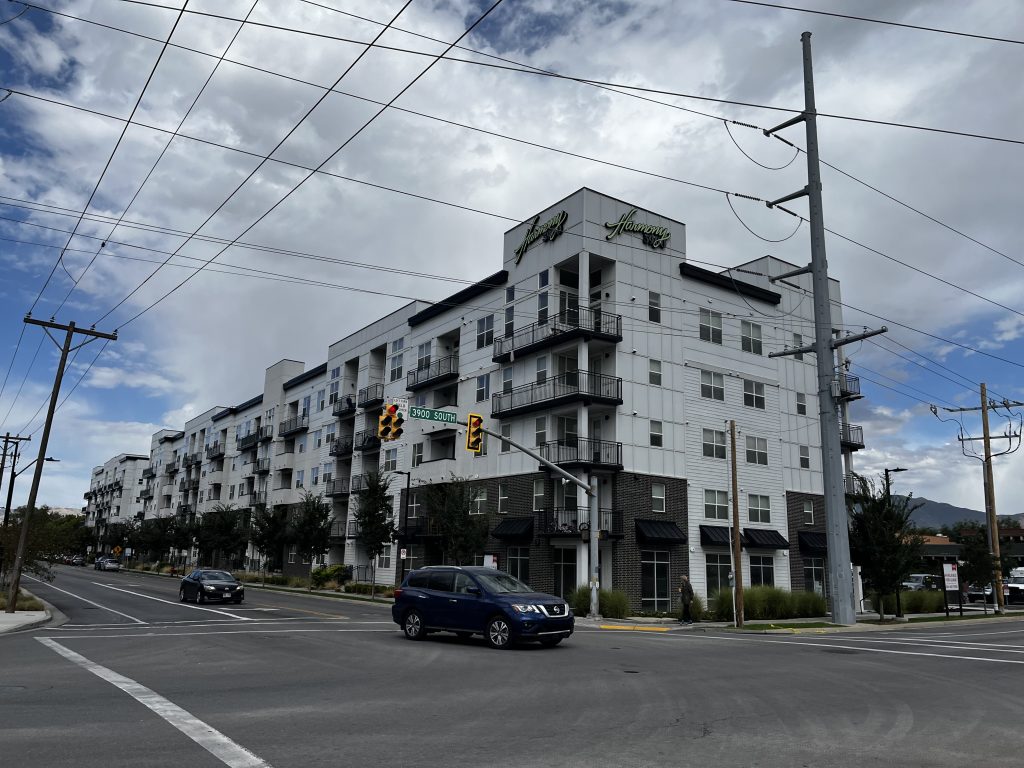
Sitting on the northeast corner of 3900 South and West Temple is Harmony3900 and a “For Lease” sign.
The sign directs to a number for WPI, a brokerage with no website and that has marketed the available ground floor retail on Crexi as up to 2,274 square feet with the potential for two tenants to split the space in half. All signs point to an attractive space for a future retailer, yet the space sits vacant.
South Salt Lake city officials said the ground floor retail currently available there has been vacant for years. Is the current vacancy the result of a poor development plan? The undisclosed rate? The area never reaching full retail recovery post-pandemic?
The answer doesn’t matter to Jonathan Weidenhamer, Community and Economic Development Director for South Salt Lake. He wants to work with any and all developers to get their ground floor spaces leased up and get businesses invested in South Salt Lake.
“We need the neighborhood to be able to buy the jug of milk or loaf of bread,” he said. Even still, he thinks there are greater possibilities. “We think that we can get more specialty grocers to South Salt Lake.”
In those efforts, he and the city are looking to modify one bit of code to move the needle in ground floor retail spaces in multifamily projects: allowing off-premises beer sales.
New Tools
The South Salt Lake Planning Commission will weigh in on the proposed change to its beer sales laws during its meeting on Thursday night.
Weidenhamer said amending Section to Section 1 of Title 17 of the city’s code is part of a bevy of upcoming changes for the 6.94-square-mile city as it looks to build out the amenities its residents want.
According to city officials, South Salt Lake had restricted off-premises beer sales convenience stores that were attached to fuel pumps and retail stores that were over 60,000 square feet in an effort to “clean up” the city and push retail development in a new direction—away from vape shops and convenience stores.
The proposed change is a petition to the Planning Commission to forward a positive recommendation to the South Salt Lake City Council in hopes to broaden the potential tenant base to lease out ground floor retail.
Developers are having a hard time leasing out ground floor retail spaces to small grocers because alcohol sales are not permitted in the city, according to city documents ahead of a Planning Commission meeting this week.
That’s an acute problem: much of South Salt Lake is considered a food desert.
With just a few supermarket oases like Winco and Chinatown Supermarket in city limits, along with smaller international markets like La Pequinita, Abdi Bros Market, and others, there’s room to meet the additional demand from new residents for more grocers. Weidenhamer is hoping the City Council will approve the change and open up possibilities now to help future multi-family developments as they go on-line.
Weidenhamer was hopeful that this shift would add another tool to the city’s toolkit, especially with the Housing and Transit Reinvestment Zones out there to improve South Sake Lake. Tax increment financing is available for developers who meet affordable housing and other requirements on projects within a specific distance of transit stations in these zones. The three UTA TRAX stations and three more UTA S-Line stations within city limits are potential hotbeds of development that can continue South Salt Lake’s upward trajectory.
With 100 acres qualifying for these funds, the city is eagerly awaiting proposals to bring new residences and retail to the area, buoyed by the potential upcoming change allowing the sale of suds at ground level.
Strong Outlook on SSL Retail
Building Salt Lake reached out to multiple brokers for a read on the situation, with all of those contacted offering “cheers” to the future of South Salt Lake retail—with or without beer.
Chloe Cypers, a broker and retail specialist with Legend Partners, said that developers that think through logistics of a retail space like parking, grease trap/hood access, etc. tend to lease it out easily. It’s going to be helpful, she said, especially with grocers like Lee’s Marketplace at 4th West Apartments and The Store in the Gateway as downtown examples of possibilities.
“This change helps open up the ground-floor retail asset class up to tenants that have never really explored it before,” Cypers said. “It opens up activity in a retail sense, but I can also see it being beneficial to residents of the apartment projects.”
Jeff Harrison, a broker with Colliers overseeing the recently completed Bowers Residences on 55 W. Utopia Ave, echoed similar sentiments.
“Available space is the main barrier right now,” he said. “Licensing being the other.”
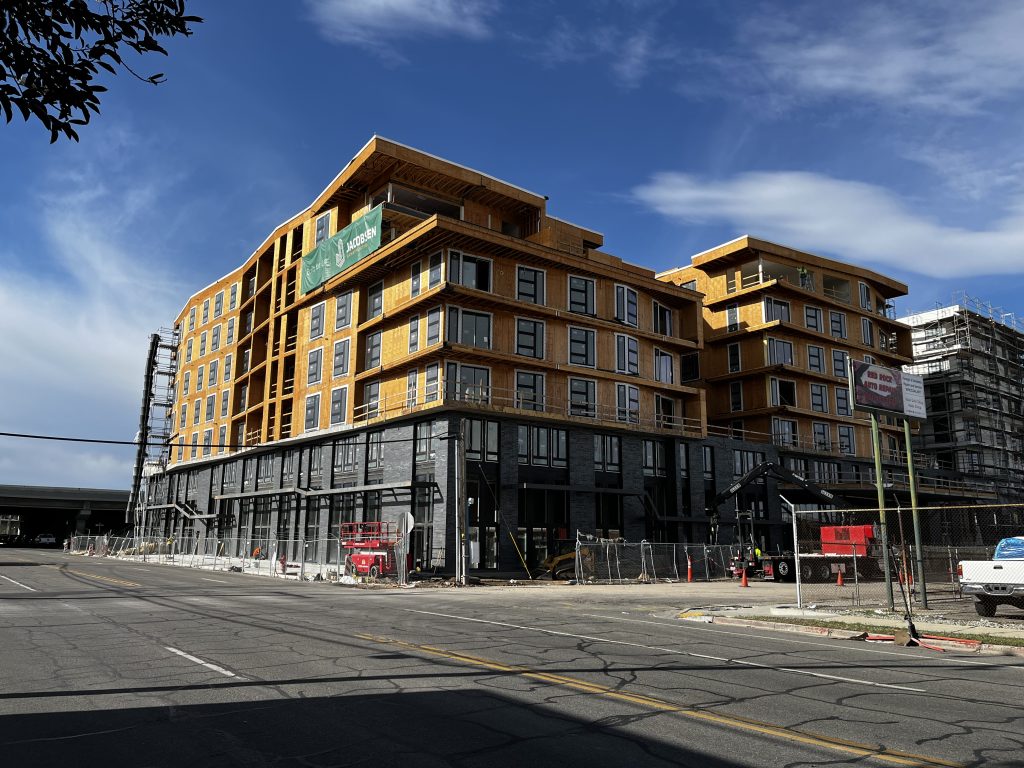
With just a handful of multifamily projects with ground floor retail in the city, Harrison said he and his team are waiting patiently as the South Salt Lake continues to fill out as it “quietly becomes a hotbed for breweries and some new food tenants.”
Christian Vasilios Priskos, COO and managing partner with InterNet Properties, said that anything to make ground floor retail more attractive for future tenants is a win in his book.
As a broker for the future One Burton development under construction on Burton Avenue, he said he and business partner Chris Metos haven’t heard much interest on the grocer front, but both were bullish on the retail outlook of South Salt Lake, with the close proximity of freeways an attractive proposition for tenants in both residential and commercial spaces.
What will push retail into the most competitive space, Metos said, is walkability. Where cities like Salt Lake, Holladay, and Millcreek have sought to improve pedestrian infrastructure, South Salt Lake has a similar opportunity.
With a new downtown, he said, it will take time for this entire corridor to fully refine and improve what South Salt Lake envisions as its future city center. Efforts like “Mural Fest” have brought forth 52 interactive public art pieces over the last seven years, helping activate many areas across the city and healthy buzz for future ground floor retail spots as more multifamily projects emerge.
Próst to New Development
Weidenhamer said he and the rest of the City of South Salt Lake staff are excited to work with developers intentionally and reward local retailers looking to bring new ideas to the city, even one as simple as the beer run downstairs. New ideas and all, they still want to hold true to the differentiator for the “City on the Move.”
“We want to continue the gritty vibe,” he said, “where [South Salt Lake] isn’t fancy, but it is comfortable for the people who live here.”












0 Comments