

DRAPER – The future of the Point of the Mountain development took flight last week as the Point of the Mountain State Land Authority Board met to discuss advancements in the project. Two agenda items, centered around transportation, highlight a persistent theme: transportation ideas for the site seem to move through like a revolving door, leaving a lingering question about the project’s core transit vision.
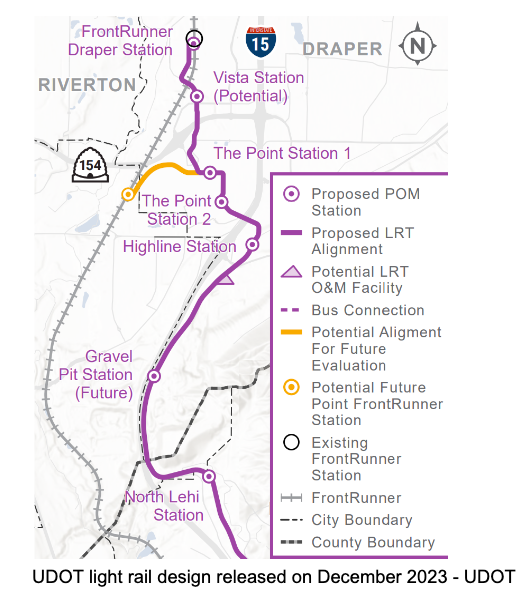
In 2021, Utah Transit Authority (UTA) envisioned a Bus Rapid Transit (BRT) system as the backbone for connecting this future community. Then came SB 2 in 2023, adding a Frontrunner commuter rail station into the mix, followed by UDOT’s decision to upgrade the proposed BRT to a light rail system. With microtransit options also on the table, the Point of the Mountain is now contending with an array of potential solutions.

Transportation designs are changing with every meeting, with inconsistency even between slides on the same presentation deck. It is possible that the site is still many years away from getting a solidified vision.
What about the FrontRunner station?
The location of the FrontRunner station is one example of this constant shifting. Original plans for the then named “Bluffdale Station”, located it at around 15000 south, in the area of Hidden Valley Middle School. As the Point project came online, the station moved north to the old prison site, receiving the name “Point Station”, with designs showing the light rail being rerouted to this new station.
Flying cars
At last week’s Tuesday meeting, The board endorsed a proposal to commission a study exploring the feasibility of incorporating advanced air mobility (AAM) at the Point.
This futuristic technology, envisioning a network of air taxis and delivery drones, is a polarizing topic. Noise pollution, a major concern with AAM, remains largely unaddressed, as do safety protocols and the infrastructure required to manage potentially thousands of autonomous aircraft. In spite of this, board members spoke enthusiastically of being at the forefront of this technological revolution, particularly with the 2034 Winter Olympics on the horizon.
“The goal is to have [air] taxis taking people from Point A to point B by the 2034 Olympics,” remarked board member Ryan Starks.
Nexa Advisors, chosen from a pool of eight applicants, will lead the feasibility study. Don Willie, Director of operations for the point, stressed the timeliness of the study, stating: “The time is now to be able to conduct these studies that way we can utilize funds effectively.”
And a gondola
Beyond exploring AAM, the board grappled with another forward-looking transit solution for the Point: an aerial personal rapid transit system proposed by Swyft Cities. This system utilizes individual gondola-like pods traveling along fixed cables, offering direct, on-demand transport to designated stations across the development.
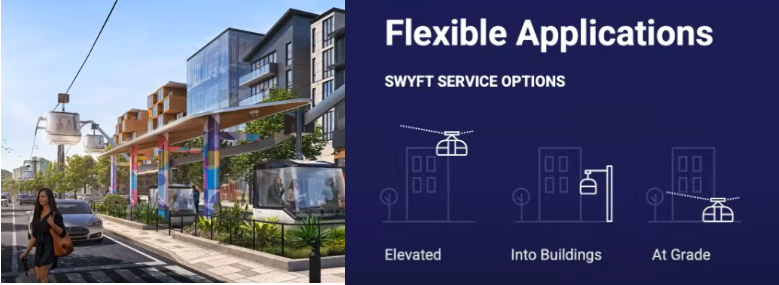
Steve Kellenberg, a consultant involved with the project, explained the system’s advantages: “It’s a continuous flow… you don’t have a head time… you get to the station and your pod is waiting for you.” He further emphasized the potential for reduced trip times and a visually appealing addition to the Point’s urban landscape.
While acknowledging the system’s innovative aspects, some board members expressed reservations about its cost, particularly the upfront investment, and the timing, given that similar systems are still under development internationally.
The board opted to defer a decision on the feasibility study for the gondola, choosing to reassess in a year after observing the progress of Swift Cities projects in New Zealand and elsewhere.
Ultimately, the Olympic games may bring a more sobering near-term outcome for the Point. The 2034 games have caused a sudden flurry of transportation projects across the state to be considered. When stepping back and looking at all of these other already greenlit projects, it seems likely that the Point will not get much of anything besides a FrontRunner stop until after the games happen.















0 Comments