

Despite a state law that adds a layer of state oversight and approvals over Salt Lake City road projects, city and state officials believe the Green Loop — an ambitious project to create a dedicated green space and an expanded biking and pedestrian pathway throughout the city — is still going ahead as planned.
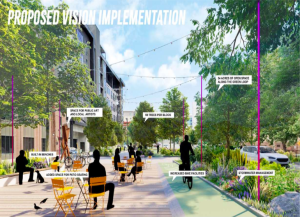
The Green Loop would be a 5.5-mile-long trail system that would create needed green space Downtown and improve biking and pedestrian mobility citywide. It would stretch from the popular 9 Line Trail along 900 South to North and South Temple, as well as span 200 East to 500 West. The project is estimated to cost up to $350 million in total, with the hopes of completing it before the 2034 Winter Olympics.
Senate Bill 195 created the need for the Utah Department of Transportation (UDOT) to approve certain road projects in Salt Lake City, and it was one of the bills Mayor Erin Mendenhall described as “punitive” back in March.
It’s also a barrier that some city officials have worried would delay — or completely derail — larger transportation projects in the city. Jon Larsen, the city’s transportation director, said of the bill last month, “I don’t know what those projects might be, but I think that there will be some projects that probably might not happen.”
But Blake Thomas, Senior Advisor on Real Estate and Capital Projects for the Salt Lake City Mayor’s Office, was more optimistic when discussing the bill with Building Salt Lake last month, though he recognized that could be an overly-rosy perspective.
“At the risk of being Pollyanna, I hope that the SB195 process enhances the project in helping facilitate increased collaboration with residents and businesses and business owners and property owners and all users of the right of way,” Thomas said. “My hope is that the SB195 lens will help take a holistic approach to analyzing traffic in downtown with UDOT and will ultimately be a net positive for the project.”
Thomas said the Green Loop project is not dead. He said that the city in the past has typically done a thorough analysis for any major project, which includes seeking input from UDOT.

In spite of the potential red tape impacting the project, Mendenhall’s proposed capital improvement budget includes setting aside $3 million to start construction on the Green Loop’s first step — overhauling 200 East between Washington Square and the library, which is being called the “Civic Center” of the whole project. Up to this budget request, all funds diverted toward the Green Loop have been for design and analysis.
“In light of SB195, we’re moving forward with the Green Loop project in conjunction with those parameters,” Thomas said. “We are soon to announce a consulting firm that will lead community engagement and design for Library Square and 200 East, with the desire to create a top of class front yard for city residents and visitors.”
Like Thomas, Mendenhall was optimistic about the Green Loop’s future when she spoke to Building Salt Lake last month. She said the city was always planning to consult UDOT for the Green Loop, and she believes the project is far from dead or stalled.
“No one in City Hall wants Downtown to be unnavigable by car or bike or for pedestrians,” Mendenhall said. “We need a city that functions and flows for the growing population that we have, the Green Loop was never designed to dissuade that. And I believe that there is absolutely still capacity for us to create the Green Loop.”

UDOT’s Point of View
Cyclists are likely already aware of UDOT’s recent move to halt a connection along the 300 West Bikeway in recent weeks, and it’s easy to see why Salt Lakers could see the move as a precursor to shutting down a bike- and pedestrian-heavy project like the Green Loop.
But UDOT spokesman John Gleason said that might not be the case. Though he told Building Salt Lake that UDOT still needs to do a comprehensive study of the Green Loop project, he said the state plans to take a holistic approach to how people get around — not just forcing them into cars, he said.
“I think there’s a lot of times that that were looked at as the ‘Department of Roads,’ and that’s just not the case,” Gleason said. “We want to make sure that we’re focusing on everyone who travels throughout the state. We want to make sure that they have the opportunity and the ability to make a choice on how they travel.”
Gleason said UDOT is still figuring out the best way to evaluate this type of large city project in light of SB195. They’ve been included in these types of talks before, but the bill now places more of the decisions in the hands of state transportation officials. UDOT will still work closely with Salt Lake City transportation staff, he said, but it’s too early to tell what the state’s determination would be for a project like this.
“I think everything’s on the table with all of the projects, and we want to make sure that we’re taking a very comprehensive look at our transportation system and what makes sense for everyone who uses it,” he said.
Despite the assurances, there’s still a sense of unease among many in Salt Lake City that the Green Loop, which would pare down car lanes, could be discarded in favor of keeping cars on the road. More and more Salt Lakers are utilizing bike trails and transit lines following recent improvements, and Gleason said UDOT will take all types of transportation into consideration when making decisions for the city’s streets.
“We really are committed to looking at what will give us the best transportation system for the future, and that includes everyone, and not just cars,” Gleason said. “It’s about moving people, it’s not about moving vehicles. So when it comes to that, we have to take a comprehensive look at how the system works and how we can accommodate everyone.”














0 Comments