

For decades the city’s Redevelopment Agency has assembled parcels at the northeast corner of 300 West and 800 South, eventually putting together nearly two acres for what it hopes will become a signature mixed-use development for the Central 9th and Granary neighborhoods.
At 765 South 300 West, the development site on FB-UN-2 zoning also hosts Montrose Avenue, an east-west neighborhood street which became disconnected as light-industrial uses proliferated in the area prior to redevelopment.
In a briefing to the RDA Board this week, staff set out the general terms for the city’s disposition of the property, which will be done through a RFP to be released soon, in Q3 of this year, they project.
One of the non-negotiables will be a re-connection of Montrose Ave. as a publicly-accessible mid-block walkway.
Let’s take a look at what the city has to offer and what it is likely to demand in successful proposals from developers.
The location
Immediately northeast of the city’s 9-acre Fleet Block development site, the 1.89-acre RDA assemblage is currently occupied by warehouse tenants on short-term leases, according to staff.
It sits steps away from local businesses across both 800 South and 300 West, including recently-expanded Fisher Brewing.
The RDA lacks control, however, of arguably the most important parcel–the corner.

The auto repair shop at 775 South 300 West, sitting on the corner .29 acres, has been owned since 2021 by disgraced local developer TAG SLC. The landmarked Fifth Ward Chapel that TAG ordered demolished on Easter Day this year is just up the street.
TAG SLC’s corner auto repair shop is assessed by Salt Lake County at $919,000.
It was first sold to development interests in 2017, passing out of a family trust, according to the Salt Lake County Recorder.
There is no mention of the privately-owned corner property in the RDA staff report.
Jordan Atkin of TAG SLC told us earlier in the year that he was getting out of residential property development, to focus on other niches in the real estate market.
If so, he’s less likely to submit a proposal to the city than offer the property to the winner. It’s another complication that any interested development team will have to deal with if signing a contract with the RDA.
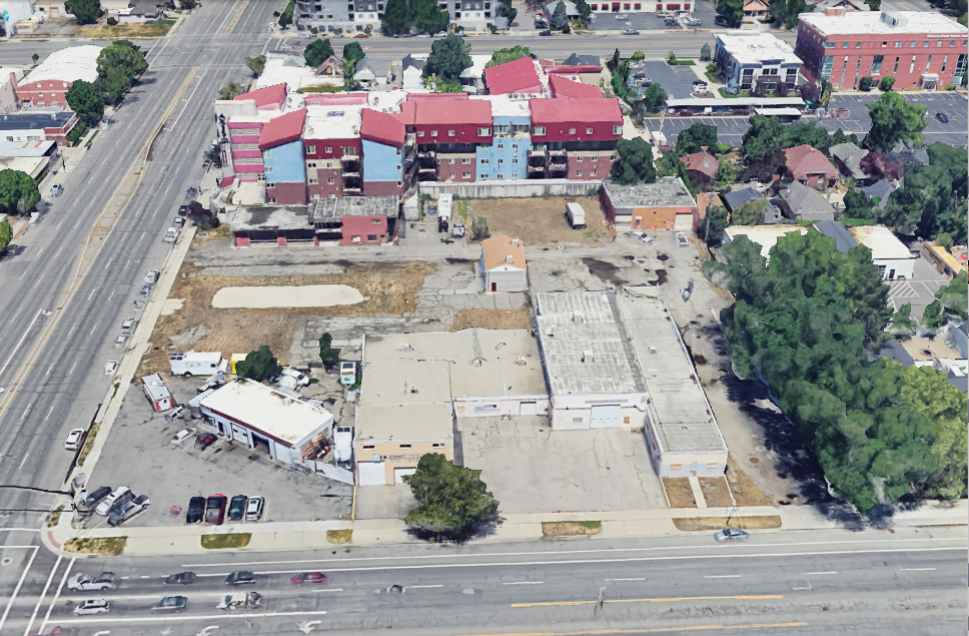
Yet the RDA’s parcels are highly strategic, now less as a development catalyst (neither neighborhood needs a development push) and more so to provide an essential urban design element in the Montrose mid-block.
What else is the city likely to look for in a winning proposal for development?
What’s the RDA asking for?
In the brief description of plan elements presented to the Board, RDA staff included the following:
- a residential mixed-use, mixed-income development
- design excellence in the site plan and building design to encourage an active street life, pedestrian connectivity, and creative integration of the Project into the neighborhood
- a resident wealth-building component for low to moderate income residents living in the new development. The wealth building component may include models such as home ownership, supplemental income opportunities, stipends for renters, cooperative housing, etc.
The 2020 RFP also had the following project goals, likely to be reproduced in the new RFP:
- Mandatory connectivity via Montrose Ave: “improvement, maintenance, and public accessibility of the street,” including creating a short N-S connection that is identified in the Mid-block section of the Downtown Master Plan.
- Adherence to the city’s Design Guidelines for West Temple Gateway and the Granary Districts
- Affordability: minimum of 20% of units shall be affordable to people making 60% of AMI or lower
- Sustainability: energy efficient design or programs
- A substantial art installation
As part of the construction and operating pro-formas to be submitted by interested developers, the 2020 RFP said discounted prices for land would be considered. This time around, Agency staff told the Board it is also interested in proposals for a long-term land lease, becoming a trend in recent RDA deals with developers.
Why wasn’t a developer signed the first time around?
Staff discovered that the section of Montrose Ave. that bisects the RDA’s property is privately-owned, and ownership was not conveyed in titles to the RDA or previous owners, “so the ownership of the right of way may have remained with the original owners rather than being transferred to subsequent lot owners.”
But this go-around, the uncertainty won’t stop the selection process, says staff. The RDA will be “clarifying the street issues by the time a developer is selected and contracts are signed” by pursuing a quiet title to the street during the RFP process.
Hopefully, the affordability and mixed-use requirements, multiple design reviews, and now the ambition to have for-sale units for income-qualifying individuals won’t deter applicants.
Not to mention the near-necessity of acquiring the corner lot from TAG SLC.
Timeline
The RDA hopes to release an updated RFP by the end of Q3 2024, with proposals due by the end of the year.
The plan calls for a developer to be selected by the end of March 2025, with closing and groundbreaking in Q1 2026.
Interested in seeing where developers are proposing and building in Salt Lake, or just want to support a local source of news on what’s happening in your neighborhood? Subscribe to Building Salt Lake.






0 Comments