

Aspiring to be the “best transit-oriented development in Utah,” Salt Lake City’s Community Reinvestment Agency (CRA) presented to the planning commission last week with the intention of updating the city’s Downtown Plan and upzoning 35 city- and University of Utah-owned parcels in the Rio Grande District.
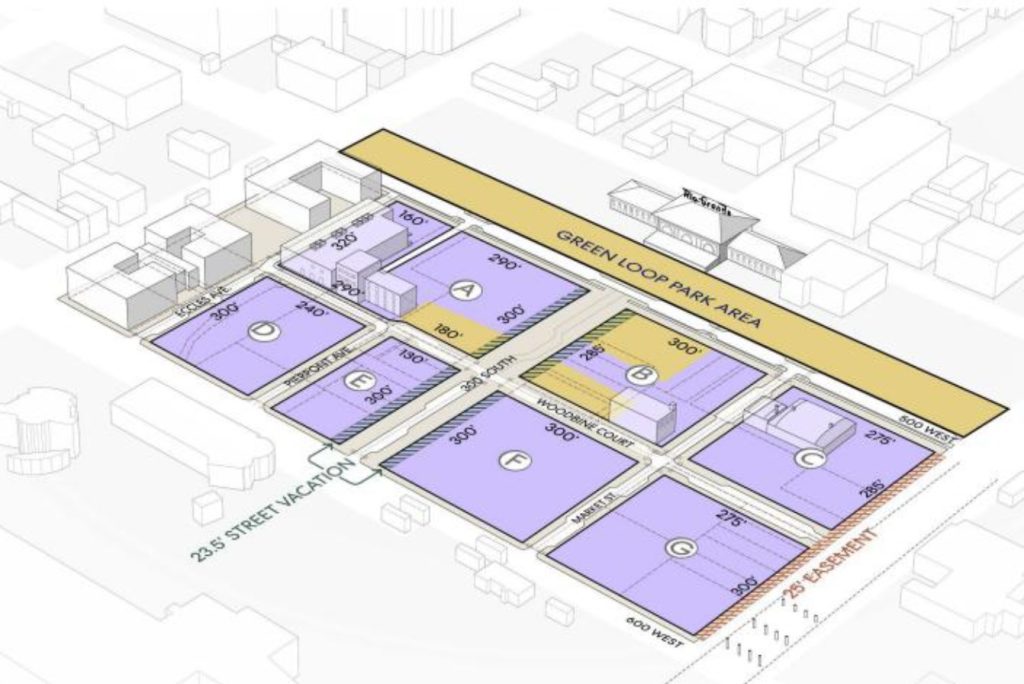
The CRA’s application follows years of failed efforts to attract developers to what is widely acknowledged as the most transit-rich neighborhood in the state, residing on the western edge of Downtown. Formerly known as Station Center in the Depot District redevelopment project area, the two blocks between 200 and 400 South, 500 and 600 West are currently vacant lots with a sprinkling of historic structures the city has saved but hasn’t found developers to rehabilitate.
The city’s ability to collect tax increment from the area was recently renewed under the state’s Housing and Transit Reinvestment Zone (HTRZ) program, after the city’s original project area expired in 2024. That same year the city pivoted to a high-density strategy, called the Rio Grande District Vision and Implementation Plan.
To do so, it needs to amend sections of the city’s Downtown Plan and carry out an upzone. That upzone would be dramatic, allowing maximum building heights to change from 180 to 600 feet.
Planning commissioners were impressed by the presentation, and sent a unanimous positive recommendation to the city council.
Zoning change would extend Downtown
If a switch in D-4 zoning on the west side of Downtown sounds familiar, it’s because the sports and entertainment district envisioned by Smith Entertainment Group, owners of the Utah Mammoth and Utah Jazz, successfully changed the rules for D-4 zoning just last year.
D-4, which covers SEG’s two-block assemblage east of the Delta Center, now allows buildings up to 600 feet, previously capped at 75 feet.
Taking advantage of the new height allowances, the CRA hopes to attract developers looking to build “up, not out,” as CRA project manager Wayne Mills put it to the commission.
“This is an opportunity that doesn’t exist Downtown. We have large vacant parcels of land. It’s also immediately adjacent to transit. The CRA owns a lot of property. Let’s go bigger,” Mills said, describing the CRA’s change in perspective.
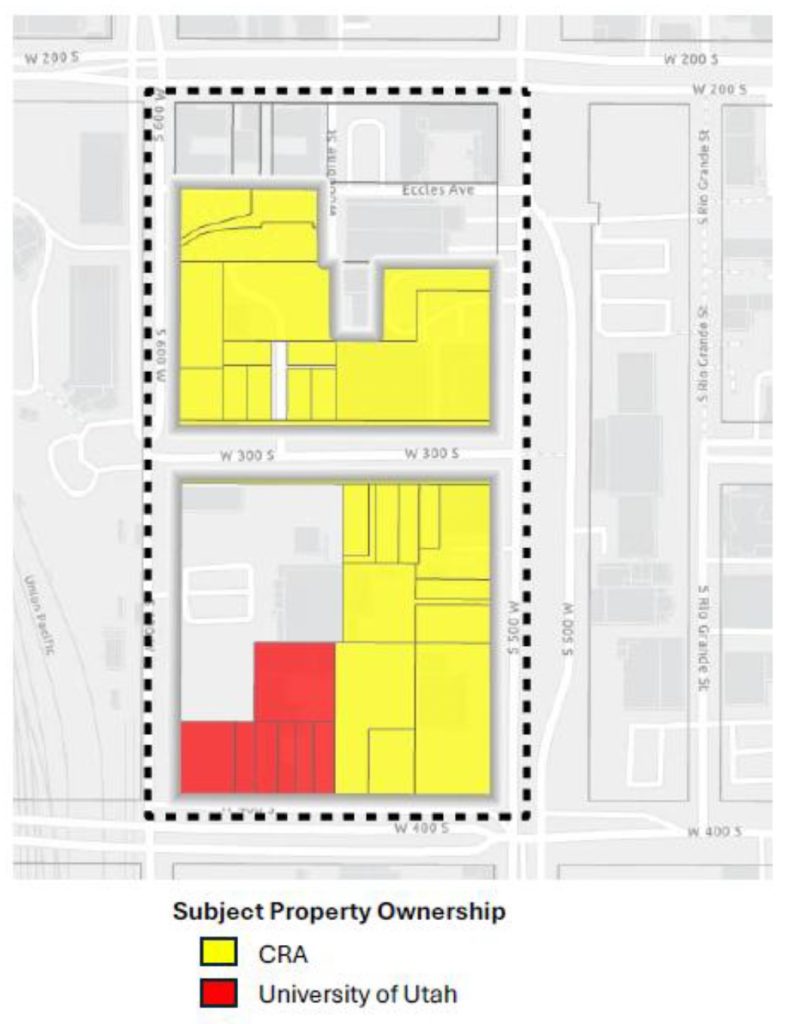
Credit: Salt Lake City CRA
Planner Cassie Younger wrote in her staff report that the Vision and Implementation Plan, adopted in December 2024, “Seeks to establish the Rio Grande District as the ‘best transit-oriented development in Utah’ and is committed to advancing community wellness and delivering equitable outcomes in the form of implementing projects like the Green Loop, Festival Street, and Arts Campus within the district boundaries.”
The only important differences between G-MU and D-4 zoning, Younger reports, is the increased height and more robust design standards for D-4. G-MU height by right is 90 feet, up to 180 feet with design review; D-4 height by right is 200 feet, up to 600 feet with design review and additional design standards.
The design standards include at least one of the following: a mid-block walkway, affordable housing incentives, enhanced active ground floor use to 100%, a restrictive covenant protecting a historic structure, or publicly-accessible open space.
Master plan changes
The requested changes to the city’s Downtown Plan, approved in 2016, are minimal. They consist of updating the “Rio Grande District” section in the city’s Downtown Plan with the zoning change from G-MU Gateway Mixed Use to D-4, as well as adopting a new map for improved mid-block walkways on the two blocks.
The midblock walkways will lose some of the awkward direction changes, thanks to property acquisitions by the CRA.
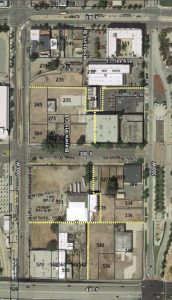
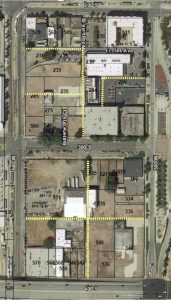
Old midblock map, left; new midblock map, right. Credit: SLC CRA
Main elements of the Vision and Implementation Plan
Mills highlighted several current moves by the CRA in the district.
First, it has a design team on hand that is responsible for delivering plans for the public infrastructure improvements to be carried out by the CRA.
Rebuilding 300 South as a festival street, constructing the midblock streets, as well as utility work will start in 2026, he told the commission.
In addition, early phasing is likely to see the construction of a parking garage. “We’re hoping that if we build a shared parking structure, that will alleviate some of the pressure of every development trying to be independently parked,” Mills said.
He also mentioned that the space under the 400 South overpass “is eventually going to be a park,” and spoke to “programmable” public gathering spaces and an “arts campus.”
In addition, he told the planning commission that the USA Climbing project will be breaking ground in 2026, and that “You’re actually going to see a design review coming your way soon for that building.”
Ignoring the Rio Grande Plan?
You know the one – the citizen-led campaign to bury the rails and revive the Rio Grande Depot as a transit center.
Younger’s staff report, as well as Mills’ presentation, doubled down on ignoring the Rio Grande Plan (RGP), specifically the implications of investing now on the very stretch of street needed for the historic Rio Grande station, owned by the state of Utah, to come back to life.
Notably, Planner Younger’s report abbreviates the Rio Grande Vision and Implementation Plan, which is a product of the CRA, several times in her memo as “the Rio Grande Plan.” That caused confusion among at least one Planning Commissioner, who enquired whether the Rio Grande Plan was being advanced by the city in the CRA’s Vision and Implementation Plan.
Commission Chair Landon Kraczek was corrected by the CRA’s Mills, who said he was referring to the Green Loop on 500 West, which is being redesigned as a low-traffic street and linear park from 200 to 400 South.
Importantly, the segment of 500 West between 200 and 400 South is identified in the Rio Grande Plan as the location of an expanded passenger rail terminal as well as a trench for underground six rail lines.
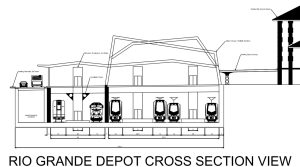
The 500 West segment of the Green Loop project, Mills confirmed, is indeed in process, but “being planned and dealt with in another department” he told the commission, which is Transportation..
Despite the indifference shown to the RGP by the Planning Division and the CRA at the briefing, the city has taken significant steps to assess the viability and benefits of the plan, including it in the ongoing federally-funded East-West Connections study.
Yet the city seems to be sending mixed signals by prioritizing the 500 West segment of the Green Loop.
Timetable for action
Despite the CRA’s enthusiasm to get moving, it still has to abide by the city council’s calendar for a work session briefing, a public hearing, and a formal meeting vote.
The City Council Office told us that since there are only a few council meetings left in the year, it’s unlikely that the work session will be scheduled before January. A public hearing and putting it on the formal meeting agenda for a vote would likely push approval of the master plan amendment and zoning change into the spring.
As to the process of finding developers to pitch projects for the publicly-owned parcels? “We hope to put two development sites out for RFP at the beginning of next year,” Mills hopefully informed the commission.















0 Comments