
Utah’s retail market is running on two tracks.
Grocers, gyms and big-box chains are pushing into the suburbs, led by northern Utah County. Meanwhile, Salt Lake City’s restaurant scene is losing longtime names, and retail spaces in mixed-use buildings are still having a harder time filling up than standalone shopping centers.
That was the picture Andy Moffitt, a partner at Newmark Mountain West, shared last week at the Urban Land Institute Utah’s Trends conference in Downtown Salt Lake City.
“The most significant retail expansion occurring throughout the state of Utah,” Moffitt said, “is certainly in the northern half of Utah County,” which has boomed in population in recent years.
The headline example is a new Whole Foods in Lehi. Moffitt said it’s the first Whole Foods announced in Utah since the Kimball Junction store in Park City opened in 2017, and that store was a relocation.
Before that, he said, you’d have to go back more than a decade to find a brand-new Whole Foods in the market.
Moffitt highlighted Utah County sites where Trader Joe’s is co-located with other major anchors, calling the combination “two of the most influential and impactful retailers” combining in one development, which he said will “add a lot of traction and energy to that area.”
Trader Joe’s is now up to about 10 locations along the Wasatch Front, Moffitt said, counting stores that are open, under construction or proposed.
The chain is targeting established regional retail areas with strong sales history. It’s building new stores from the ground up, he said, while also hunting for existing boxes it can backfill quickly.
Building Salt Lake has tracked that march. The grocer converted a former Pep Boys in Sugar House, landed in Holladay Hills on the former Cottonwood Mall site, opened in Riverdale as Weber County’s first store and has plans for Herriman and Downtown Daybreak.
All told, Moffitt counted 35 new big-box retailers in the pipeline. Trader Joe’s leads the list, followed by Kroger’s Smith’s banner, Target, Life Time Fitness, WinCo, Walmart, Harmons and Larry H. Miller’s Megaplex theaters.
“That’s significant growth for our market, really coming on the heels of COVID with the uncertainty and the issues that existed around that period of time,” Moffitt said. “So the market’s roaring back in a significant way.”
The name that stood out to him wasn’t a grocer. Life Time has four clubs proposed or under construction in Utah, and Moffitt said the gym chain is becoming “less of an amenity and more of an anchor to these projects.” That reflects consumers “moving more to health and wellness and where consumers are willing to spend money,” he said.
One of those is in Lehi, where Gardner Group and Plumb Holdings are building The Shops at Sky View, a 97-acre project anchored by a Life Time and Utah County’s fifth Target. The first phase is scheduled for 2027.
Megaplex has two new locations in the works. “Entertainment is not dead,” Moffitt said, pointing to this summer’s blockbuster season.
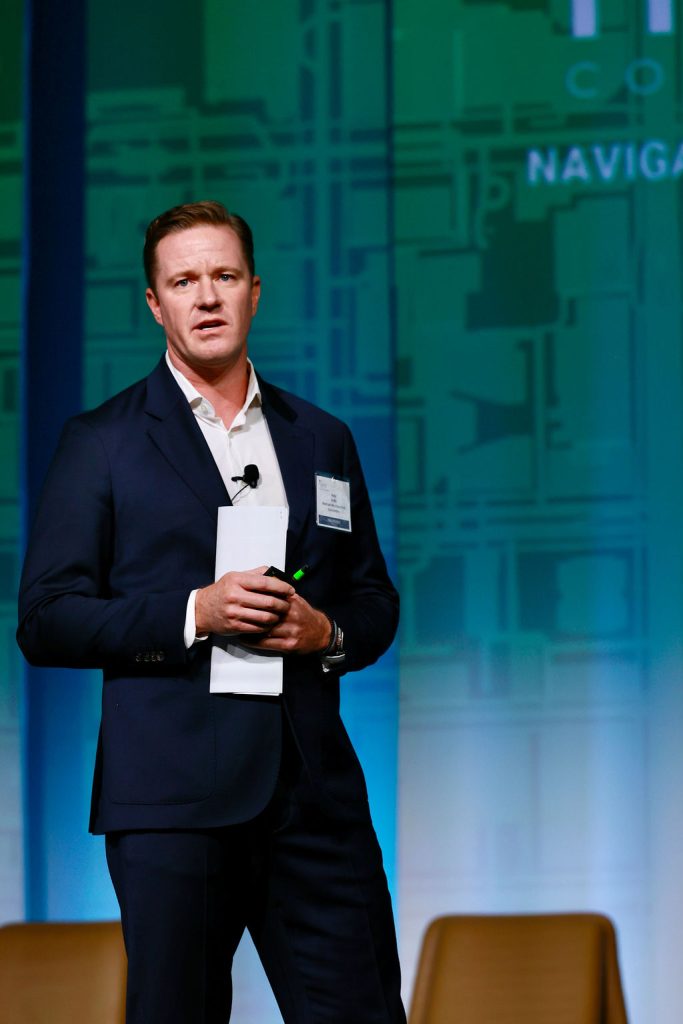
Andy Moffitt of Newmark Mountain West speaks during the ULI Utah Trends conference in Salt Lake City. Photo by Kelli Freshman.
National brands keep arriving
Moffitt also ran through a list of lifestyle restaurants and fitness brands new to Utah or expanding here, including Shake Shack, Snooze, Sweetgreen, Flower Child, Cava, North Italia, Kura Sushi, Equinox, Barry’s, Solidcore and Alo.
“To call out these names in any of the top 25 markets around the country, you would find a lot of excitement from those brands,” he said. “The fact that they’re moving into Utah today is really a great sign for us overall.”
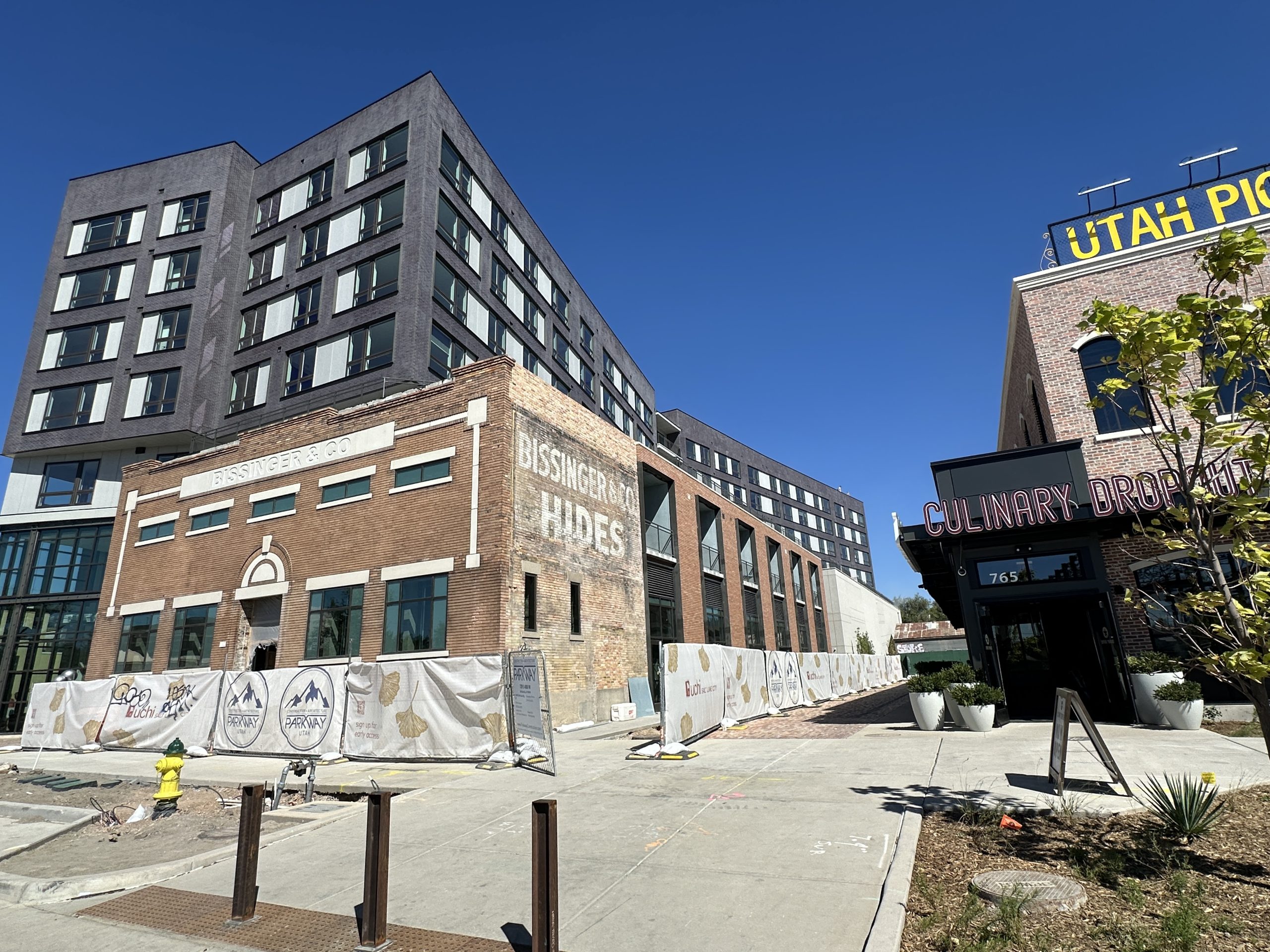
Some are already here. Sweetgreen made its Utah debut in Lowe Property Group’s Sugar Alley building in Sugar House. Mensho and Urban Hill took up space in the Post District. The Texas-based sushi concept Uchi is preparing to open in the Granary District immediately next to Culinary Dropout.
Moffitt singled out three he said “move the needle anywhere throughout the country”: Barcelona Wine Bar, Uchi and Postino, all headed for the Granary District. Culinary Dropout is already open there in Blaser Ventures’ rebuilt Pickle Building, and county filings and site plans have shown Uchi and Postino in the neighboring Pickle & Hide buildings. Moffitt said Barcelona and Uchi should open next year.
It wasn’t a complete wish list. “We do not see Din Tai Fung on this list,” Moffitt said. “They’ll be here someday. Not today.”
Mixed-use retail still lags
Traditional retail built between 2016 and 2025 in Salt Lake City’s core averaged about 2.9 percent vacancy, he said. “Sub-3 percent vacant means there’s essentially no space sitting on the market available for lease today.”
Retail in mixed-use projects is a different story. Vacancy there is about 10.3 percent.
“We’re three and a half times more vacant in mixed-use than we are in traditional retail,” Moffitt said.
That’s still an improvement. Four years ago, mixed-use retail in Utah was about 30 percent vacant, he said, and the last 24 months or so have brought solid absorption. But “suburban retail is performing much stronger than mixed-use retail,” he said.
The gap matters because Salt Lake City has been leaning on ground-floor retail. Salt Lake City’s street activation rules push developers to put retail and other active uses on the ground floor. Some developers have argued that it forces retail into spaces where it will fail.
Moffitt said mixed-use projects remain a growing focus, mostly in the suburbs, with retail serving as the anchor that helps lease the apartments above. He pointed to Holladay Hills, The Point, the Post District, Ogden’s WonderBlock, Utah City and The Silos.
Restaurant closures pile up
The biggest headwind Moffitt flagged was food and beverage, specifically near Downtown Salt Lake City.
“We are seeing significant closures, unfortunately, in Salt Lake City specifically,” he said. “We’ve also seen some out in the suburbs as well.”
His slide listed Market Street Grill, Cucina, Buca, Laziz, Xiao Bao, Yoko, Craft by Proper, Carson Kitchen, Quarters and Kiitos’ 600 West location among recent closures.
Moffitt said consumers want more value, a higher level of execution and “a little bit more of an experiential component” from restaurants. Some of the shift, he said, is a carryover from changes in consumer demand during COVID. Operators that aren’t evolving are struggling.
There was good news for the restaurant scene, too. Moffitt said Monte in South Salt Lake received the first Michelin star for the state of Utah after the organization expanded its footprint.
“We’re no longer competing against the West Coast to get these accolades,” he said. “I don’t think it’s a lack of overall quality with our operators. It’s just more competition-based.”
Eyes on the west side
Moffitt closed with Smith Entertainment Group, which released plans earlier this month for its Downtown entertainment district and Salt Palace overhaul. The plans include retail along a paseo linking the Delta Center and Salt Palace, and retail replacing loading docks on 100 South.
He said he’s excited about the west side of Salt Lake “from the Delta Center all the way down to the Granary District.” He named the Granary, Sugar House and the East Bench as the three Salt Lake City neighborhoods drawing the most attention.
“Those three neighborhoods are on everybody’s radar on a national level,” he said. “We get a lot of inbound activity and calls asking us about what’s happening in those areas.”
Moffitt noted that SEG owner Ryan Smith let the public vote on the Utah Mammoth’s name, and said Smith has opened a similar poll on which restaurants people want in the district. Moffitt urged the audience to weigh in.
“If you’ve got something you want to see in Salt Lake City, put it on the list,” he said, “because I think Ryan will pursue it as he’s done in the past.”














0 Comments