
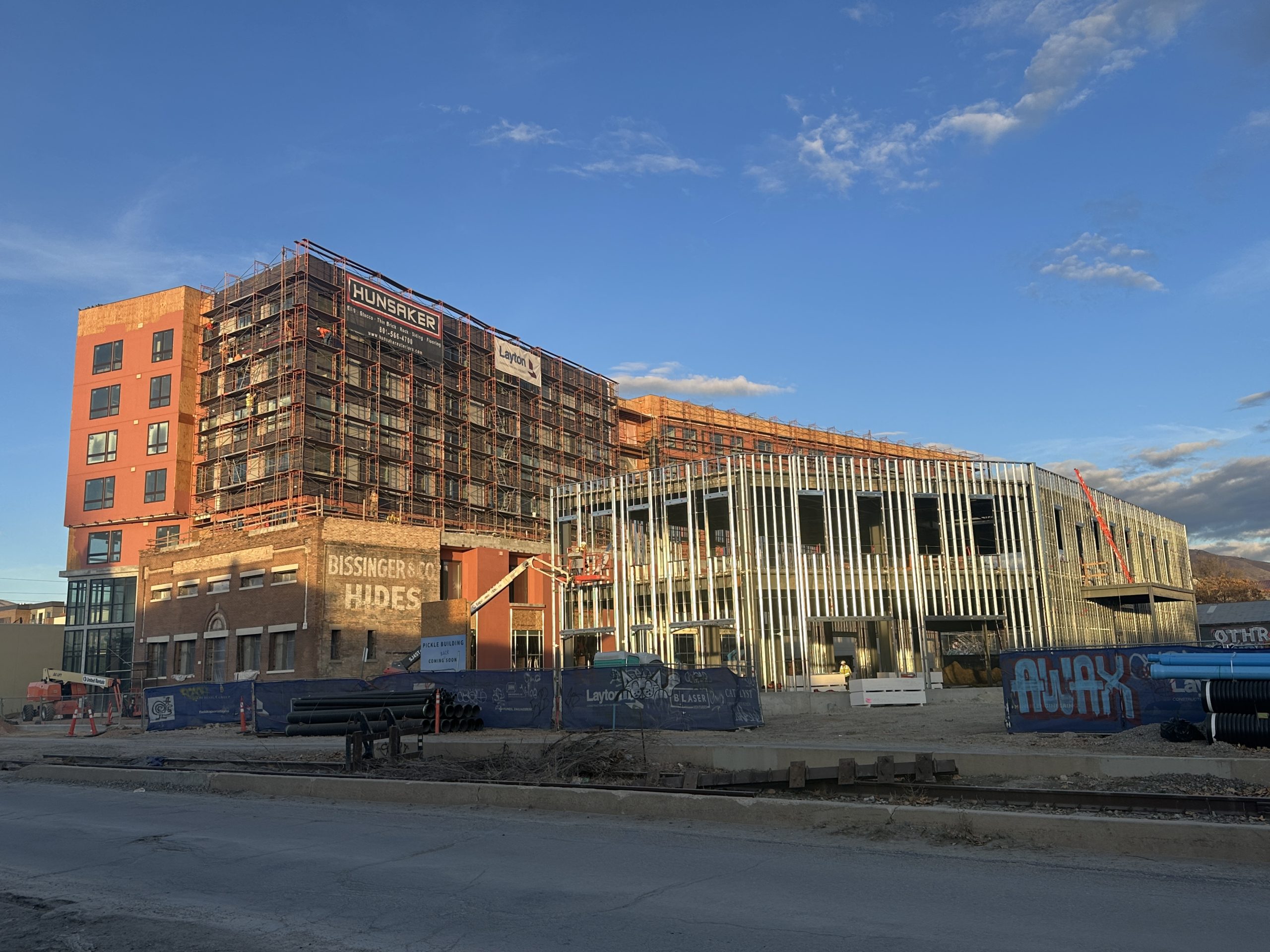
Nearly a year after a Granary District building slated for rehabilitation was torn down, Salt Lake City officials opted to penalize the project, but not enough to kill it.
The city’s Community Reinvestment Agency board, which is made up of Salt Lake City Council members, voted to take away a little over $1 million in tax increment funds for the Pickle building, part of the Pickle and Hide redevelopment that would add affordable housing units, retail and office space to the Granary. The Pickle building is located at 741 S. 400 West.
The CRA board voted 6-1 to reduce its tax increment commitment to the project, with Council Member Eva Lopez Chavez being the lone no vote. The council opted to reduce the project’s maximum tax increment cap from $6,094,254 to $5,078,545.
The CRA meeting comes nearly a year after the developer behind the project, Blaser Ventures, a past Building Salt Lake advertiser, demolished the historic Pickle building that was initially slated for renovation as part of an agreement with the city.
Tuesday’s vote puts to rest a issue that has lingered over the development’s head since March 2025. Initially, the Pickle building was slated to be preserved and reused as part of the redevelopment. However, Blaser later found that the building had a number of issues that made the building untenable for rehabilitation. Blaser later was granted a demolition permit by the city, but the move caught members of the city council and the community off guard.
Brandon Blaser, president of Blaser Ventures, has repeatedly apologized since, and said razing the building will enable the company to reuse and recycle more materials than first planned. But the move still caused issues for the Pickle and Hyde project.
During their discussion, council members made clear they wanted the project to move forward, but also voiced their strong disapproval of being out of the loop surrounding the demolition.
“It’s disappointing that we have to have this conversation, I’d rather not be here having this conversation,” said Council Member Dan Dugan. “But we’re here.”
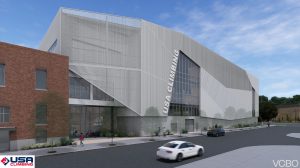
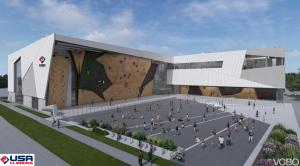
Council Member Alejandro Puy offered the sharpest rebuke of the situation, saying he was disappointed with the lack of transparency surrounding the demolition. He pointed to the situation surrounding the historic Salt Lake Mattress Company building, where USA Climbing needed an extra $250,000 to rebuild the structure as part of its new National Training Center in the Rio Grande District.
In that situation, however, USAC came to the CRA and asked for help, and the agency ultimately allocated the needed funds. Puy said in this instance, that didn’t happen.
“Instead, this applicant took us for granted, and I don’t believe that there is a true partnership,” Puy said Tuesday. He later said the council reached a tax increment figure that felt safe, but also, “teaches that this is not the way of a true partner in our city.”
After the vote, Blaser told Building Salt Lake the council’s decision will impact the project, but not enough to derail the plans. He said he appreciated the council’s understanding of the situation, but understood their decision to reduce the project’s tax increment funding.
“I appreciate that the council understood that — while there needs to be a lesson learned by not only myself, the city and the broader development community on better communication — they were not so punitive that it would be detrimental to the continuation of the project, which I think they articulated well,” Blaser told BSL. “The shared objective is to help rebuild this neighborhood and provide true mixed income, mixed use, activated area that we’re all striving for.”
Blaser, who is known for retrofitting buildings as part of many of his projects, said he takes full responsibility for the miscommunication surrounding the Pickle building’s demolition. He said the council’s decision will not only enable the Pickle project to be completed on time, but it will also act as a warning to other developers.
“We are taking a significant penalty for that, but it’s still a penalty that (the council) structured in a way that will still allow the project to move forward,” he said Tuesday. “The community won’t have to pay the price of my error — I will, and I’m ready to accept that and move forward.”
Blaser said the council’s reduction in the funding cap will take place on the tail end of the project, which enables the project to move forward. He said the council understood that if done another way, the reduction could’ve threatened not only the project, but his business as well.
“Had (the council) done that, under both our equity relationships and our lending relationships, that would have caused a default under both of those agreements and would have stalled the project, and had potentially put my entire development firm at risk,” Blaser said. “I think the city council understood that they did not want to do that, but they still needed to ensure that the message was received by the broader community and myself.”
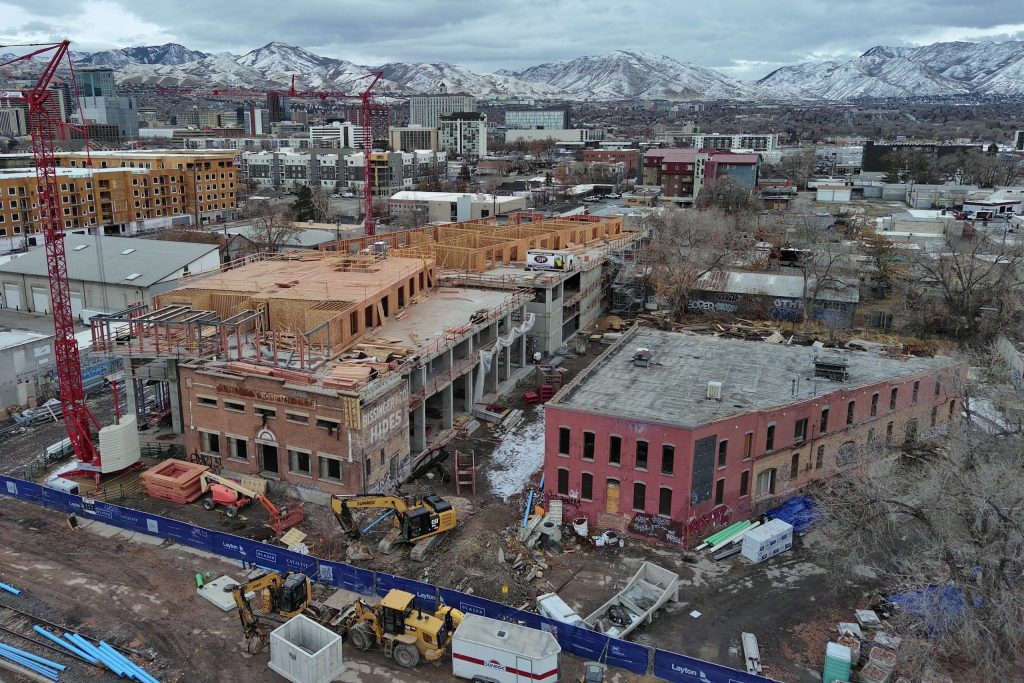
The former Utah Pickle Company Building is pictured on the right on Jan. 1, 2025, prior to its demolition.
In the staff report, city officials explained the CRA board adopted the original tax increment reimbursement agreement term sheet and participation in the HTRZ tax increment reimbursement program on March 18, 2025. However, three days later, the Pickle building was demolished, which threw the deal into question.
“While the term sheet for the reimbursement agreement had been approved by the CRA Board prior to demolition, CRA staff and the Developer had not yet entered into a tax increment reimbursement agreement (Agreement),” the staff report says. “Due to the Pickle Building demolition, work on the Agreement was suspended.”
Blaser later filed a supplemental tax increment reimbursement in February, setting up the Tuesday meeting before the CRA.
A handful of people offered public comments to the CRA prior to the Pickle building discussion, including James Alfandre, founding principal at Urban Alfandre, a local development company and Building Salt Lake advertiser. Alfandre implored the CRA board to push the Pickle building funding forward, saying no one has built up the Granary District more than Blaser.
“If that building were salvageable, Mr. Blaser would’ve saved it,” Alfandre said. “No developer in this city is more committed to adaptive reuse.”
Another commenter was Garth Franklin, a board member for the Granary District Alliance. He told the council that when a bulldozer was about to tear down the Pickle building, he stood in front of the machine in the hopes of preventing the demolition.
“Within five minutes, I was talking to Brandon Blaser on the phone, and he was profusely apologizing for miscommunication,” Franklin told the council.
Franklin said he fully supports what Blaser is doing and asked the council to approve the tax measure, adding that he’s been working in Granary for a decade and he supports the activation that’s taken place because of Blaser’s efforts.
“What I heard was that the building had to come down, structurally unsound, couldn’t get occupation, but what Blaser Industries didn’t have to do was rebuild the Pickle Co., which I think is just so cool,” Franklin said.
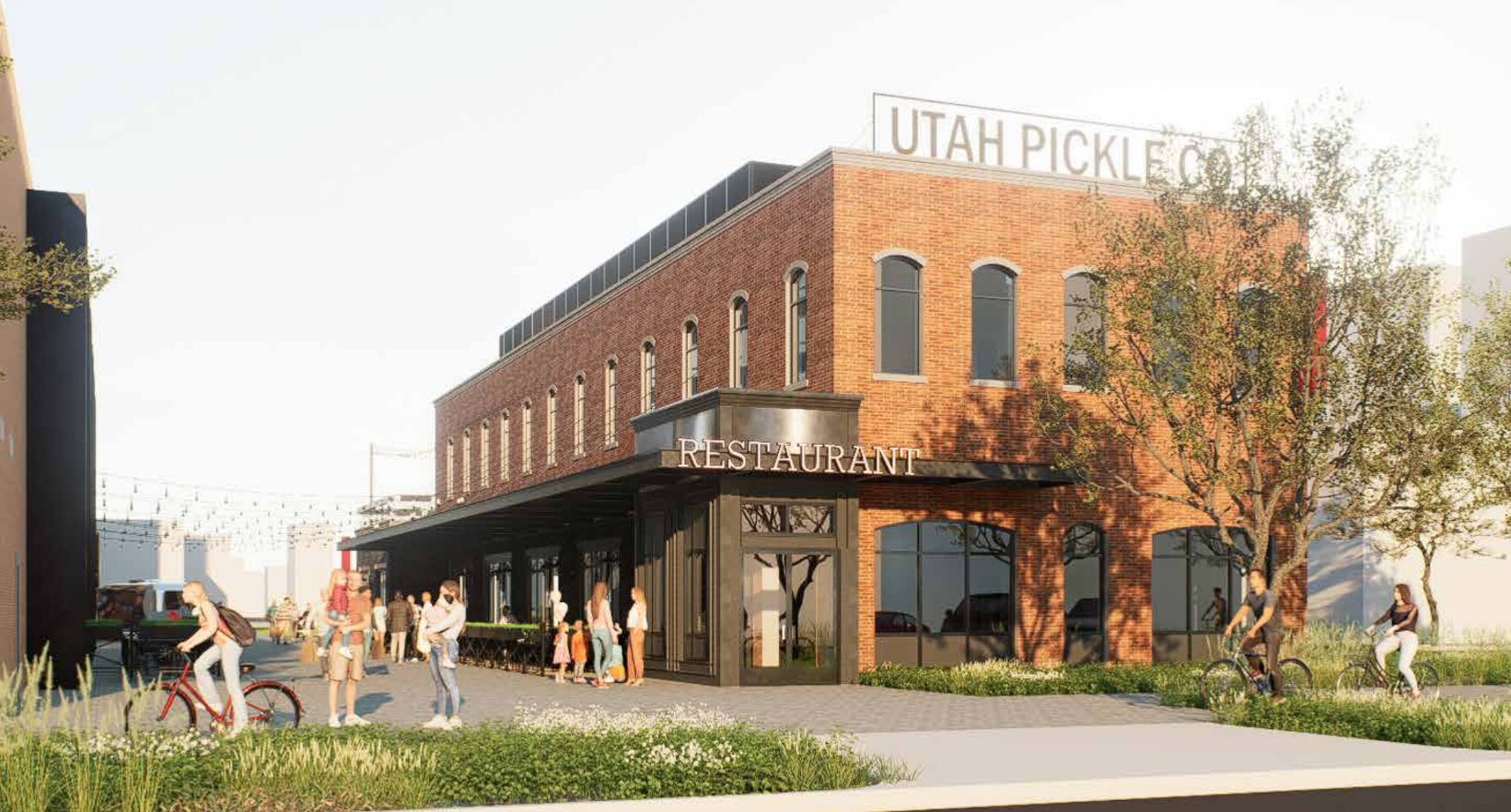
Delivery on the Pickle building’s residential units is still slated for this summer, Blaser said, adding that 20,000 square feet of commercial space is already leased out. Uchi, a Japanese restaurant, will be located in the Hide building, while a restaurant called Culinary Dropout will be located in the Pickle building, he said. Blaser added that his company’s offices will also be located within the complex.
The Hide building will feature 141 residential units, with around 38% of those units being offered to people with AMIs ranging from 60%-80%.














The city council needs to apologize to Mr. Blaser for this awful decision.