

Salt Lake City leaders are negotiating with Smith Entertainment Group over a plan to allow outdoor signage and digital advertising outside the Delta Center in what will be a tricky test for all parties.
SEG has said a commercial sign program, including off-premises content, is “one of the primary economic engines of the District,” that would keep it competitive for events and sponsorships through the 2034 Olympics and beyond.
The city, meanwhile, is tasked with deciding whether to carve out its own ordinances around billboards for just one hyper-targeted part of the city, Building Salt Lake has learned.
The standards that would govern signage on and around the Delta Center are one piece of the draft master development agreement released earlier this month and one that is far from settled as all parties continue working to finalize the rules that will govern the revitalization effort on the west side of Downtown.
“This is one of those evolving pieces,” Salt Lake City Council Chair Ale Puy told us. “This piece of the language on the signage still needs” to be worked out.
Puy has described the ongoing negotiations as amicable among all parties, and he noted that much of the signage standards that were released earlier this month will likely change after further discussions.
The mayor’s office declined to respond to questions related to the signage negotiations, noting that they’re still under review and that changes will likely occur during the public review process.
After that review process and votes by the Planning Commission and City Council, the signage standards will become part of a set of rules guiding the attempted revitalization of land immediately east of the Delta Center, as well as signage and screens on the arena itself.
The blocks covered by the draft development and signage agreements are home to the Salt Palace convention center but will soon be sold to SEG and redeveloped into a mixed-use district that the Utah Jazz and Utah Mammoth owner hopes to activate year-round with retail, office, hotel and residential.
As written, the draft rules would allow off-premise advertising and full-motion video across most of the district, a roof sign of up to 30,000 square feet on the arena, freestanding signs 50 feet tall, and up to 33,000 square feet of digital screens.
This is the second in a series on the current state of the proposed rules for the development near the Delta Center.
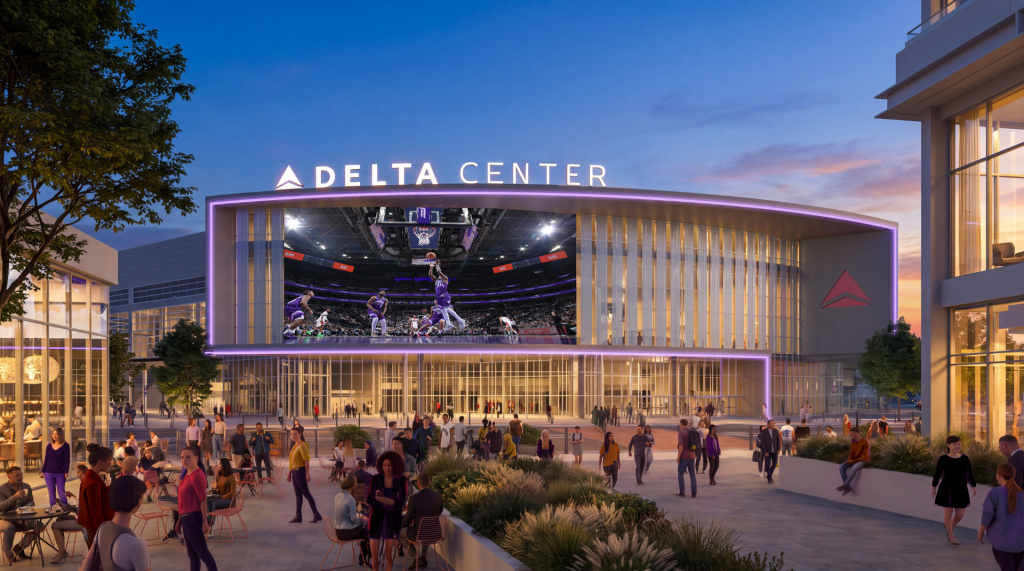
A rendering of a new facade for the Delta Center as part of the new downtown entertainment district. Image via Smith Entertainment Group.
Four sign zones
The sign code splits the two blocks into four zones, each with its own rules for what signs can say and how they can move.
Zone 1 is a band around the edge of the Delta Center block. Zone 2 covers the arena itself. Zone 4 covers nearly all of the new development east of 300 West: the paseo, the private North Lane, the interior of the block and the future performance venue. Off-premise advertising and full-motion video are allowed in all three.
Zone 3 is the exception. It’s a strip along 100 South, the stretch of street known as Japantown, plus a narrow edge on 200 West. There, signs can carry the district’s own businesses, events, sponsors and teams, but no off-premise ads and no video.
Much of the ongoing negotiation around the district has to do with protecting Japantown from becoming a de facto “back of house” zone for the mixed-use district and the Delta Center.
That effort extends to signage, as well.
The city has already taken steps to create signage that would help with branding and awareness around the history and existence of Japantown along 100 South. Now it’s working to ensure that the SEG signage standards don’t infringe on that work.
The code defines off-premise content broadly. It covers any message about a business, product, event or person “which is generally conducted, sold, manufactured, produced, offered, marketed, promoted, activated, or occurs elsewhere than within the Project,” and it explicitly says an off-premise sign corresponds to what city code calls an off-premises sign.
A screen on the arena or along the paseo could run ads for a suburban car dealership, a phone carrier or a beer brand, whether or not that company has any tie to an event on site.
SEG argues the allowance is narrow. The exhibit says off-premise content exists to carry out the partnership, sponsorship, media rights and naming-rights deals that sports and entertainment operations depend on, and that it “is not intended to serve as precedent” for billboard rules anywhere else in the city.
SEG also agrees that no off-premise sign in the district could be relocated outside it, or used to claim relocation rights elsewhere under state billboard law.
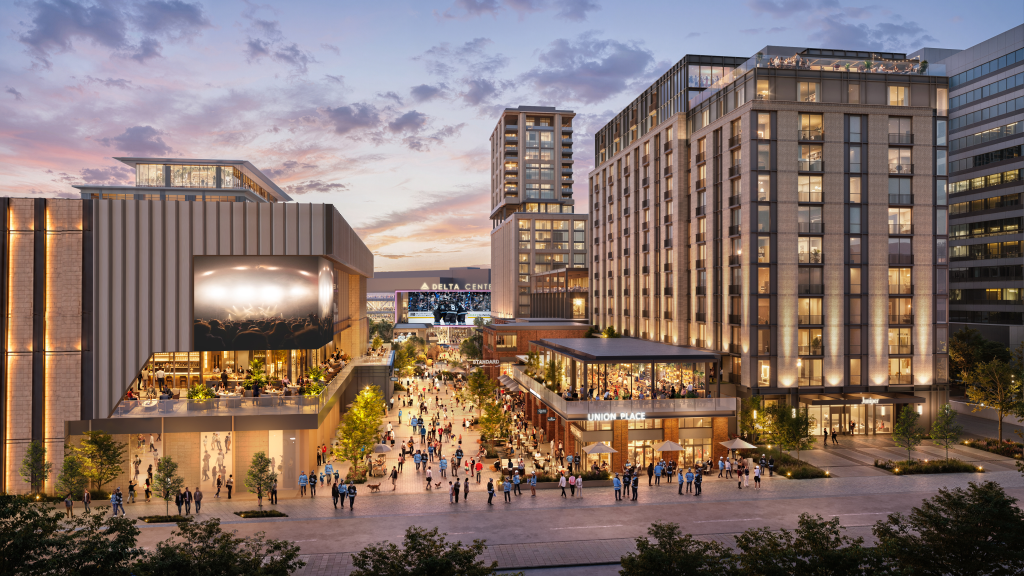
A rendering of the new paseo as part of the new downtown entertainment district. Image via Smith Entertainment Group.
How big?
The Delta Center could carry one roof sign of up to 30,000 square feet, oriented toward the surrounding streets.
Renderings have shown a large screen that apparently shows live streaming of games within the arena fronting the future mixed-use site to the east across 300 West.
Separately, a painted or applied graphic meant to be seen from above, not from the street, could cover up to half of the arena roof. The existing painted logo on the arena roof falls into that second category.
On the ground, the code allows:
- Up to 10 freestanding signs, each up to 50 feet tall with as much as 5,000 square feet of sign face.
- Up to 8 monument signs, also up to 50 feet tall, with up to 2,500 square feet each.
- Up to 6 “perimeter” signs near driveways and entrances, 50 feet tall and up to 5,000 square feet each.
- Facade signs covering up to 60% of any building face, allowed to rise above the roofline. The code says their number, form and method of attachment are “otherwise unrestricted.”
- Banners totaling up to 3,000 square feet per zone, and an unlimited number of wayfinding signs.
Digital screens are capped separately by zone: 5,000 square feet around the arena’s edge, 10,000 on the arena, 5,000 in the 100 South strip and 13,000 across the new district. That’s 33,000 square feet in all, roughly the equivalent of 49 standard 14-by-48-foot highway billboards.
What’s inside the arena isn’t counted. Scoreboard signs meant for fans in their seats are exempt and need no permit, even if they can be seen from the street.
SEG didn’t respond to questions related to the draft signage standards on the record.
Hours, brightness and opposition
Digital screens in every zone could run from sunrise or 6 a.m., whichever comes first, until 1 a.m.
Between 1 a.m. and sunrise they would have to go dark. For a “Significant Event,” such as an Olympic event, playoff game or all-star game, the city could extend those hours through a special permit.
At night, screens could be no brighter than 0.3 footcandles above the surrounding light, with automatic dimming at dusk. The code sets no daytime brightness limit.
Outside the video zones, digital images must hold for at least eight seconds before changing. Flashing, strobing and moving structural parts are banned everywhere.
The code does carve out protections on 100 South, the last remnant of the Japantown that was largely displaced when the Salt Palace was built. Along that frontage, digital screens must be at least 150 feet apart, video is banned, and signs within 100 feet of the Japanese Church of Christ or the Salt Lake Buddhist Temple can be no taller than 25 feet.
A separate “Sensitive Use Frontage” along the edge the district shares with the Japanese Church of Christ bars digital screens and banners outright, though illuminated building and business signs are still allowed. The code says those 100 South boundaries stay fixed even if buildings or uses in the district change.
Kate Kopischke, policy director for the advocacy group Scenic Utah, noted that the proposed changes are significant.
“The proposed agreement would allow off-premises advertising (“billboards”) in a district where city code bans it today,” Kopischke said. “Just two years ago, the City wrote into law that signs in the sports-arena area ‘shall not include off-premises advertising.’ SEG’s plan reverses that decision by allowing up to 33,000 square feet of digital screens, freestanding signs as large as 5,000 square feet, full-motion video facing city streets, and a 30,000-square-foot roof sign on the Delta Center. It’s a major reversal.”
Kopischke noted that there are unanswered questions about the proposal as it heads into the public process.
What’s next
The city is taking written comments on the development agreement, including the sign code, through Nov. 30. The Planning Commission will hold a public hearing Dec. 9 at 5:30 p.m. in room 326 of City Hall, 451 S. State St., according to the city’s online open house. The City Council makes the final decision after its own hearing.
Tomorrow will include coverage on proposed changes to the streets surrounding the Delta Center.
















0 Comments