

Salt Lake City is considering updating its single-family exclusive zoning to allow for building on smaller lots throughout much of the city.
As part of its effort to update its single-family zoning code, Salt Lake City is considering a proposal that would create Small Lot Dwellings as a permitted, by-right development option in the city’s residential zones.
The zones impacted in the proposed changes include all R-1, R-2, SR-1 and SR-1A zones. According to city staff, such zones make up 36% of all land in the city and 77% of Salt Lake City’s residentially zoned land.
The single-family zoning code changes, which the city has dubbed “Expanding Housing Options,” was discussed Tuesday before the Salt Lake City Council, with some council members expressing their support for the changes while another voiced concerns.
Andy Hulka, a senior planner for Salt Lake City, said Small Lot Dwellings would allow homes to be built on lots as small as 2,000 square feet per unit. This new type of unit would also have a maximum building footprint of 1,000 square feet for a single dwelling, and up to 850 square feet per unit for duplexes, triplexes, fourplexes, and townhomes up to four units.
The maximum gross floor area would be 1,200 square feet per unit, according to a city staff report on the proposed changes. At least one off-street parking space per unit would be required for the smaller dwellings.
“Think of this like an ADU, as a different type of building that has its own rules in the zoning code,” Hulka said. But unlike ADUs in Salt Lake City, Small Lot Dwellings could be individually owned.
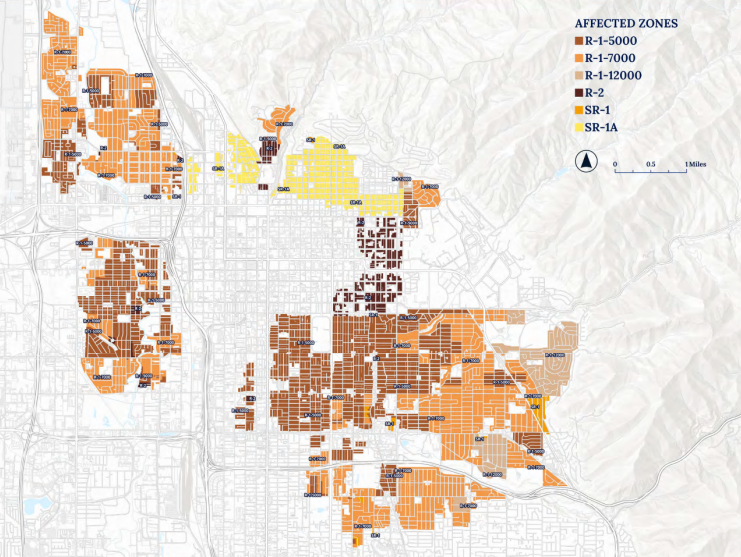
A map of Salt Lake City depicting all R-1, R-2, SR-1 and SR-1A zones that could be impacted by the Expanding Housing Options changes. Image via Salt Lake City
Later, Council Member Dan Dugan asked city staff if a 6,000 square foot lot that’s currently zoned R-1-7000 could be subdivided into three equal lots, developed into three homes and sold individually. Ben Buckley, a principal planner for Salt Lake City, said yes, “as long as they build under the Small Lot Dwelling code.”
Other proposed changes
Also included in the Tuesday briefing were a handful of proposed changes to residential zones. Maximum building heights in R-1 and R-2 zones would gradually increase — going from a 28-foot maximum to 30 feet for pitched roofs, and increasing from 20 feet to 24 feet for flat roofs. Lot width requirements in both zoning types would be removed as well. A restriction on how many duplexes can be on a block face in R-2 would also be removed.
Buckley told the council that multiple units on flag lots would be allowed as a permitted use under the proposed updates. Currently flag lots are only permitted for single-family dwellings, but the proposed changes would allow up to four units on flag lots, so long as they have the space.
Hulka emphasized the proposed changes would not eliminate single-family zoning, nor would it block construction of new, larger homes. The changes would also not rezone land or remove historic overlay protections.
He also explained the current proposal shares similarities with the city’s 2023 Affordable Housing Incentives ordinance, though the two are different. For example, AHI has no size limits and allows new housing in most zones, though it still requires a planning application and restrictive covenants while capping development at four units.
No planning application or restrictive covenants are required under the proposed Expanding Housing Options concept, and there’s no cap on the number of units.
Buckley said the proposed changes were prompted by Salt Lake City’s rising cost of housing. The city’s median home price is around $615,000, he said, while the household income needed to buy a median home ($162,230) is over double the city’s median income ($74,925). Buckley added that families are moving away from Salt Lake, as the city has seen significantly fewer children despite its growing population.
“Since 2000, Salt Lake City has gained over 36,000 total residents, but has lost nearly 10,000 children from its population,” Buckley said. “So we’re trying to encourage more housing to bring back families to the city.”
The proposed changes are the latest efforts by the city to overhaul its zoning code, as last year saw changes to missing middle zones and a complete overhaul of the city’s mixed-use code. Salt Lake City Mayor Erin Mendenhall noted last month that the zoning code updates are working, and more changes would be on the horizon.
Council Member Chris Wharton, who represents the Greater Avenues and Capitol Hill neighborhoods, was unsure about the proposed changes.
He said Tuesday he worries the Small Lot Dwellings seemed to heavily overlap with the city’s 2023 ordinance on ADUs, and he wanted more time to gauge the impact of the city’s recent zoning changes on local affordability. He was in favor of the changes to flag lots, but other aspects of the proposal gave him pause.
“Overall, I also worry that if we might be moving a little quickly on this, in addition to all the changes that we made in the last year or so that we haven’t really seen come to fruition yet — affordable housing overlay, the RMFs, the MUs,” Wharton said.
He later said the proposed changes, while not technically a rezone, could impact a substantial number of homeowners citywide. Unlike a rezone, abutting property owners likely wouldn’t get a notification for these types of changes. He added, “it is a big change for those where a lot does qualify.”
On the other side of the spectrum, District 1 Council Member Victoria Petro said she was fully in favor of the proposal, adding, “I actually love everything we’re doing here.” Petro did question whether the city should restrict lot coverage to no more than 50%, saying that she would be in favor of maxing out their square footage on a single floor.
The council took no vote on the proposal Tuesday, as city staff is expected to make changes based on input from the council and the public. It’s not clear when the council could hold a hearing to accept public comment or vote on the proposal.
The city has a number of public engagement events scheduled regarding the potential changes, which will take place around Salt Lake City until late March. Dates and locations for the events can be found on the city’s Expanding Housing Options website.
















0 Comments