
Between the new Deer Valley East Village and the impending 2034 Winter Olympics, there’s plenty of reasons to be bullish on the Wasatch Back’s resort economy. Unlike much of the Wasatch Front, developers have large swaths of land to work with, often turning open fields into housing.
But resort leaders and municipal officials agree — a lack of affordable and workforce housing remains an issue in Park City.
That notion isn’t new, but it was discussed frequently during the Urban Land Institute – Utah Chapter’s recent Resort Town Summit, which took place Thursday at the Hyatt Centric at Park City Mountain Resort. The event brought together municipal officials and ski industry experts to discuss what the future holds for resort communities.
In Summit County, the AMI for a family of four is $168,600 — notably higher than Salt Lake County’s mark of $122,700. For a single person, Summit County’s AMI is $118,000, while Salt Lake’s is $85,900.
Like any other resort communities, home prices in Summit County are out of reach for many. Tony Tyler, a partner with Columbus Pacific Development, told the audience that to buy an average home in Summit County, you’d have to make $410,000 per year, or $197 an hour. Meanwhile, the county’s average workforce wage is $47 an hour.
“Just to highlight the predicament that we’re in, in these resort towns, we run on our existing workforce today, and we’re currently in the process of forcing them out with our high real estate values and barriers to entry,” Tyler said.
AFFORDABLE HOUSING IN PARK CITY
To combat that problem, local government and developers have fought to bring in affordable housing to Park City, though some in town fought against it. Those efforts result in projects like EngineHouse, a 123-unit mixed-income complex at 1875 Homestake Road. The complex cut its ribbon in December, according to KPCW.
Rory Murphy, a longtime developer in Park City, was behind the EngineHouse project. He said during a panel Thursday that 99 units of the development are offered to those making 60% AMI or lower. He said building a 4% LIHTC building in the middle of town drew a lot of attention, some good and some bad.
“There is a remarkable pushback from some sectors of our society in Park City regarding affordable housing and just a lack of understanding of how the economics work in a resort town,” Murphy said.
Despite any local worries, he said the response since opening has been dramatic. He planned for a full lease up in 12 months, but after around three, the project is around 70% leased with another 20 leases ready to be signed.
“The response is overwhelming,” Murphy said. “I could fill three more of those.”
Back in 2016, Park City’s government set a goal to house 15% of its workforce in city limits. But the city determined last year that it wouldn’t hit that mark. Sara Wineman, the city’s housing director, said the city government now has a goal of creating just under 1,900 affordable housing units, which the city aims to build before 2032.
“If we look at that today, we’ve reached about 44% of that goal, and if we look at the projects that are under construction, we’ve reached about 63% of that goal,” Wineman said during a panel. “So we still have a lot to build.”
Another bright spot in the county’s housing efforts is the Mountainlands Community Land Trust, a nonprofit that provides affordable housing along the Wasatch Back. Jason Glidden, the trust’s executive director, told the same panel Thursday that increasing costs have made it difficult for new projects to be built.
Glidden said one of the land trust’s projects, called HOPA, seeks to convert two aging apartment properties into 317 affordable housing units. The property is entitled and slated to be delivered in 2030, but Glidden said financing the project was difficult. One problem with financing affordable projects in a resort town like Park City is the cost efficiency. That’s a key aspect when applying for LIHTC credits. Because of the high cost of land and rising building costs, applications for the competitive 9% LIHTC have not been awarded to the HOPA project.
“We applied three years in a row and (did) not receive it, based on our cost efficiency scores,” Glidden said. “So we now have to step back and look at redesigning the project to make it more cost efficient.”
Of course, Park City and other parts of the Wasatch Back are on the cusp of more development in light of the 2034 Winter Olympics. Resort industry insiders said Thursday that the need for workforce housing is one of the aspects that’s changing in their line of work.
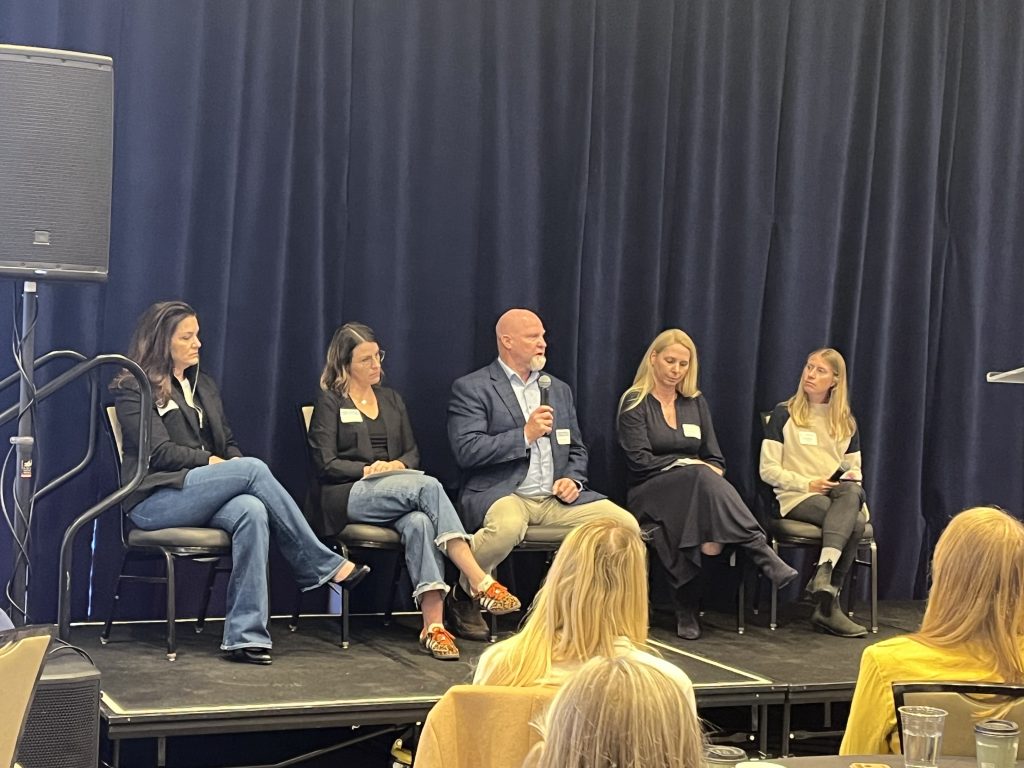
Glen Clement, vice president of development at Extell Development, center, speaks during a panel at the Urban Land Institute – Utah Resort Town Summit. Photo by Jacob Scholl | Building Salt Lake.
Glen Clement, vice president of development at Extell Development, said he came from the Lake Tahoe area to Utah to work on the new Deer Valley East Village project. He said starting from the ground up on a project like that is exciting, but noted that a lack of employee housing is a notable shift in the industry.
In addition to workforce housing at East Village, Clement said there’s another affordable housing project in the works nearby. He said on the east side of Highway 189 and closer to Jordanelle State Park, around 40 acres of land could be developed into roughly 600 affordable housing units with around 2,000 beds.
“I think that’s something that we’ve learned — if you’re going to build a resort, we’ve got to think from beginning to end,” Clement said on a panel Thursday. “We can’t just focus on the lucrative real estate. We also need to focus on, how are you going to service it? So we made a big effort to plan for and prepare for the employees, the workforce housing.”
CHANGING CLIMATE, CHANGING RESORTS
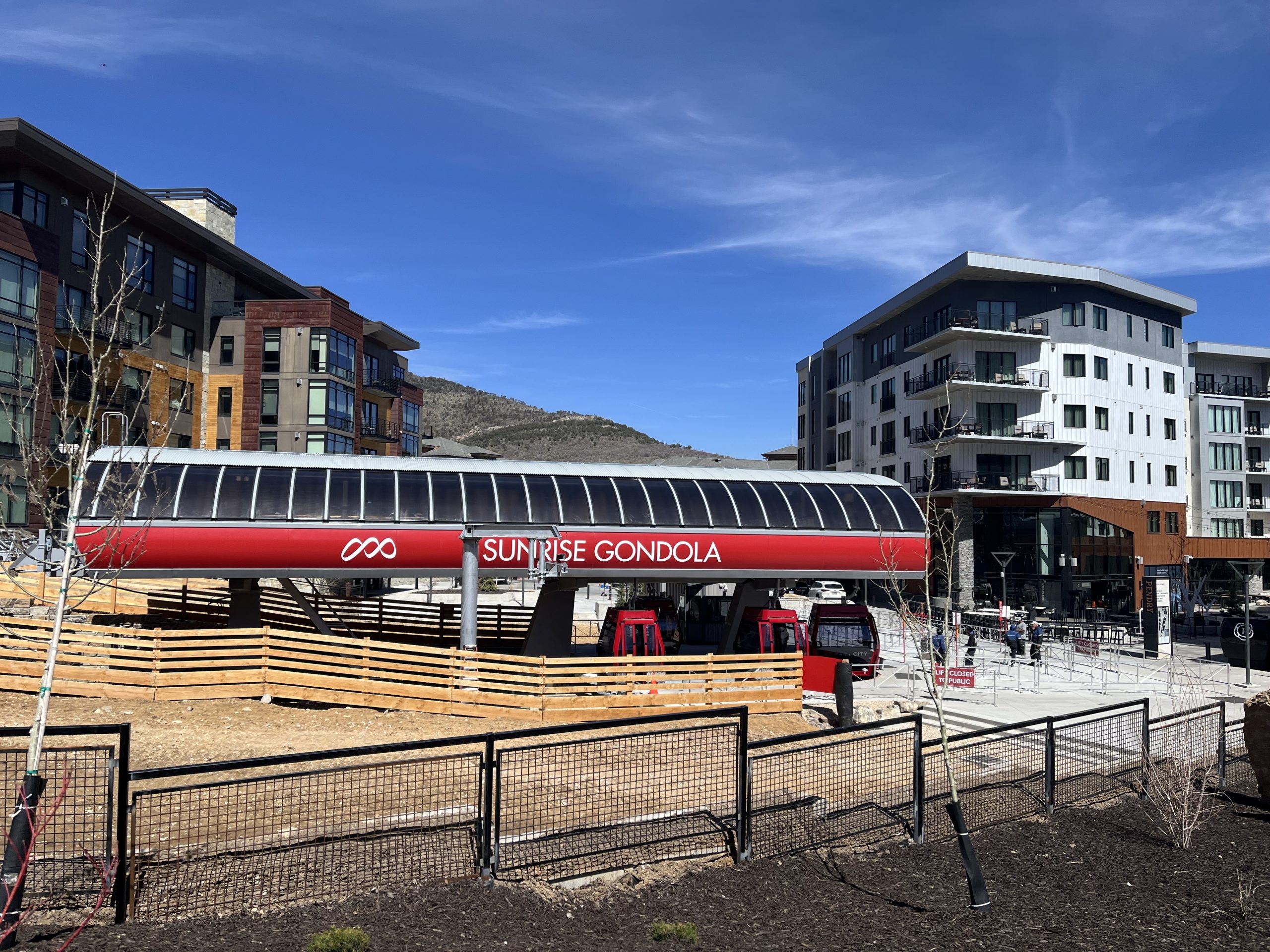
Another aspect discussed Thursday was the changing climate, which is causing resorts to make a shift toward focusing on year-round visitors. In a typical snow year, PCMR would be filled with skiers looking for fresh turns amid a busy resort village. But on Thursday, the base of the newly-opened Sunrise Gondola had no line, and the base village had no snow in sight.
Despite the terrible snow year, Dana Schoewe, a principal at RCLCO, a real estate economics consulting firm, said the down year might not be as bad for resorts as imagined. She said more resorts are shifting towards having a 10-month season, taking shorter breaks between the winter and summer seasons.
“Forward bookings for spring and summer remain really solid, especially in the short term rental market, which we actually (are seeing) shoulder seasons becoming more and more resilient,” Schoewe said. She later added that resort hotels have seen strong occupancy in the summer months, though summer rates still aren’t as high compared to the winter months.
Other resort towns like Jackson Hole, Aspen and Telluride have limited land availability due to their geography, which tends to drive up prices and offer little options for workforce housing. But Schoewe said Park City has a leg up due to the amount of land that’s available for new projects.
“We’re fortunate in Park City that this is one of the markets that has seen a big building boom, just given Deer Valley East, as well as a lot of workforce housing green shoots in Kamas and Heber City and other areas,” she said.















0 Comments