

The fate of a national historic site in Cottonwood Heights is up for discussion later this week.
On Wednesday, the Cottonwood Heights Planning Commission will hear a proposal and take public comments for a plan to tear down the old Cottonwood Paper Mill, located at 6851 S. Big Cottonwood Canyon Road. The mill sits on a .86-acre plot, and it’s currently zoned as Regional Commercial (CR).
The landowner and applicant, Doug Shelby of WDOM Properties LLC, is seeking a conditional use permit to raze the site, according to a planning staff report made public Friday. Staff wrote that Shelby had engineers analyze the site in 2022 and 2024, which found a number of issues.
“The applicant asserts that the structure is an attractive nuisance, an imminent danger to public safety, and is structurally unsalvageable,” the staff report says.
One report from 2022 found the building has no foundation, as granite blocks were stacked on the ground without a concrete foundation. The same report found the building is at risk of collapse, and it has deteriorated after years of disuse and exposure to the elements, the staff report says.
Another engineering study from 2022 found that updating and retrofitting the old mill would, “shoring each granite block individually during excavation, a process deemed unsafe and structurally infeasible due to the risk of collapse,” the staff report says.
The most recent engineering report from 2024 estimated it would cost over $45 million to overhaul the site, the staff report says.
Included in the report are a number of methods the city could use to commemorate the old mill if it were torn down. For example, Daughters of Utah Pioneers want to commission a bronze plaque and historical marker for the site. Shelby and the Cottonwood Heights Historical Society commissioning a digital history of the mill is also an option listed in the staff report.
Another option would be to preserve elements of the mill as part of Cottonwood Heights’ proposed town center, which would be built at the former Hillside Plaza at the corner of Fort Union Boulevard and 2300 East. The city bought the 10-acre town center parcel back in 2023, and voters approved a $30 million general obligation bond in 2024 as a funding kickstart for the project. Architects and engineers for the project could choose elements of the old mill to incorporate into the new development, the staff report says.
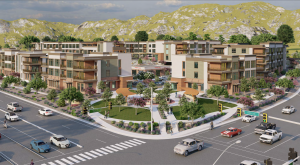
What’s not included in the planning commission report is what the old mill site would become if the building is demolished. It’s possible the area would be developed into housing, as the city has seen a pitch for the site in recent years. In June 2024, developers announced plans to build over 300 housing units near the mill. The plan sought to convert nearly 31 acres into 175 condos, 120 townhomes and 14 single-family homes.
Construction on the mill began in 1880 and was completed in 1883, and it was built using excess granite that was quarried for the Salt Lake Temple for The Church of Jesus Christ of Latter-day Saints. The site was built as a secondary paper mill for the Deseret News, and it operated for roughly a decade until a fire in 1893, according to Preservation Utah.
After sitting abandoned, the mill was rebuilt in 1927 as an open-air dance hall, but it closed during World War II. It served as a concert venue in the 1960s, and it was later used as a haunted house and boutique in the ‘70s and ‘80s, according to Preservation Utah. Though it earned a designation onto the National Register of Historic Places in 1971, the building was condemned by the city in 2005.
Brandy Strand, executive director of Preservation Utah, told Building Salt Lake that while the building has been vacant for a number of years, the old mill’s impact can be seen in the surrounding neighborhoods.
“If you now start to look at all the developments that’s been happening around this historic structure, that identity has expanded beyond that,” Strand said. “I mean, you have old mill developments and names and things all around there. You can really see it as an anchor point.”
Strand said the mill has been a topic of discussion in Cottonwood Heights for years, and she hopes there’s a way to preserve the site for years to come. She said city officials have been supportive of restoration, adding she hopes there’s a way to use historic preservation incentives to rebuild the site.
“It doesn’t have to be completely restored to perfection,” she said, “it can be adaptively reused to what we need that parcel to be.”
Even if the Cottonwood Heights Planning Commission gives a thumbs up to the demolition plans, the mill likely won’t be going anywhere for the time being. The final say on the old mill will be up to the city council, which will determine whether or not to demolish the site.













0 Comments