

Developers of new, low-income housing developments in Salt Lake City seem to be hanging on, despite a soft multifamily market, slow lease-up periods, ongoing concessions and lingering questions over whether distress is coming to subsidized projects.
Plans for new affordable developments keep popping up through loan applications to city and state programs, and others are gradually clearing sites for future builds. Other projects have gone further, as some have filed for building permits or moved into the construction phase around town in hopes of delivering when other projects get closer to stabilizing in the coming years.
One project nearing a groundbreaking is the Emeril Apartments, located at 37 N. 800 West near the North Temple corridor. The project, which is being developed by the Community Development Corporation of Utah, would consist of 135 units ranging from one to three bedrooms and cater to incomes ranging from 80% AMI to below 30%.
Todd Reeder, CEO of CDCU, told Building Salt Lake he hopes to close on the Emeril’s financing around Thanksgiving and start construction in January. Though the project is moving forward, he said it’s a nerve-wracking time to be a LIHTC developer.
Other projects in the area are ready to build, but have remained on hold due to the current market conditions. Plenty of other multifamily developers face the question of whether to move forward on planned projects or hold off until conditions improve.
“Honestly this Emeril project has me really worried,” Reeder told BSL, later noting that a parcel near the Emeril is home to a planned multifamily project that’s sitting empty.
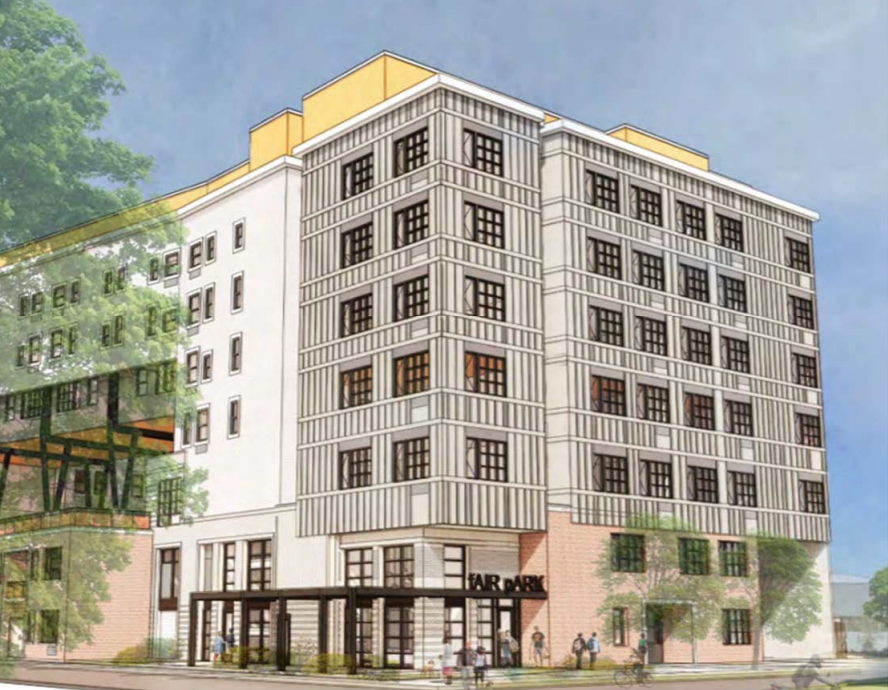
A rendering of the Emeril Apartments in Poplar Grove. Image via BlueLine Development, Inc. and the Community Development Corporation of Utah
Current LIHTC Market
Peter Corroon, a longtime local developer, said the LIHTC market has been largely stagnant over the past year, if not getting slightly worse.
Last month, he said the 144 South affordable project, which opened in early 2025, was around 15% vacant, though he noted the figure was taken near the beginning of the month just after some tenants moved out.
“We’re so overbuilt in Salt Lake City, that even the affordable housing projects are struggling to stay full,” he told BSL.
He added that 144 South is offering studios starting at $999 per month and one-bedroom units starting at $1,250 per month. Add in the four weeks of free rent being offered, the effective rents are $916 for a studio and $1,140 for one bedroom, he said.
Though Salt Lake City is still seeing many market-rate and affordable projects offer heavy incentives to draw in new tenants, recent reports have shown the market could be tightening.
A Q2 multifamily report from Northmarq found that while vacancy was up slightly year over year, asking rents in the Salt Lake City market had risen slightly by 1.6% — which is the strongest quarterly gain since 2022. A 2026 multifamily report from Marcus & Millichap also found the Salt Lake metro’s rent had increased 1.5% year over year.
However, the Northmarq report notes that Downtown Salt Lake City accounts for roughly a third of the metropolitan area’s vacant units. The Marcus & Millichap report said the Central Business District accounted for a fourth of all vacant units.
Northmarq forecasts the ongoing developments in Downtown Salt Lake City will keep vacancy rates up, but notes that could just be temporary.
“Multifamily permitting has fallen well below its 10-year average, and with fewer projects breaking ground, the pipeline feeding 2027 is thinning quickly,” the Q2 report says. “Rent growth is likely to follow the same path, cooling from the recent rebound before firming again as the supply overhang clears, with asking rents projected to finish the year near $1,600 per month.”
In the long run, developers are hoping that the lack of new product being built in the near future will result in a tighter, more supply-constrained market that will see vacancy rates decline while rents start to go up. But that means taking risks now.
“Those who are finishing projects are struggling, and I think those who are building are hoping that it’s a short-term issue and not a long-term issue,” Corroon said.
Reeder told BSL that one of CDCU’s recent projects started leasing at the beginning of the year. That project, called The Howick and located at 4101 S. Howick Street in Millcreek, caters to those making 30%-60% AMI and includes units ranging from one to four bedrooms. Reeder said around 115 of 150 units are rented, noting the one- and two-bedroom units have all been spoken for.
“I thought the (one bedrooms) would be hardest (to lease) because they’re close to market rate, but what’s surprising is the three and four bedrooms are still lagging behind,” Reeder said. “The (four bedrooms) are affordable at 60% AMI but $2,000 a month. To me, just in my own little bubble, that is a lot of money.”
Future market outlook
For a nonprofit developer like CDCU, it can be difficult to move projects forward.
Without institutional investors with deep pockets, groups like CDCU often rely on loans from places like the Salt Lake City Community Reinvestment Agency to bridge shortfalls in the budget.
Groups like the city’s CRA, or other organizations like the Olene Walker Housing Loan Fund, will ask developers what could happen if they didn’t get the loan they’re seeking. Reeder said his response is often “we just have to go pass the hat around.”
In a statement to BSL, Tauni Barker, a spokesperson for the CRA, said rental market conditions have shifted significantly in recent years, which has resulted in a more selective equity market. The CRA has seen this firsthand.
“Even with these challenges, affordable housing projects using Low Income Housing Tax Credits (LIHTC) still pencil,” she said in an email to BSL. “Interest in our affordable housing financing programs remains strong, indicating that developers are still finding ways to make projects work and bring much-needed affordable housing to Salt Lake City.”
Reeder said it’s easier for larger institutions with deeper pockets to move forward with projects and anticipate a longer lease up period. However, developers like CDCU more frequently have to rely on gap sources of funds — like the CRA’s Housing Development Loan Program — to get LIHTC projects across the finish line.
In the long run, developers are building nowadays because they’re bullish on the future of the Salt Lake City market, Reeder said. Much of the Wasatch Front is still slated to grow in the coming years, and things like the 2034 Olympics gives investors a reason to have their money in Utah. Plans to overhaul the city’s urban core help, too.
Reeder and others are confident there’s a need for more housing, adding there are market studies from places like the Kem C. Gardner Institute that outlines that demand.
“The need is out there, it’s proven and we can get this sold to the market, and because they’re affordable, we should have an easier time renting them up,” Reeder said.











0 Comments