

After months of discussions, debates and neighborhood infighting, the Salt Lake City Council has begun moving toward a long-awaited update to its single-family zoning code after years of growing unaffordability and families fleeing the city for the suburbs.
The Expanding Housing Options (EHO) initiative would allow for small-lot dwellings of up to 1,700 square feet to be built on lots as small as 2,000 square feet.
The thought process behind the initiative is simple — land costs are high and smaller lots cost less. Allowing these types of dwellings by-right would allow the structures to be built more quickly without needing approvals from levels of city bureaucracy. Other cities around the country, like Durham, North Carolina, have seen success with adopting this approach.
But the Salt Lake City Council appears ready to dial back the proposal and include what some experts call “poison pills” that will limit the effectiveness of the policy. The lobbying and eventual vote before the end of this year will dictate how far Salt Lake City is willing to go in its quest to make houses less expensive.
The council voiced their preference during an Oct. 20 meeting to largely kneecap the anticipated zoning update. The council voted in a straw poll to add an owner-occupancy requirement, which would mandate that if a landowner wants to build small-lot dwellings on a property, at least one of the units has to be owner-occupied.
While straw polls are not necessarily binding, experts fear the changes, if passed, would restrict the number of new units built under the proposal.
‘Poison pills’
Andra Ghent, a University of Utah professor and academic director of the university’s Ivory-Boyer Real Estate Center, said the owner-occupancy requirement is now the second poison pill introduced in the proposal.
“The first poison fill was this 1,200-square-foot max,” Ghent told Building Salt Lake. “When you’re competing with housing in Murray and Taylorsville, most families would rather a 1,800 or 2,000-square-foot home. 1,200 square feet is just not competitive for family-sized housing in the Salt Lake metro.”
She said the council’s recent move harkens back to its debate on accessory dwelling units (ADUs), where a majority of the council voted to include an owner-occupancy requirement in the 2023 ordinance.
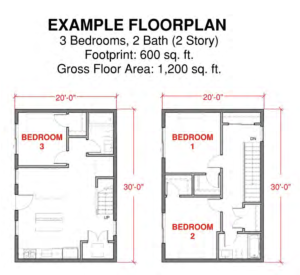
An example of a 1,200 square foot home that could be built in Salt Lake City under the EHO proposal. Image via Salt Lake City
City data show that provision is almost never enforced, but the requirement adds uncertainty to property owners who might want to add another rentable unit to their property, but who might not plan to live there long-term. It also creates uncertainty for future tenants within either the primary home or ADU.
Darin Mano, who didn’t run for reelection and was replaced on the City Council earlier this year, pushed against adding the owner-occupancy restriction to the ADU ordinance, but was ultimately outvoted. Mano told BSL he does not support adding the owner-occupancy to the new single-family zoning changes.
“The owner occupancy requirement will for sure mean fewer people take advantage of it,” Mano told BSL. “So if we’re just looking at it from a supply perspective, that’s going to really hamper the effectiveness of this ordinance.”
He noted that some building types could still work with the owner-occupancy requirement. Mano said if someone built a four-unit townhome complex, it would be possible for the land owner to live in one unit and rent out the other three.
It’s unclear whether homeowners with surplus vacant land would be allowed to split their lots and build a new single-family home to sell or sell the split lot to a developer with the owner-occupancy provision. The actual legislative language will determine that.
Financing is another issue. Unless a homeowner has enough money in the bank to cover building costs, those seeking to build on their lots could have a tough time getting a loan for construction.
Ghent said construction loans are largely personal recourse loans, meaning that if the project goes belly up, the homeowner is personally liable to repay the loan. These types of loans aren’t collateralized like mortgages, she said. Instead of a bank foreclosing on a home if the owner doesn’t pay the mortgage, if a personal recourse loan isn’t repaid, the bank can garnish wages and go after earnings.
On the flip side, Ghent said, a bank is unlikely to loan money to someone who doesn’t have the financial assets to support it. She said anyone who would want a loan to develop their land under EHO would have to have a significant amount of assets and income potential for a bank to give them a loan.
Ghent said that leaves smaller-scale, local developers as the most likely option to build infill projects like the ones sought in the EHO initiative. Mano said a typical homeowner might not be able to pull off the financing, but partnering with a developer with more resources could enable projects to get across the finish line.
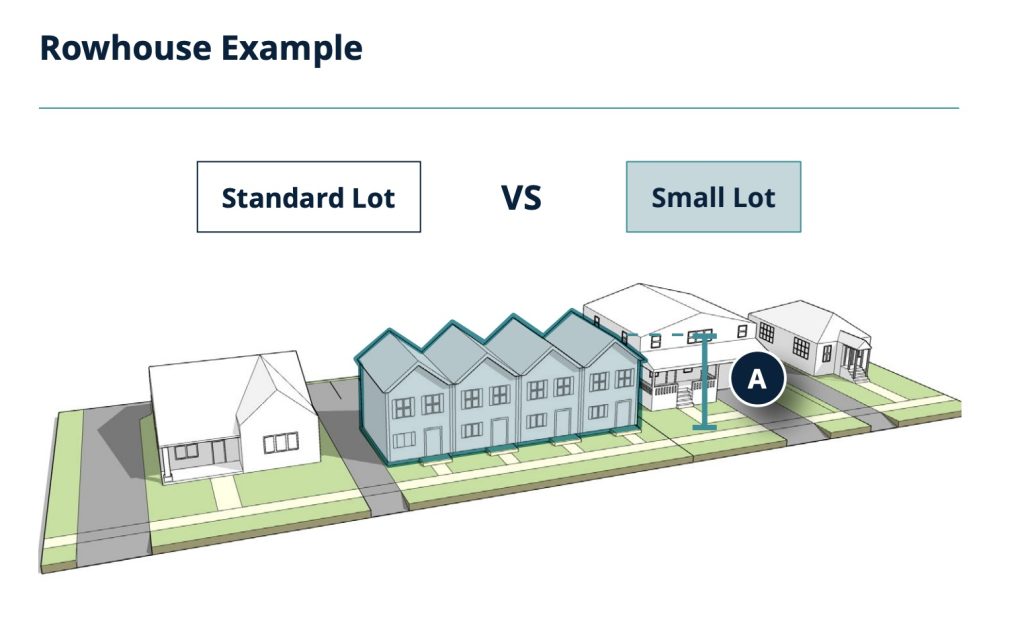
An example of a rowhouse under Salt Lake City’s Expanding Housing Options initiative. Image via Salt Lake City
Developers and investors
Council Member Erika Carlsen replaced Mano on the city council earlier this year. She told BSL that she supports the owner-occupancy requirement, largely because increasing homeownership was one of the aspects outlined in the council’s legislative intent approved last year that kicked off the zoning initiative.
Carlsen said she’s concerned that without the owner-occupancy requirement, the only units that would be built would be rentals. She noted that rental units are needed in the market, but she circled back to the homeownership aspect in the legislative intent. She believes the EHO initiative could lead to more homes for sale.
“But I want to make sure that it actually benefits Salt Lakers, and it doesn’t benefit institutional or corporate investors who likely have access to both the capital and the technical expertise to develop more properties,” Carlsen said.
When asked what she considers an institutional investor, Carlsen said, “I’m talking about the local individuals who maybe own more than 10 properties or 10 units in Salt Lake City.
“There are some questions about the degree to which private equity, large institutional investors are operating in Utah and the Salt Lake City market, and I think we still don’t have the clear data on this. But we do have a sense that renters are outpacing owners, and that has not always been the case in Salt Lake City.
Ghent, whose research specializes in real estate finance and other topics, said large institutions own less than 2 percent of the family-sized housing stock in the United States.
She said having more capitalized and experienced builders, which is not the same as a large bank or institution, would mean more efficient building. It would also add more affordability long term, as research has shown that efficiencies in construction can be passed down to renters.
“The No. 1 thing we need for rent to come down — for family-size housing, obviously we have a lot of supply Downtown for studios and one-bedrooms — but for family-size housing, we need more units, and so if we could get institutional investors interested in investing in the Salt Lake housing stock, that’d be amazing,” Ghent said.
But she said that large investment firms aren’t interested in the type of infill projects EHO aims to enable. Mano agreed, as he told BSL a large institutional bank wouldn’t invest in the types of smaller projects that would be allowed under the proposed changes.
“If we’re talking about really big investment real estate firms, I don’t see them going through the headache to deal with a four-unit development,” Mano said. “The time involved wouldn’t make sense to me, but I don’t know, I’m not a large commercial real estate investor.”

A duplex is an example of missing middle housing.
Ripple effects
During the Oct. 20 council meeting, city staff said that in previous housing efforts, like the city’s ADU ordinance or its Affordable Housing Incentives (AHI) initiative, only around 0.5 percent of properties around the city have utilized the program.
Staff estimated that if 1 percent of parcels eligible under EHO, meaning the land must have the zoning and the space needed to build any new units, used the initiative, that would total around 130 properties with at least one new housing unit. That number doesn’t factor in the potential impacts of an owner-occupancy requirement.
Carlsen is under no illusions that 130 new units would fix Salt Lake City’s housing crisis, as she told BSL that one multifamily project could add that many units in a single building.
“What I see as a part of Expanding Housing Options is really a way for us to use a policy lever to increase the outcomes that we want to see in our city,” Carlsen said. “(The) outcomes we want to see are lowering the cost of housing and providing more opportunities for affordable home ownership for folks.”
Ghent explained that by imposing restrictions on the EHO effort, even in the name of only creating more home ownership opportunities, could have the opposite effect.
She told BSL that all new housing supply will help to make homes more affordable. She doesn’t think the City Council is keeping in mind that Salt Lake City is trying to compete with other nearby cities — which commonly have homes larger than 1,200 square feet for less than a home in Salt Lake City — for young families.
“Restricting supply by not allowing 2,000 square feet lots, that doesn’t serve home ownership,” Ghent said. “Even if your goal is home ownership, by restricting supply in this way, you’re decreasing opportunities for home ownership.”
Mano takes a more optimistic approach. While he doesn’t think the owner-occupancy requirement should be in the final EHO proposal, which he said it sounds like it will, any new units the initiative could yield is a net-positive for the city. Those new units wouldn’t be built otherwise, and Salt Lake City needs every housing unit it can get.
“It’s better than if nothing can get built, so it’s moving the needle in the right direction,” Mano told BSL. “That’s what this ordinance is trying to do, is to create multiple tools so that whatever situation you’re in, if you’re trying to create housing in Salt Lake City, you can find a pathway to do it.”
Public hearings on the initiative are scheduled for the next two City Council meetings, which will be held at 7 p.m. on Nov. 10 and 17. A vote is tentatively scheduled for early December.


















0 Comments