
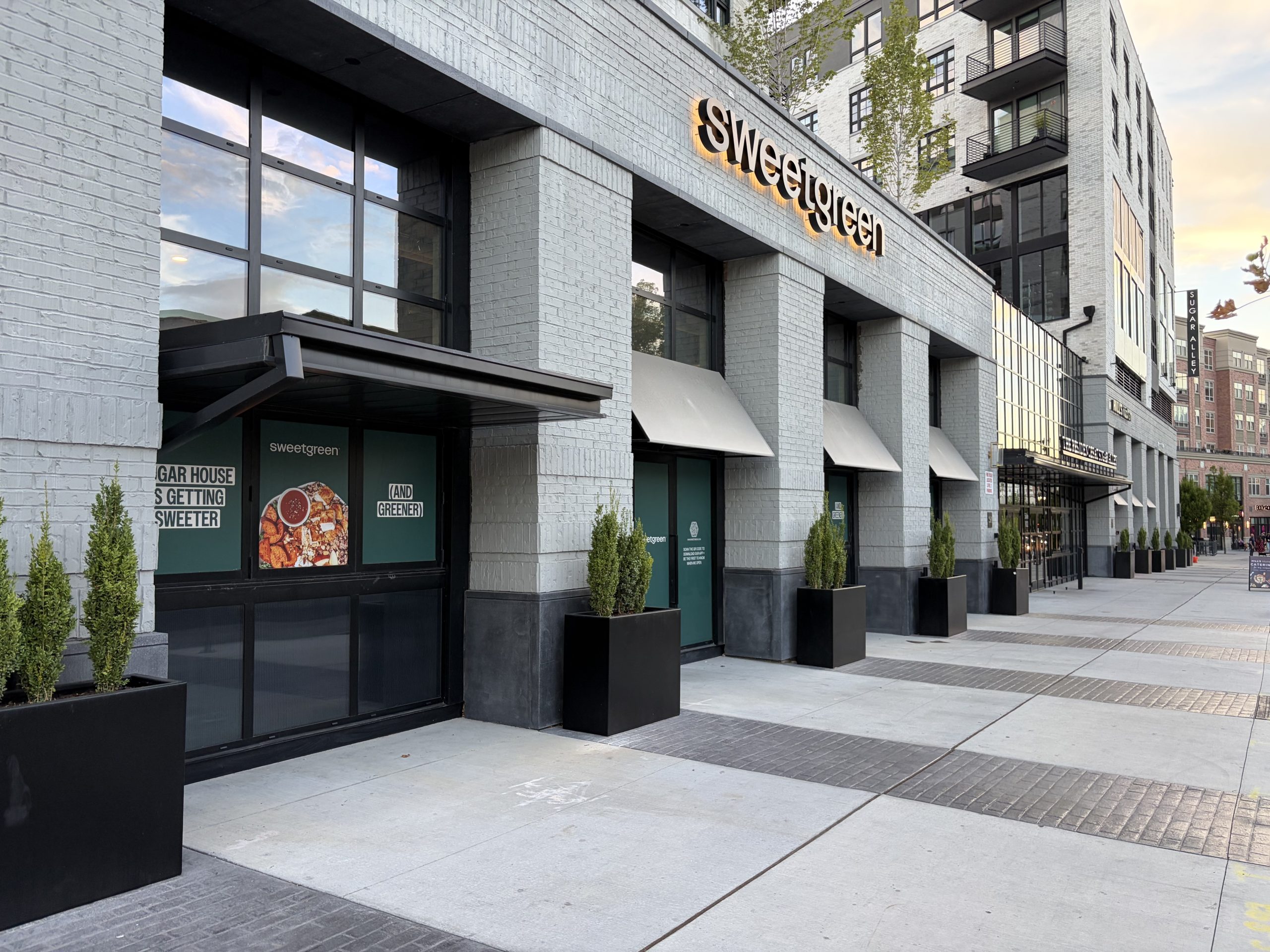
After years of street construction, sidewalk closures for development projects, and uncertainty about zoning changes, the future of Sugar House’s business district may soon be coming into sharper focus.
A formal process started in 2021 by the Sugar House Chamber and Community Alliance, but put on hold during construction, will come to fruition or wither on the vine over the next 90 days.
The Salt Lake City Council held a public hearing last night that begins the official two-month protest period for property owners in the area designated for a business improvement district (BID).
The district, also called a Special Assessment Area (SAA), would provide signage, an ambassador program for homeless services, events that promote business district identity, marketing, and business support. It is expected to raise $1.7 million over its first three years, paid for by the owners of commercial properties (excluding residential commercial properties).
The model
The city’s Department of Economic Development modeled the Sugar House Business District SAA based on the only other business improvement district in the city – Downtown’s. SAA’s are enabled and regulated in Utah code.
Founded in 1991 and most recently renewed in April 2025, the Central Business Improvement Assessment area (CBIA) currently collects $6 million over a three-year period. It funds programs likely familiar to downtown residents and visitors: the vertical banners hitched to light posts, the Downtown Farmers Market, the Downtown Ambassadors homeless services, and holiday-themed lighting.
The CBIA is administered by the Downtown Alliance, a 501(c)(6) non-profit which has won the city’s bidding process each time the city has put out an RFP for the services. The Alliance also provides a yearly economic benchmark report that chronicles the economic health of the district.
The process and purpose
To create the Sugar House BID, property owners, in proportion to the value of the commercial property they own, must object at a 40% rate or higher. According to state statute, every three years the district’s rate-paying property owners must be invited to protest the SAA.
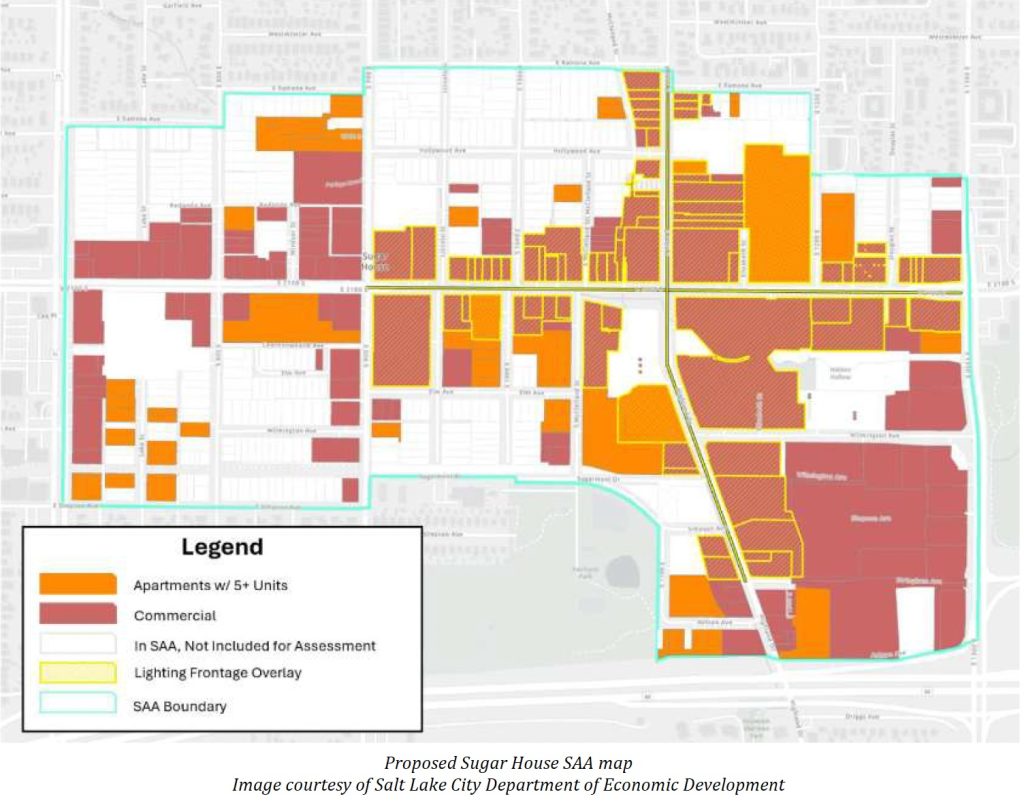
The “protest hearing” period, which began yesterday, will conclude in 60 days; the City is then allowed 30 days to tabulate and report the vote.
According to the City Council’s staff report, “The protest hearing gives property owners an opportunity to object to the creation of the assessment area, their inclusion in it, or the proposed services…If property owners holding 40% or more of the total valuation in the SAA protest its creation, then the SAA cannot be created, and the process ends.”
If that protest threshold is not met, the city council will pass a resolution designating the area SHBD-27 and create a Board of Equalization to make final adjustments to assessments. Those would be issued on March 21 and due on April 6, 2027.
A second assessment for properties along 2100 South and 1100 East would provide specialized signage and decorative lighting for those streetscapes.
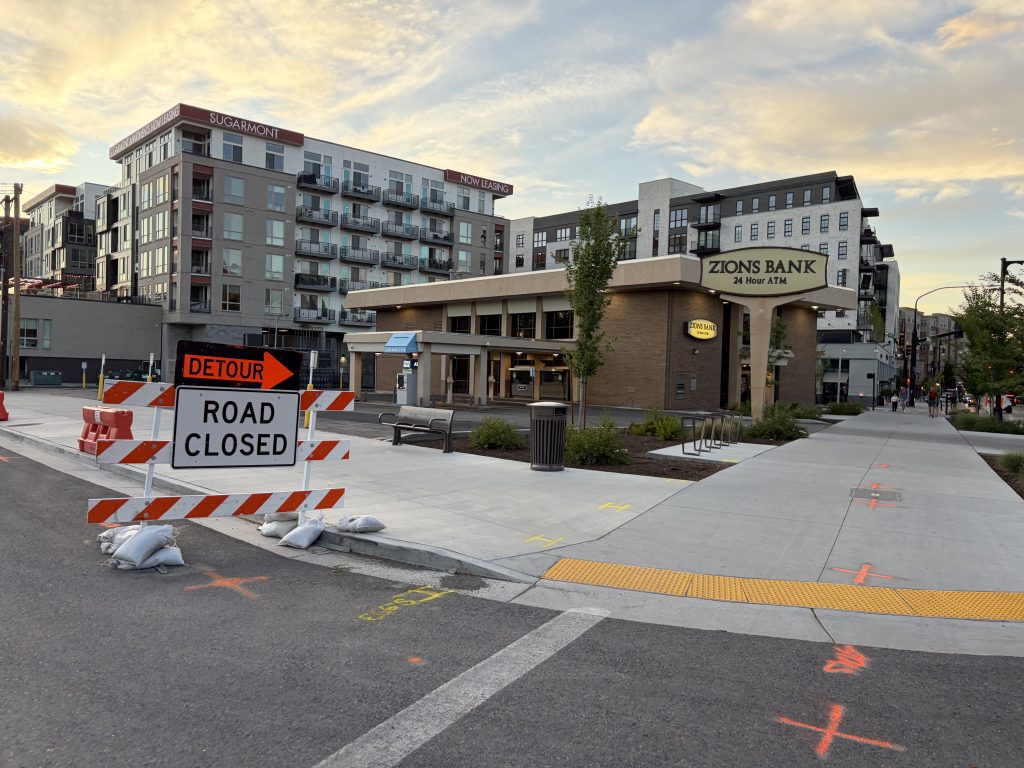
1100 East and 2200 South, looking north. Devin Zander | Building Salt Lake
According to city staff reports, the assessments would fund promotional activities including “advertising campaigns, newsletters, placemaking initiatives, limited trash pickup, hospitality, wayfinding assistance, holiday lighting/signage, light maintenance, homeless services including connection to social services through the Ambassadors & Public Realm Services, business recruitment, district research/reporting, surveys, government coordination, housing advocacy collaboration, town meetings, strategic planning and special projects.”
Voices from the neighborhood
Scott Lyttle, Co-Chair of the Sugar House Chamber and Community Alliance, told Building Salt Lake, “After 2-3 years of construction, change, and coming out the other side, we have an incredible opportunity to redefine the future of Sugar House.”
Lyttle, who is the owner-operator with spouse Becky of Tea Zaanti at 1944 S 1100 East, wholeheartedly supports the creation of the SAA.
“Our assessment is going to be less than $80/month for 3 years. For that much you can’t get a lot of advertising,” he told us.
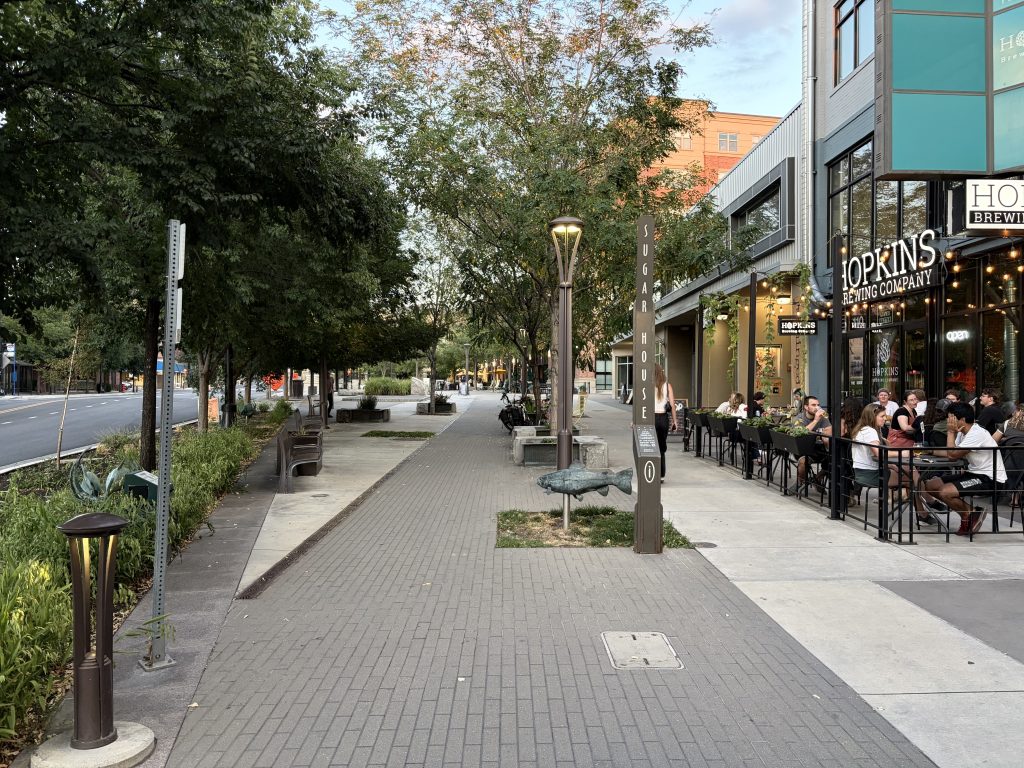
Sugar House Monument Plaza, August 2026. Devin Zander | Building Salt Lake
In a letter sent to the city council yesterday, the Lyttles acknowledged that “For the past two and a half years, Sugar House businesses have endured significant construction and disruption. For many of us, it has often felt like we were ‘closed for business’ even when our doors were open.”
They argued that “Without a coordinated effort to reintroduce Sugar House and actively invest in the district, we risk allowing the disruption of the last several years to define what comes next.”
“Now we have an opportunity to do more than simply recover from construction,” they wrote. “We have an opportunity to define the new Sugar House.”
At the council’s protest hearing, four property owners spoke in opposition to the SAA, emphasizing skepticism that the assessments would help their businesses and emphasizing their lost sales during street construction.
Chris Hatch, a commercial real estate developer and property owner, told BSL that “It is an interesting approach for the city to hit the property owners up and thus the retailers to pay taxes to revive the area.”
He spoke of the impact to triple net (NNN) leases, where the leasing business pays many expenses for the property owner, including property taxes.
Hatch argued, “The revival that is needed is in large part due to the city tearing the road up for the last 4 years. Tearing up the road to fix the storm drain, then the water line, then the sewer line and then to improve the road sequentially was a terrible series of events.”
“I feel like penalizing the retailers with a tax to revive the area is adding insult to injury,” he told us. “It doesn’t feel like a good partnership.”
The dissidents have 60 days to express their disapproval to the city in writing. If property owners holding 40% or more of the total valuation in the proposed area opt out, the BID dies.
Who will run it?
The city’s Department of Economic Development will provide “management, professional and technical services, printing, and postage” for ratepayers–a portion of what it takes to administer the SAA. That cost is projected to be $229,000, or about 13.5% of the $1.7 million expected to be collected in the first three years.
Running the promotional programs will be outsourced, likely to a local organization, and are preliminarily budgeted at $227,000 of a projected $1.4 million operating budget.
While the city is obligated to issue an RFP for the services, and may look nationally for bids, it also has an interest in cultivating local capacity to win the contract.
Both Scott Lyttle of the Sugar House Chamber and Dee Brewer of the Downtown Alliance (DTA) told us that they have been working together up to this point.
“The Sugar House Chamber has had great discussions with the Downtown Alliance,” Lyttle told us, speaking of “a synergy” between the organizations.
Brewer of the DTA confirmed that “Over the last six years, we have met with Sugar House business leaders (at their request) to answer questions and suggest ways that they could organize and fund a Business Improvement District (BID). I am glad to see them organizing and taking on the City process for creating a Special Assessment Area and BID.”
When asked about how the DTA might be involved in administering the promotional programs, Lyttle mentioned that the Ambassador homeless services were a likely partnership, as “reinventing the wheel doesn’t make sense.” Would the Sugar House Chamber, whose annual budget is in the $20-30,000 range, be able to grow the capacity to bid for the service contract? That’s one of the several important issues that needs to be addressed moving forward, he said.
Brewer, for his part, told us that if the BID proposal succeeds, the Downtown Alliance “would likely make a proposal to manage the prescribed services. We have communicated this to Sugar House leaders in our various meetings. We believe the Alliance could bring efficiencies to BID management in Sugar House based on our experience, infrastructure and local knowledge.”
It’s a clear fork in the road for Downtown Sugar House. By mid-November we’ll know what the property owners decide.













0 Comments