
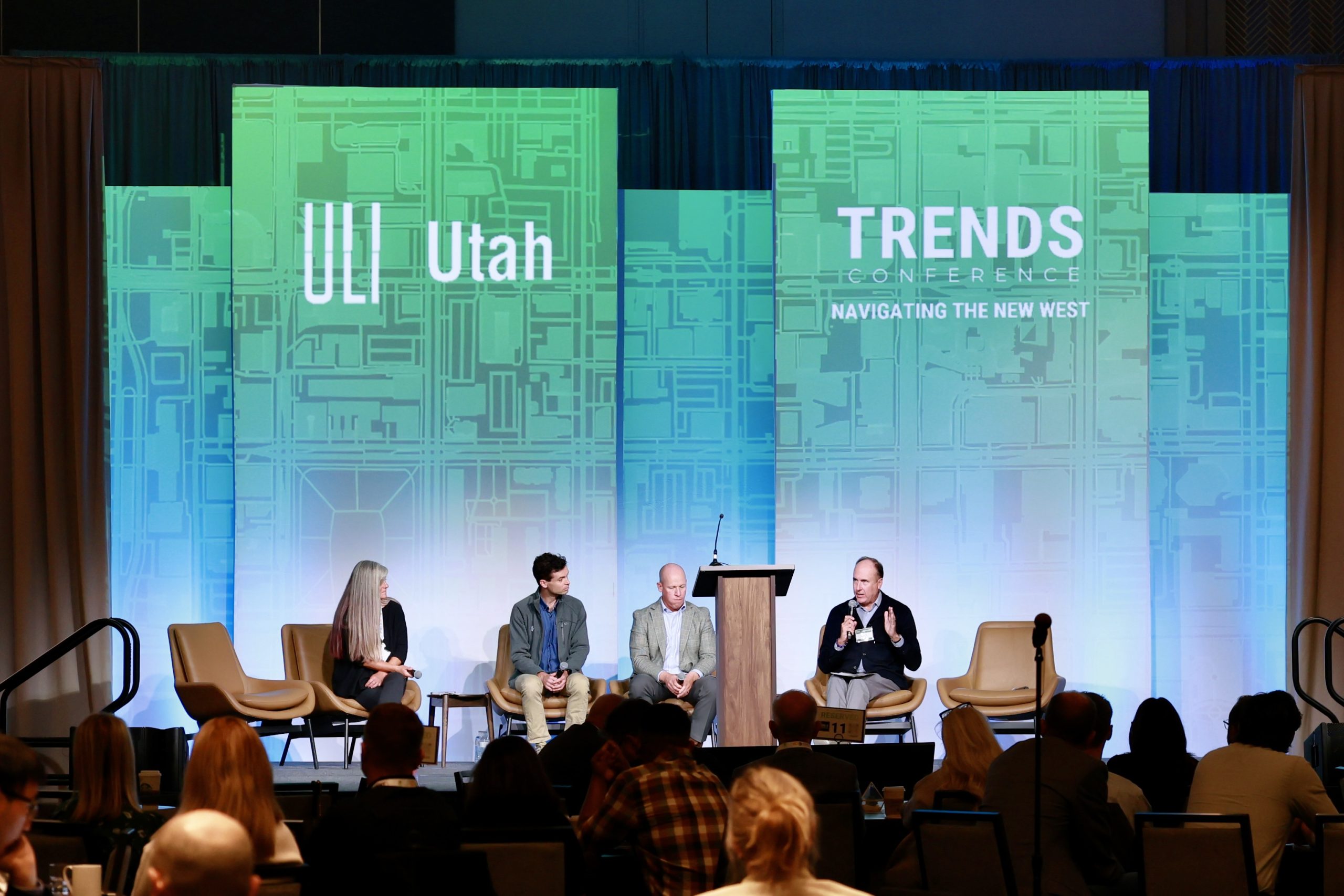
From left: Dr. Brenda Bowen, Ben Abbott, Joel Ferry and Ty McCutcheon during the ULI Utah 2026 Trends conference in Salt Lake City. Photo courtesy of Kelli Freshman
Two large problems facing Utah are rising costs for housing and the drying Great Salt Lake. While the state still has a shortage of housing, Utah is still expected to grow amid ongoing fears of the lake drying and water levels being depleted.
During Tuesday’s ULI Utah Trends conference in Downtown Salt Lake City, one session aimed to analyze this important question: is Utah sacrificing its natural resources for economic development?
Ben Abbott, an associate professor at Brigham Young University and executive director of Grow the Flow, said sacrificing the environment to benefit the economy is a short-term gain, adding every part of the global economy depends on a healthy environment. Utah is currently consuming more water than is sustainable, he said, and the drying Great Salt Lake has lost about 70% of its water.
He pointed to the Salton Sea in California and the Aral Sea in Uzbekistan as examples of what can happen when economic gains are given priority over the environment. What was once one of the largest lakes in the world, most of the Aral Sea is now gone due to water diversions over time.
“That’s where they lived out beyond their means hydrologically,” Abbott said. “Those ecosystems collapsed, and then all of a sudden, the local economic vitality evaporated.”
Fellow panelist Joel Ferry, who recently retired as the director of the Utah Department of Natural Resources, said the lake’s impact on the future of Utah is immeasurable, adding, “if we get this wrong, it will be devastating.”
Ferry noted these environmental issues can cause financial issues as well. He referenced how the City of Los Angeles, which for decades diverted water away from the Salton Sea, has spent millions of dollars trying to remediate the dust storms caused by the dried lake bed to no avail.
“Salton Sea is one-sixth the size of Great Salt Lake, and it sits 60 miles away from Los Angeles,” he said. “Great Salt Lake is five miles from Downtown. Right now, we’re five miles away from where Great Salt Lake is, so it’s significant and it will have an impact.”
Ty McCutcheon, president and CEO of Third Cadence and the former CEO of Daybreak Communities, agreed with his fellow panelists, and added the state has seen significant movement toward addressing conservation. McCutcheon said state leaders have made strides in recent years to conserve water, and he added local homebuilders have taken note.
“I know that the market is pushing in this direction,” he said. “You see it within commercial development. You see it within residential development, people want to be part of the solution.”
In McCutcheon’s 630-acre development in West Jordan, dubbed Terraine, he said one of the project’s main intents was to deliver housing with dramatically reduced water consumption. He said taking a water-wise approach to the entire development has resulted in a 70% reduction in water consumption. He said a large amount of water is being used to water lawns.
Ferry said being water-wise with new developments is a good first step, but existing homes and cities also need to get with the program.
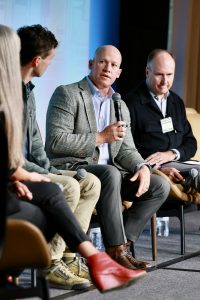
Joel Ferry talks during the ULI Utah 2026 Trends conference in Salt Lake City. Photo courtesy of Kelli Freshman
“There’s still over a third of our cities on the Wasatch Front that have not adopted water-wise landscape ordinances,” Ferry said. “What does that mean? It doesn’t mean that you can’t have grass. It doesn’t mean that you can’t have a beautiful yard. It just means that you’ll follow a certain standard that significantly reduces the amount of water that you use.”
Abbott agreed, saying around 90% of water consumption in cities is tied to outdoor watering. He said water reductions are not a matter of showering less or giving up the ability to grow, it’s “choices in decorative vegetation outdoors in cities.”
“If you look at overall water consumption in our region, it has been perfectly flat for 40 years, at least,” Abbott said. “During that time, the population has doubled. The economy has increased by a factor of 10. So, can we flourish within limits? Can we do better? The answer is definitively yes. We don’t need a scientific or economic model for that, we’ve proved it here.”
The new question facing Utah is whether the state can decrease water consumption while water is still available. Abbott said that yes, many cities haven’t set conservation targets, but neither does the state as a whole.
“We took a huge step forward a year ago when the governor, speaker of the (Utah) House, and (Utah) Senate president committed to restore the lake by the Olympics,” Abbott said. “We haven’t yet seen that followed up by a conservation target and timeline. When are we going to reach that sustainable limit of decreasing our water use by 20%? We need to know, and then cities, developers, farmers, and others can start innovating to get there.”
McCutcheon added that any future solutions must account for not only future Utahns and their water consumption, but also those who already live here and are consuming resources at unsustainable rates.
“The most contentious set of decisions that gets made every week in our state, are land use decisions,” he said. “Part of that stems from the fact that we think all of our problems are tied to the next development, the next house, the next office building, the next warehouse. It fails to recognize there’s already three and a half million of us Utahns living here.”


















0 Comments